Bacco’s Wine Club August 2026
The Forgotten Corners:
Three Growers, One River Valley
Ask most people what the Mosel makes and they'll say Riesling before you finish the question. Fair enough — it's not wrong, exactly. It's just incomplete in a way that flattens a river valley with a lot more going on than the postcard suggests.
The Mosel isn't one thing. It's slate in the middle stretch and limestone up top. It's a handful of growers who never bothered grafting onto resistant rootstock because the vines they had were doing fine, thanks. It's a red grape from Burgundy and two from Bordeaux showing up in a rosé nobody asked for and everybody should try. This month is about the parts of that river that don't make the postcard — three growers who kept farming what everyone else walked away from, for reasons that have more to do with stubbornness than business sense.
None of these wines are trying to be the Riesling you already know. That's the whole point.
We start at the top of the river, where the map stops looking like the Mosel at all.
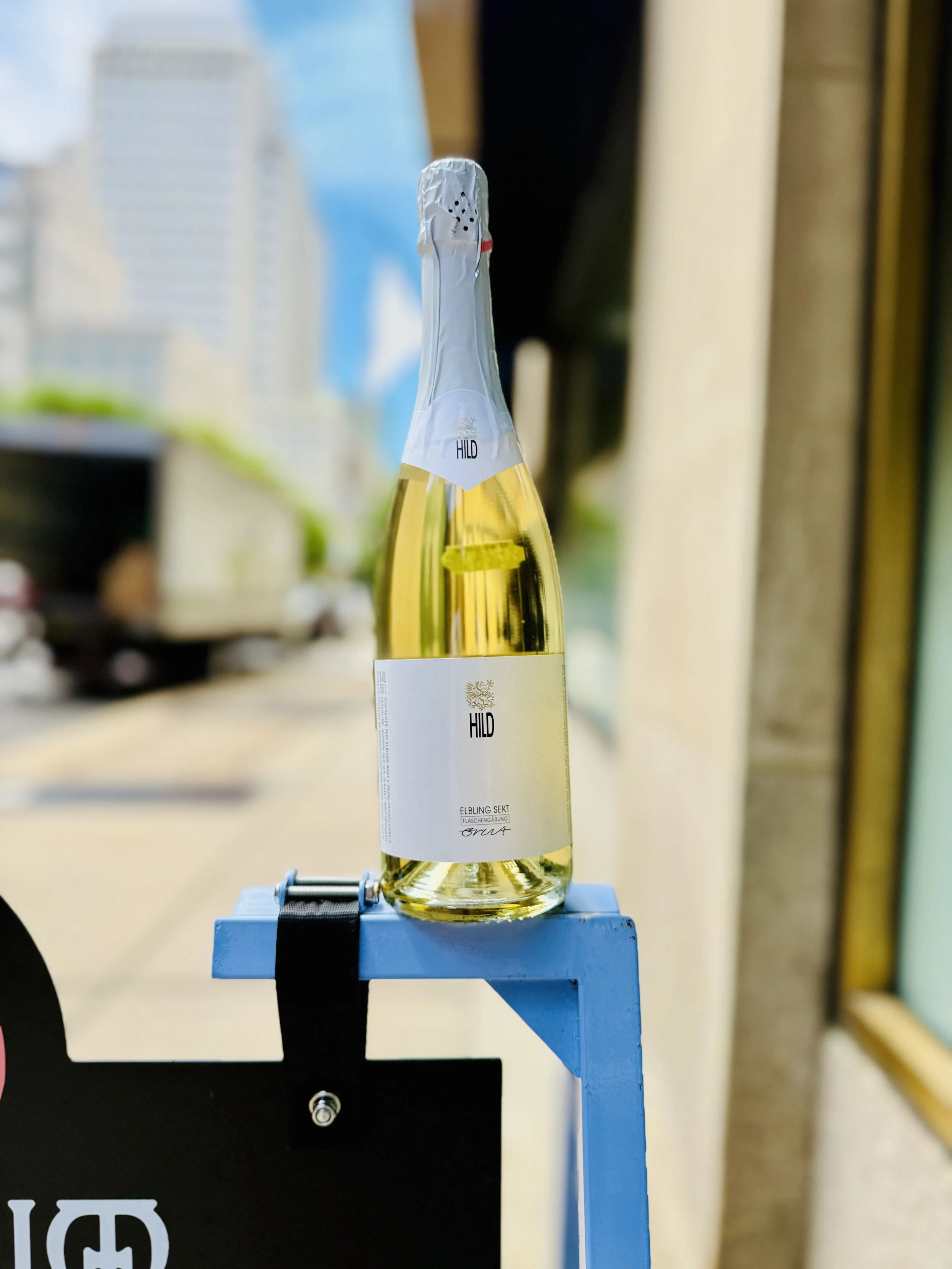
Pictured: Hild Elbing Sekt
Hild Elbing Sekt
Drive far enough upstream from the postcard villages and the slate runs out. In its place: limestone, chalk, the beginning of the same geological basin that eventually becomes Chablis and Sancerre a few hundred miles away. Nobody talks about the Obermosel. There's no marketing budget for it, no glossy import catalog copy. What there is instead is Elbling — one of the oldest grapes in Europe, and one most of the country stopped bothering with generations ago.
Matthias Hild farms about five hectares of it around the sleepy town of Wincheringen, working alongside his son Jonas on steep, terraced sites that make no financial sense to keep alive. He's been at this a long time, and he's exacting about it in a way that borders on obsessive — there's a story about him tasting an Elbling in the 1980s that had dipped under 8.5 grams of acid and wondering out loud whether it was still Elbling at all. That's the kind of standard he holds the grape to, and it shows.
The Sekt is Hild's simplest cuvée and arguably his best argument. It's made the way Champagne is made — extended lees aging, disgorged by hand, a touch of dosage — except the base wine is Elbling instead of Chardonnay or Pinot Noir, and the soil underneath is nothing like anywhere else on this river. What lands in the glass is lemon pith, quince, a chalky mineral snap that reads more Chablis than Mosel. It's not trying to impress you with complexity. It's trying to be exactly what it is: direct, sharp, and genuinely refreshing, in a way that a lot of more expensive sparkling wine forgets how to be.
Farming these old terraced parcels doesn't pay the way easier land would. Hild does it anyway, because somebody has to, and because he apparently can't imagine doing anything else.
From limestone we drop back down into slate — into the part of the Mosel that actually looks like the postcard, except farmed by two people who've spent twenty years refusing to take any shortcuts.
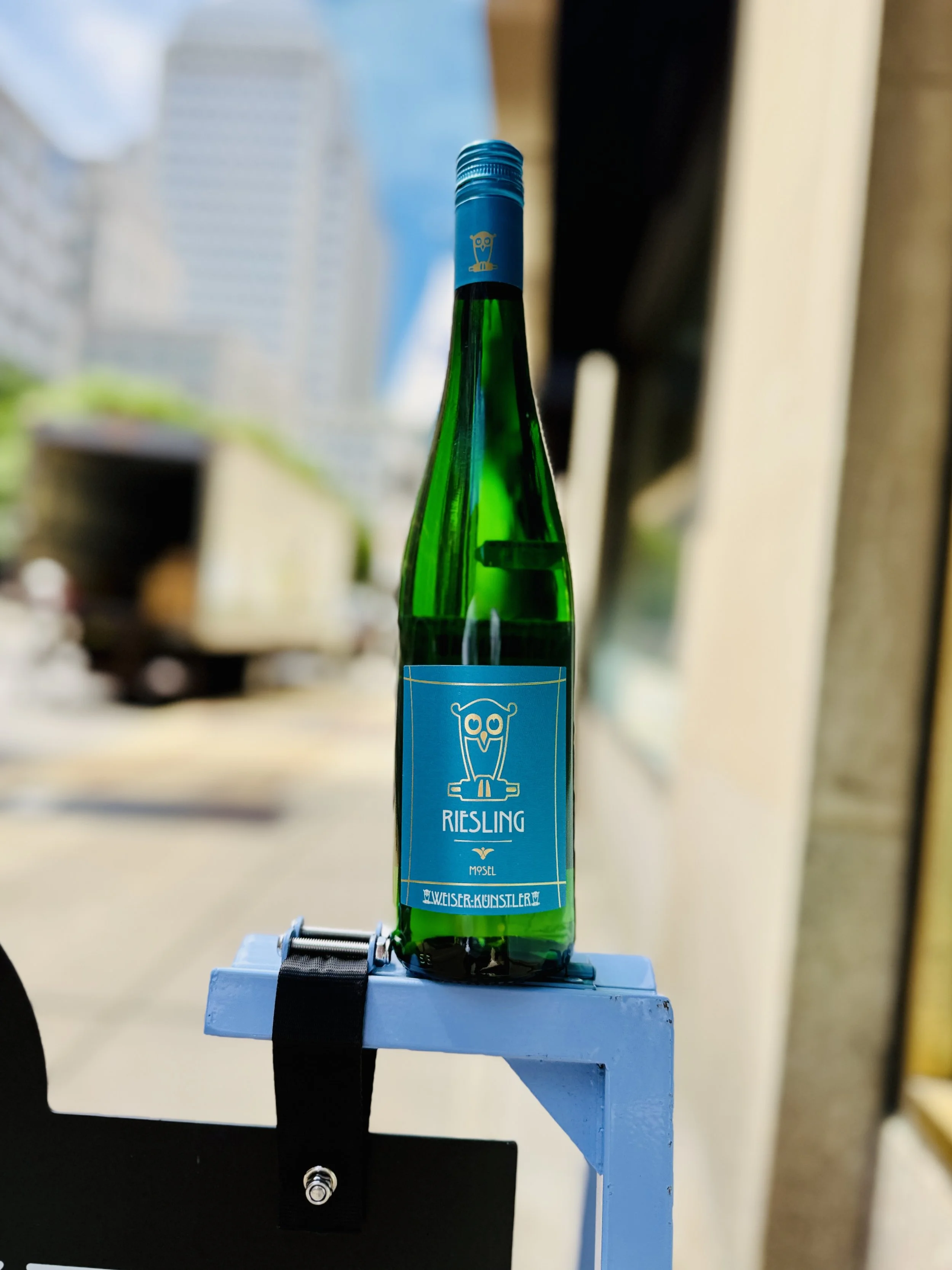
Pictured: KWeiser-Künstler Estate Riesling Feinherb
Weiser-Künstler Estate Riesling Feinherb
Konstantin Weiser and Alexandra Künstler didn't inherit an estate. They built one, starting in 2005 with a lease on 1.8 hectares of steep, ungrafted vines in the village of Enkirch — no family name behind them, no cellar full of equipment, just a conviction that the old sites around them were worth saving. Twenty years later they farm around 4.2 hectares, still entirely Riesling, still mostly ungrafted vines on slopes that top out near 70% grade. Konstantin trained under serious company — Immich-Batterieberg, Leitz, Minges — before deciding he'd rather work impossibly steep slate by hand than do anything easier.
Their core sites — Ellergrub, Gaispfad, Steffensberg — all carried Grand Cru status on the historic 1897 Mosel classification map, the same document Ernst Loosen spent years studying. These are not obscure vineyards because they're bad. They're obscure because they're brutal to farm, and most people gave up on them a long time ago.
This is the house wine — the one made in the largest volume, sourced primarily from their holdings in Trabacher Taubenhaus and supplemented from elsewhere on the estate. Barely off-dry, built on the kind of acidity that makes the residual sugar read as weight rather than sweetness. Peach, tangerine, a little ginger, and a saline finish that keeps snapping back into focus. Mosel Fine Wine Review doesn't treat this as a starter wine — they've called it a great estate wine outright, full stop, not an entry point to something better.
That's the case for it here: the same ungrafted, hand-farmed, impossibly steep-slope pedigree as their single-vineyard bottlings, at a fraction of the price. It's Riesling doing what Riesling does best without asking you to think too hard about it.
Last stop, same river, a different grower who decided the Mosel didn't have to be a white wine's problem.
The Man Who Farms What Nobody Else Wants
Ulli Stein, working now alongside his protégé Philip Lardot, has spent his career on parcels of Mosel slate that share three things in common: they're difficult to work, they're commercially unknown, and Ulli loves them. That's not marketing language — that's close to his own description of why he keeps at it. In 2010 he published a manifesto warning about the disappearance of the region's two-thousand-year-old viticultural tradition. He never grafted his vines onto phylloxera-resistant rootstock, even when it would have made his life easier. Today he farms roughly ten percent of all the ungrafted vines left standing in Germany.
Winemaking with Ulli stays out of the way. No imposed style, no attempt to project an idea onto the fruit — just a relentless preference for cut over size, for wines that stay dry and alive rather than heavy and sweet.
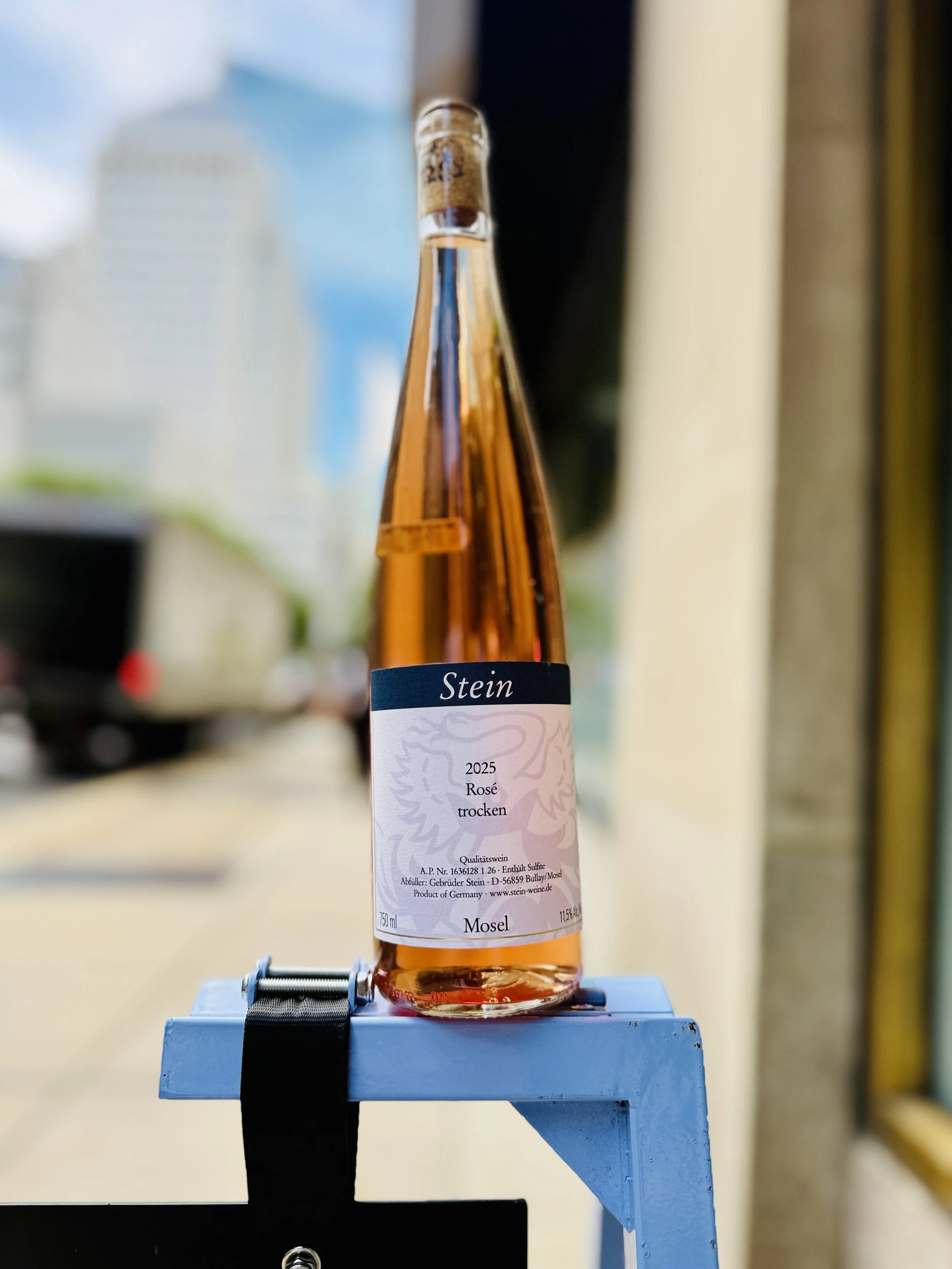
Pictured: Stein Trocken Rose
Stein Rose Trocken
This is the wine in the lineup least interested in following the rules. It's Pinot Noir with roughly 20% Cabernet Sauvignon and Merlot folded in — grapes Ulli had to fight the Mosel authorities just to legally plant, on slate soils that are supposed to belong exclusively to Riesling and Pinot. (The region banned red wine production outright from 1933 to 1986; Ulli's persistence was part of what got that ban lifted.) The rosé itself is a mix of saignée and direct press, raised entirely in stainless steel, with nothing added to soften it. Bone dry, mineral, built on tension rather than fruit. It's not a poolside rosé. It's a Mosel wine that happens to be pink, made by a man who's never been especially interested in doing things the expected way.
The Last Drop
Three wines, three grapes, one river that refuses to be summed up in a single word. Limestone Elbling that tastes nothing like the Mosel is supposed to. Ungrafted Riesling farmed by two people who started with nothing. A red-grape rosé from a man who's spent his life keeping vines alive that everyone else wrote off decades ago.
None of these wines are famous. That's not an accident — it's the entire reason they're here.