
Bacco’s Wine Club June 2026
The Hard Way: Farming Wines in all the Tough Places
Here's something I've noticed over the years. You can read a restaurant wine list the way you read a face. Give it thirty seconds and you know whether someone actually made decisions or just filled slots. Mass-market Albariño, generic Montepulciano d'Abruzzo, three Napa Cabs that exist to justify the price point — that's a list built around liability management. Nobody's passionate, nobody's curious, and the kitchen is probably the same.
But then you see a Lalama. Or a Telescópico. Or a Treixadura from a producer who built their winery into a Galician hillside. And you know. You know that someone who works there loves wine — not the idea of wine, not the margin on wine — actually loves it. These aren't wines that end up on a list by accident. They're not on anyone's push sheet. No distributor rep is leading with them. Someone sought them out, made a case for them, and put their credibility on the line.
I first saw Lalama on a list at Spoke Wine Bar, my favorite restaurant. Didn't know the wine. Ordered it because I trusted the room. That's the deal these wines make with you.
There's a version of Spain that exists in the American wine imagination — Rioja, Ribera del Duero, maybe Priorat if you've been paying attention. Big tannins, sun-baked extraction, price points that apologize for nothing. The wine equivalent of a bullfight poster.
This club is about the other Spain. The one you find when you turn off the highway.
Northwest Galicia is wet, green, and chaotic in ways the rest of the Iberian Peninsula isn't. It feels more like a Celtic fringe than a Mediterranean wine country — fog that won't lift, granite everywhere, rivers cutting through gorges so steep you wonder why anyone thought to plant vines here at all. The answer, it turns out, is that the Romans did. And before the Romans, probably someone else. You don't build stone terraces on a sixty-degree slope for the fun of it. You do it because something worth having is up there.
Javier Dominguez came to the Quiroga-Bibei subzone — the most remote eastern corner of Ribeira Sacra — around the turn of this century, when most people were moving away from places like this. His family bought a 140-hectare estate in a valley where the rivers Bibei and Sil converge, and he proceeded to spend the next two decades doing something Galicians call viticultura heroica. That's not marketing language. That's an acknowledgment that working these slopes — harvesting by hand on gradients that would challenge a mountain goat, moving wine by gravity through a facility built into the hillside — requires a specific kind of stubbornness.
He brought in Sara Pérez and René Barbier as consultants. If those names mean something to you — Priorat, the generation that rebuilt that region from rubble — you start to understand the ambition here.
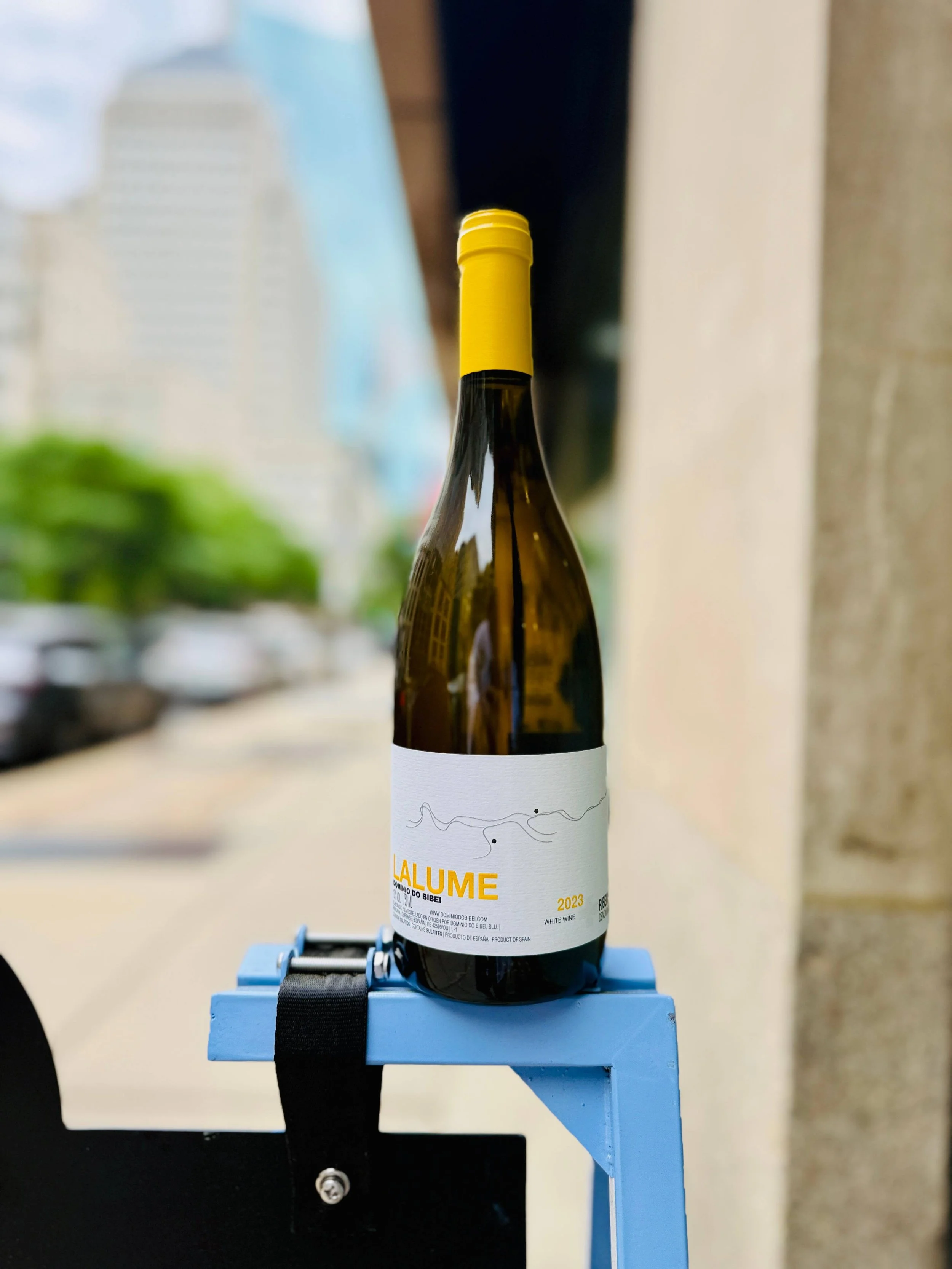
Domaine do Bibei Lalume Blanco
The Lalume Blanco is from Ribeiro, Galicia's other white-wine appellation, which historically has lived in the shadow of Rías Baixas and its relentless Albariño monoculture. Ribeiro's signature grape is Treixadura — known locally, without irony, as the Queen of Ribeiro. It's naturally lower in acid than Albariño, rounder in texture, which is why it's traditionally blended with sharper partners: a little Godello, some Albariño, small amounts of Caíño Blanco, Loureira, Torrontés. The Lalume is exactly that — Treixadura leading, the others providing structure and lift.
What Dominguez does with it is worth paying attention to. The wine ferments in a mix of oak barrels, large foudres, concrete eggs, and stainless steel — no single vessel dominates, because no single vessel should. No malolactic fermentation, which keeps the whole thing alive. The result is a white wine that takes a few minutes in the glass to wake up (this is not a complaint), and then rewards you with something that doesn't taste like anything you expected from Spain: stone fruit, yellow flowers, a mineral note that feels almost saline, an herbal thing running underneath.
If your frame of reference for Spanish white wine is Albariño on a summer patio, this will recalibrate you. It should.
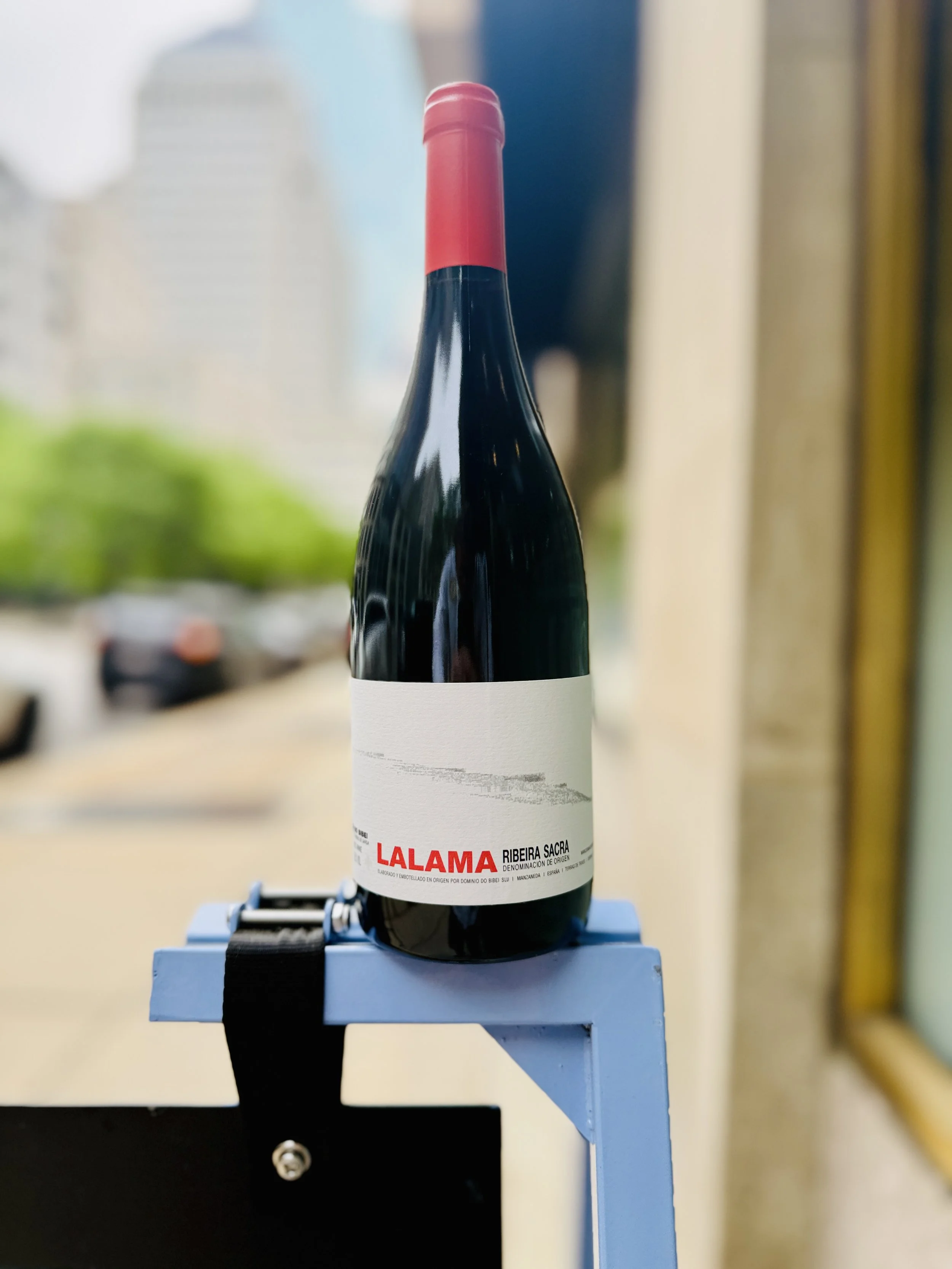
Pictured: Domaine do Bibei Lalama
Domaine do Bibei Lalama
The Lalama is the red, and it comes from the part of the estate that will make you understand the word heroic all over again. Steep, north-facing terraces. Slate and granite with flecks of quartz and iron. Vines at anywhere from 200 to 700 meters above sea level, harvested by hand because there is no other way.
Mencía is the main grape here — that dark, earthy, slightly ferrous variety that northern Spain does better than anywhere else on earth — blended with indigenous partners like Mouratón, Brancellao, and Sousón. They're vinified separately, each one prized for what it specifically adds, then brought together. The wine goes into old barrels and large neutral vessels, nothing that interferes with the fruit, and it rests until it's ready. You will not find a winemaker's fingerprint in this bottle. That's the point. What you find instead is the hillside.
Now we turn east, toward a place most Spanish wine drinkers couldn't locate on a map, and that's precisely the point.
Valdejalón sits in Aragón, wedged between the more famous Campo de Borja and Calatayud, in the triangle between Zaragoza and the Ebro valley. The climate is Mediterranean continental — dry as a bone, sun-baked, punished by a wind called El Cierzo that tears down from the Pyrenees. Nobody moved here to make wine. Nobody built a lifestyle brand here. For most of the twentieth century, the old vines in these mountains existed primarily to be sold in bulk to cooperatives, or not sold at all.
Fernando Mora was an engineer in the wind industry when he fell into wine hard enough to change his life. He wrote his Master of Wine thesis on Garnacha classification in Campo de Borja — the academic equivalent of deciding your life's work will be in an underfunded library in a city no one visits. After he earned his MW, he came back to Aragón and, with his partner Mario López, started Frontonio in 2008. They made wine in the back room of a small bulk-wine winery. They called themselves a "garage winery" because that was accurate.
The winery is named after Saint Frontonio, the patron saint of Épila, the town where they work. The legend: he was beheaded by the Romans. His body was buried. His severed head was thrown into the Ebro River. It swam upstream.
Fernando thought that was a good name for a project.
The work at Frontonio is essentially archaeological. They've spent nearly two decades tracking down plots of ancient Garnacha — some of them 50, 60, 80 years old — owned by elderly farmers who've been tending them all their lives. Some of those farmers won't sell, because without their vines they have nothing to live for. Frontonio waits. They offer care and respect and sometimes just time. They are, as of today, the only winery bottling wine under the Valdejalón designation. An entire wine region, one producer.
Pictured: Illahe Pinot Noir 2023
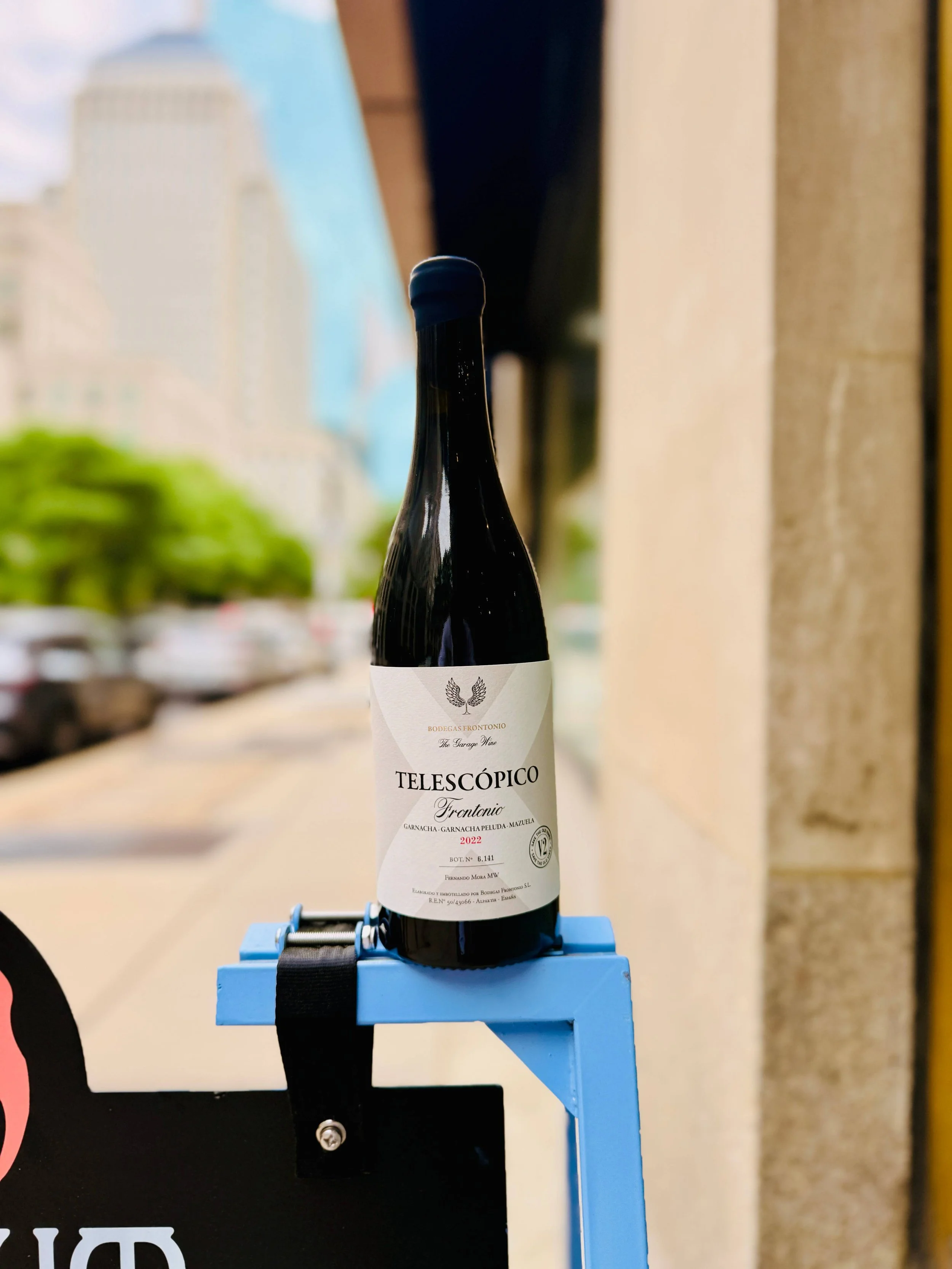
Bodega Frontonio ‘Telescopico’ Garnacha
The Telescópico is Frontonio's "village wine" in the Burgundian sense — a step up from the regional, a step below the single vineyards. The blend is Garnacha Fina, Garnacha Peluda (a downy, heat-tolerant biotype), and Mazuela, the local name for Carignan, from 50-plus-year-old vines on slate and clay-limestone at 500 to 600 meters. Everything is farmed organically. The grapes go into cement vats with indigenous yeasts, macerate for five weeks, and then spend thirteen months in large used foudres and 500-liter barrels.
What you get in the glass is nothing like the Garnacha that built Aragón's reputation for cheap, jammy, extracted red wine. This is precise, dark-fruited, mineral. Red currant, dried rose, a thread of herbs that probably has a name in Spanish I don't know. It drinks with a lightness that belies its depth — the high altitude, the old vines, the long maceration quietly doing its work.
The Last Drop
Three bottles from two regions, two winemakers, one conviction: that the hard way is the right way, and that what you're drinking is proof.
You're not drinking prestige here. You're drinking places that stayed forgotten long enough to be worth finding.