Bacco’s Wine Club October 2026
The Extra Half Pound, or a Long Hill To Climb
Working in a small wine and cheese shop has taught me one thing over and over: the eyes are bigger than the stomach. That was true long before anyone had heard of GLP-1s. I see it most at the cheese counter, where the size of the wedge never tells you how full you’ll be until you’re a third of the way through it. A precious few know this going in, and happily repack the piece and whittle it down until it’s gone. Others decide a half pound can’t possibly feed three people for an evening, and end up throwing half of it away.
Why am I talking about cheese in the introduction to our latest Wine Club? Well, it’s partly a confession, and partly a long-winded metaphor. The confession: I’m the person with the extra half pound. For the past couple of months, I’ve been running our cheese department and our wine department at the same time, as we ramp up to OND, retail’s name for the last three months of the year, when everything comes out of the woodwork. I looked at both plates and decided I could finish them. Some days that’s been true. Other days I’m a third of the way in and starting to feel it.
The metaphor is October, which has the same problem and handles it better than I do. It’s the tail end of harvest: a glut of grapes arrives all at once, then gets whittled down, pressed, fermented, and stored in vessels of every kind until what’s left is wine. The late ripeners finish last. None of that is about having more. It’s about deciding what’s worth keeping. It’s also the month drinkers retire the summer rosé and reach for structured wines that suit savory food.
That’s the idea behind this month’s club. Three bottles, chosen rather than piled up. We start in Crozes-Hermitage with the white, take a detour up into the Alps of Lombardy, and come back to the Rhône for the red.
Pictured: Domaine Huet Pétillant Vouvray 2019
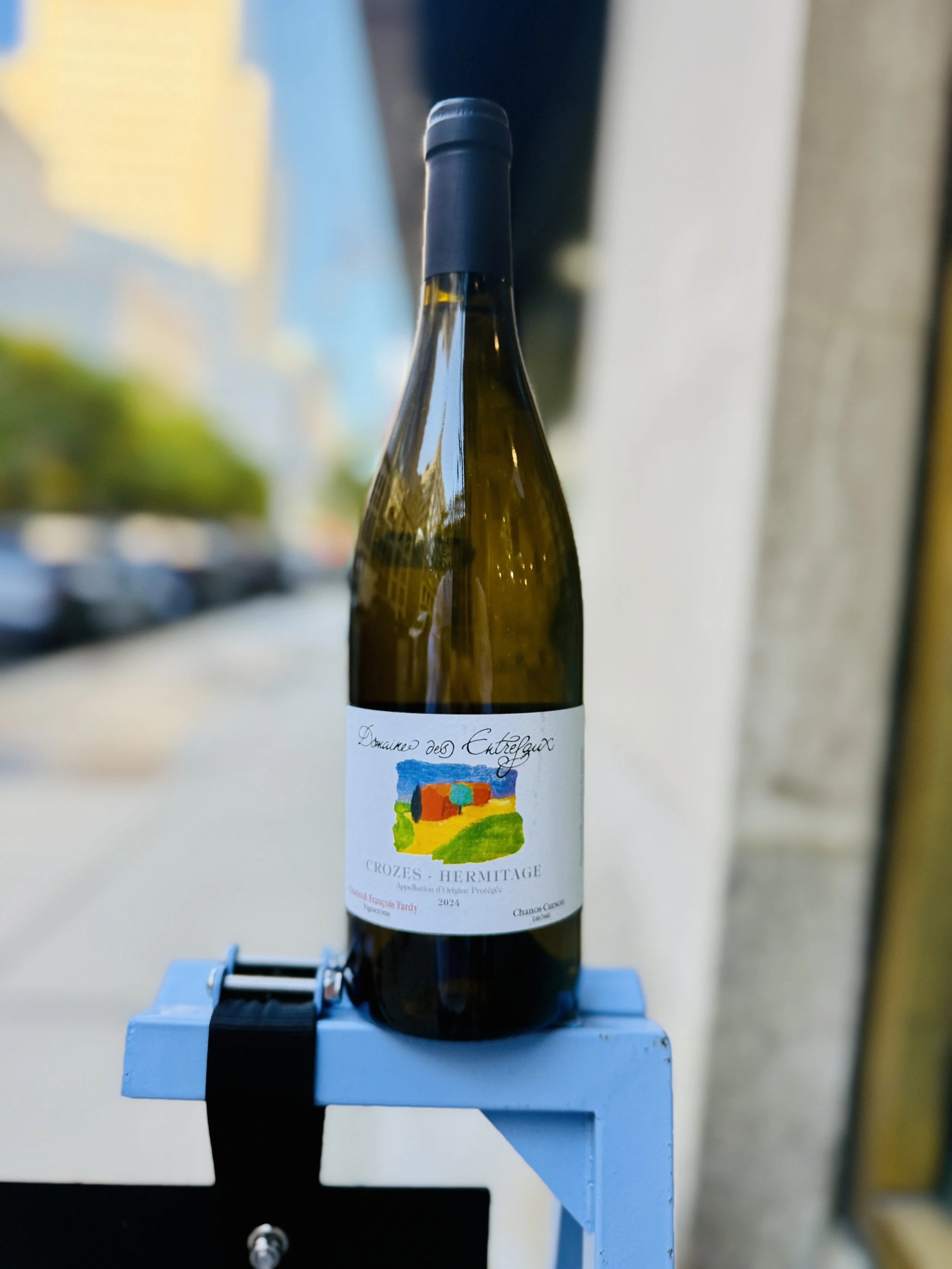
Domaine des Entrefaux, Crozes-Hermitage Blanc 2024
Start with a hill that charges for its name. Hermitage is one slope above the Rhône at Tain, and the price tag comes with the address. Crozes-Hermitage is the appellation that grew up around it: a small zone around the village of Crozes in 1937, the main body added in 1952, 2,007 hectares today, the largest in the northern Rhône by a wide margin. Nobody is paying for the hill here.
Domaine des Entrefaux is in Chanos-Curson. Charles Tardy founded it in 1979. His son François joined in the 1990s and now runs it with his wife Anne, the fifth generation of the family to farm wine. The estate is mostly Syrah, so the white grapes are the smaller share of the vines, and this bottle is a small corner of the place.
The blend is 70% Marsanne and 30% Roussanne, at 13% alcohol, and the two grapes do different jobs. Marsanne is the body; it brings full, rich wines with low-to-medium acidity and flavors of melon, peach, and apricot, with honey and nut creeping in under oak as the wine ages. Marsanne brings the texture, sometimes described as waxy or oily. Roussanne is the lift. It brings floral, herbal-tea aromatics and the acidity that keeps a rich wine from going slack, and in the northern Rhône it can be too delicate alone and needs Marsanne for structure. Some snobs will consider Roussanne the higher-quality grape, which is a funny thing to say about a vine growers have been pulling out for the easier, more productive Marsanne. Neither does the job without the other.
Pictured: Pascal Janvier, Jasnières "Cuvée du Silex" 2024
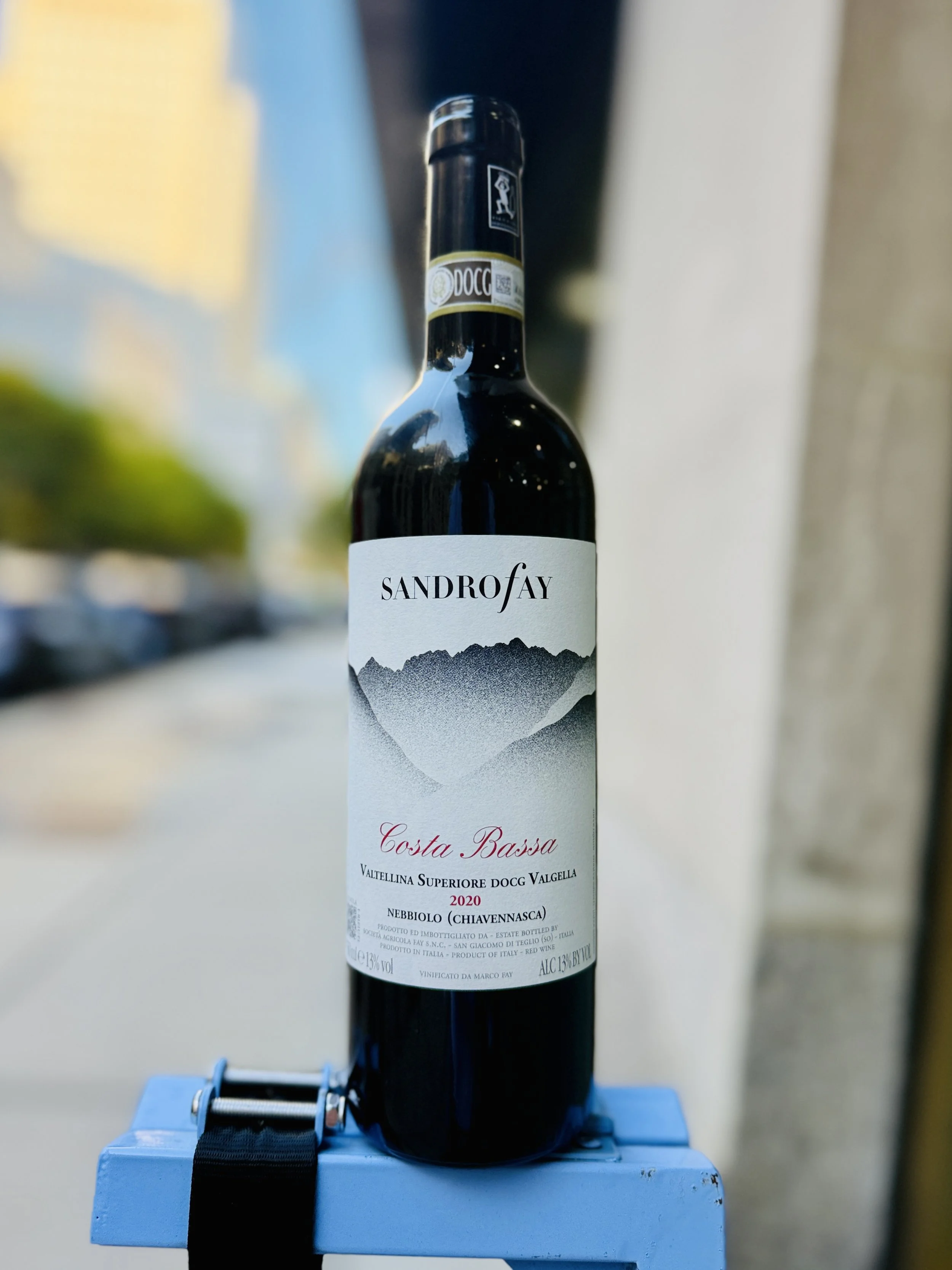
Sandro Fay, Costa Bassa 2020
Now the detour: east, over the Alps, and up. Valtellina is a strip of Alpine hillside about 43 kilometers long, running along the Adda River in Lombardy. Nebbiolo is called Chiavennasca here, and the rules call for at least 90% of it. The slopes run past 30 degrees and some approach 70, held up by roughly 2,500 kilometers of dry-stone walls, so the work is done by hand. About 850 hectares are planted today, down from around 6,000 in the mid-19th century. Valtellina Superiore became a DOCG in 1998 and divides into five sub-zones: Sassella, Grumello, Inferno, Valgella and Maroggia.
Sandro Fay works in Teglio, in Valgella. He started in the early 1970s by redeveloping a small family vineyard, and his children run it now. Marco makes the wine, after studying oenology in Trentino and training in Barolo, which is a pointed place to have learned. Elena handles visits and sales, and she told one writer that Valtellina means “the Valley of Teglio.” The estate farms about 15 hectares of terraces between 350 and 900 meters on the south-facing slope of the Rhaetian Alps. The soil is mostly sand from decomposed granite, and each parcel is bottled separately.
The Nebbiolo comes in late. In 2020, Superiore picking began in late September, stopped for rain, and finished in October, which is the October in this month’s club. Costa Bassa is the oldest bottle in the set. If you’ve been in the shop this past month, I’ve probably tried to sell you this bottle. I first discovered its merits upon taking it home with my first seasonal foray into Bolognese, though I’m loath to put any dairy in the sauce, so perhaps I can’t truly call it Bolognese. The result was magnificent, perhaps because Nebbiolo truly opens up with time. It was structured enough to stand up to the meat, and lively enough to lean into the tomatoes. If you ask nicely, I can give you the recipe.
Pictured: Domaine de Pallus, "Les Pensées de Pallus" Chinon 2020
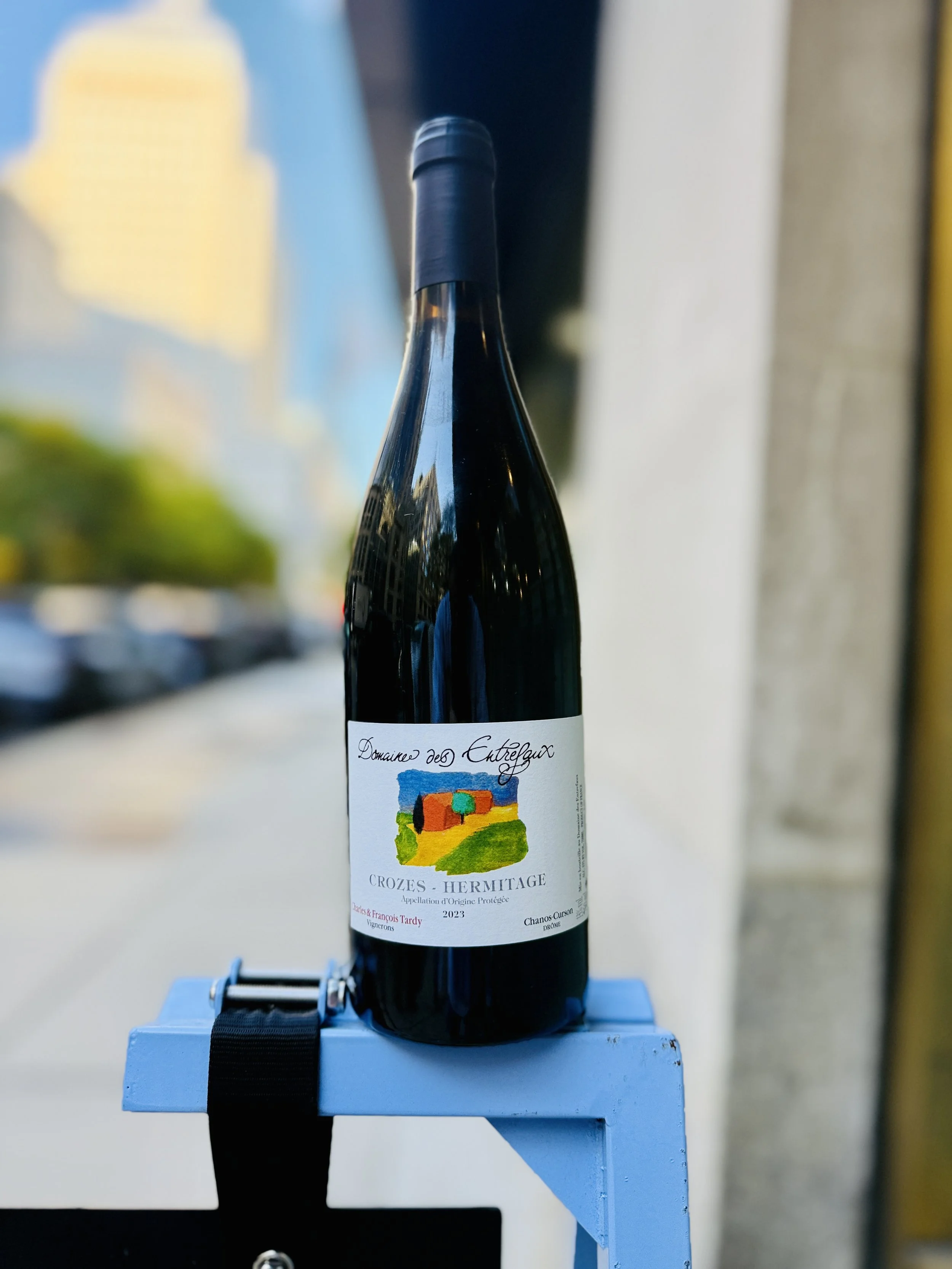
Domaine des Entrefaux, Crozes-Hermitage Rouge 2023
Back to the Rhône, and to the same estate as the white. That’s the point of the order. Only about a quarter of Crozes-Hermitage is on slopes. Most of the rest is old river terraces, flat and easy to farm, and after a stop in Valtellina, where flat is not an option, that reads differently. Which part you get depends on the grower, and the label won’t tell you.
At Entrefaux, Syrah is most of the estate. The main plot is a gravelly terrace called Les Chassis, and the Les Pends vineyard is clay and limestone, though both bottles in this box are the straight Crozes, not the single-site Les Pends. The Tardys converted to organic farming around 2011 to 2013, depending on who you ask, and they ferment on native yeasts with minimal sulfur. The Rouge is 100% Syrah at 12% alcohol. Yann Chave, co-president of the Crozes-Hermitage growers, praised the 2023 vintage’s balance and fine tannins.