The Other Pilgrim
It’s 1988 and Georges Duboeuf, thousands of miles over the Atlantic Ocean, has become unstuck in time. He’s flying on the Concorde with wine that is two months old, a plane that seems out of place even now, almost forty (!) years later. The destination? New York City, to make Beaujolais Nouveau an international phenomenon.
Despite the name, Nouveau was only relatively new, thanks to stubborn winemakers who insisted the government let them release wine before December and still grant it protected AOC status. That passed in 1951, and Duboeuf, a négociant who had set up shop in Romanèche-Thorins, ran with the concept.
Now as then, Beaujolais Nouveau is released the third Thursday of November, and like Manischewitz, it’s a bottle people buy for the one date and make fun of the rest of the year.
This wasn’t the first affront to Gamay. By the late 1300s it had spread north through Burgundy, thriving for growers while Pinot Noir remained fickle. In 1395 Philip the Bold, Duke of Burgundy, who owned nearly 200 hectares of vines himself, declared Gamay poisonous and gave the growers in Burgundy thirty days to tear it out.
The city council in Dijon, the duke’s own capital, refused to publish the order. Beaujolais was outside his reach anyway, and Gamay, which dated back to the time of the Caesars, remained for good.
Right around the time Duboeuf took flight, another fight for Beaujolais was underway, not for juicy quasi-wines that tasted like candy but for serious wines that were every bit the equal of their northern neighbors in Burgundy.
That group, nicknamed the Gang of Four by intrepid American wine importer Kermit Lynch, was made up of Marcel Lapierre, Jean Foillard, Guy Breton, and Jean-Paul Thévenet. In the beginning, the wines were great values for the quality, but as their reputation grew, so did their prices, working out for everyone except for those of us buying them.
Beaujolais is split, both in pedigree and style, by its natural geography. The south of Beaujolais is flatter, on clay and limestone, and makes most of the plain Beaujolais. The north is hills of granite and schist, and that’s where you find Beaujolais-Villages and the ten crus. A cru gets its own village name on the label. By law, it also can’t be sold as Nouveau.
Chénas is the smallest cru, and most people never go looking for it. Morgon is one of the biggest, with the Côte du Py, a dark knob of diorite, rising out of it. Brouilly is the largest, and Côte de Brouilly is the hill in the middle of it.
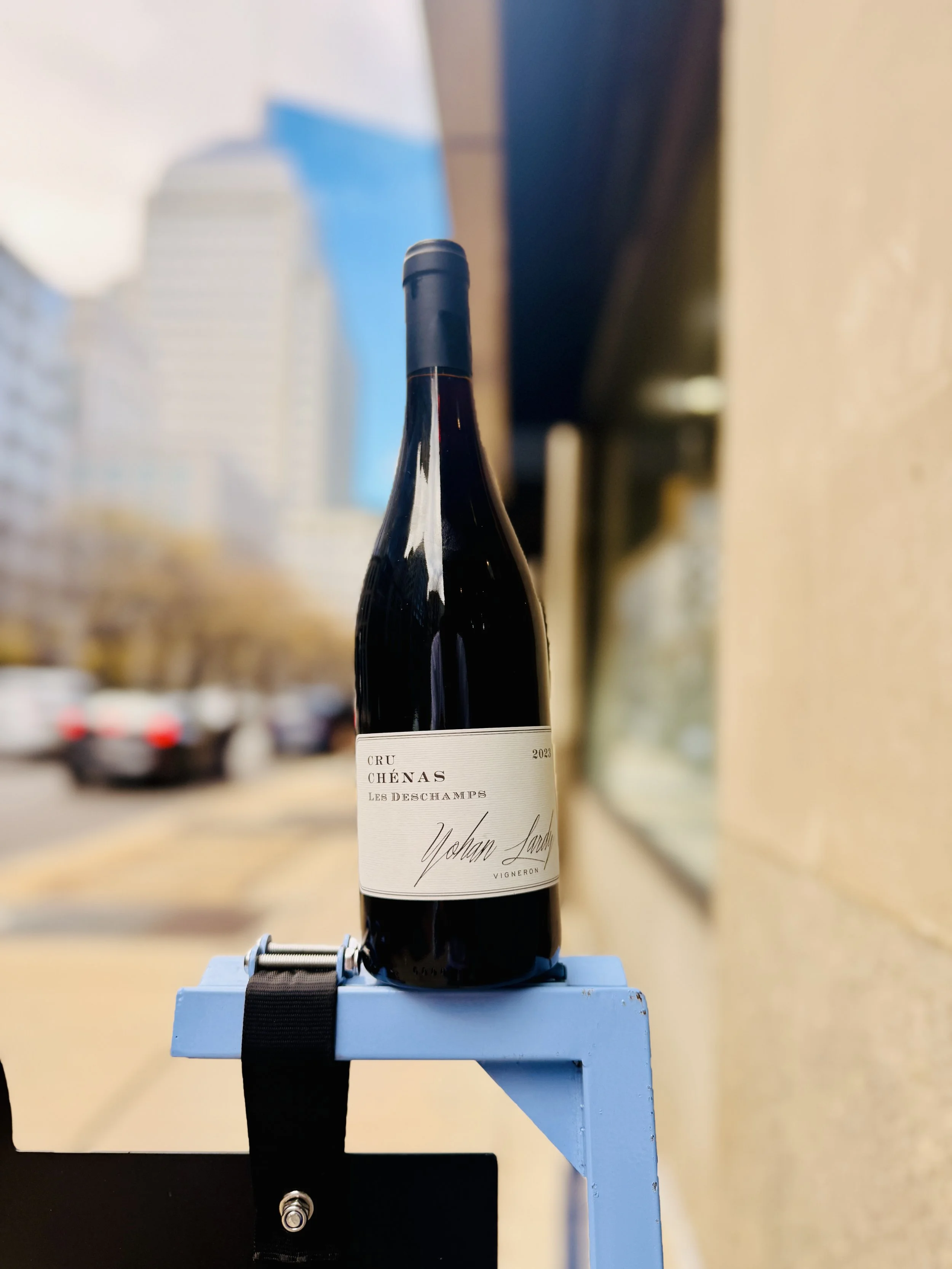
Pictured: Yohan Lardy Chénas Les Deschamps 2023
Yohan Lardy Chénas Les Deschamps 2023
Yohan Lardy’s cellar is in Romanèche-Thorins, the same village where Duboeuf got started. He’s a fifth-generation grower who spent time making wine in Chile, then came home in 2012 and bought two hectares of old Moulin-à-Vent vines, which he has farmed without pesticides from the start. Les Deschamps is about half an acre of 75-year-old Gamay in Chénas, nearly 1,000 feet up, on granite, quartz and manganese. It goes into bottle unfiltered and with very little sulfur, which is why he tells people to open it fifteen or twenty minutes before pouring.
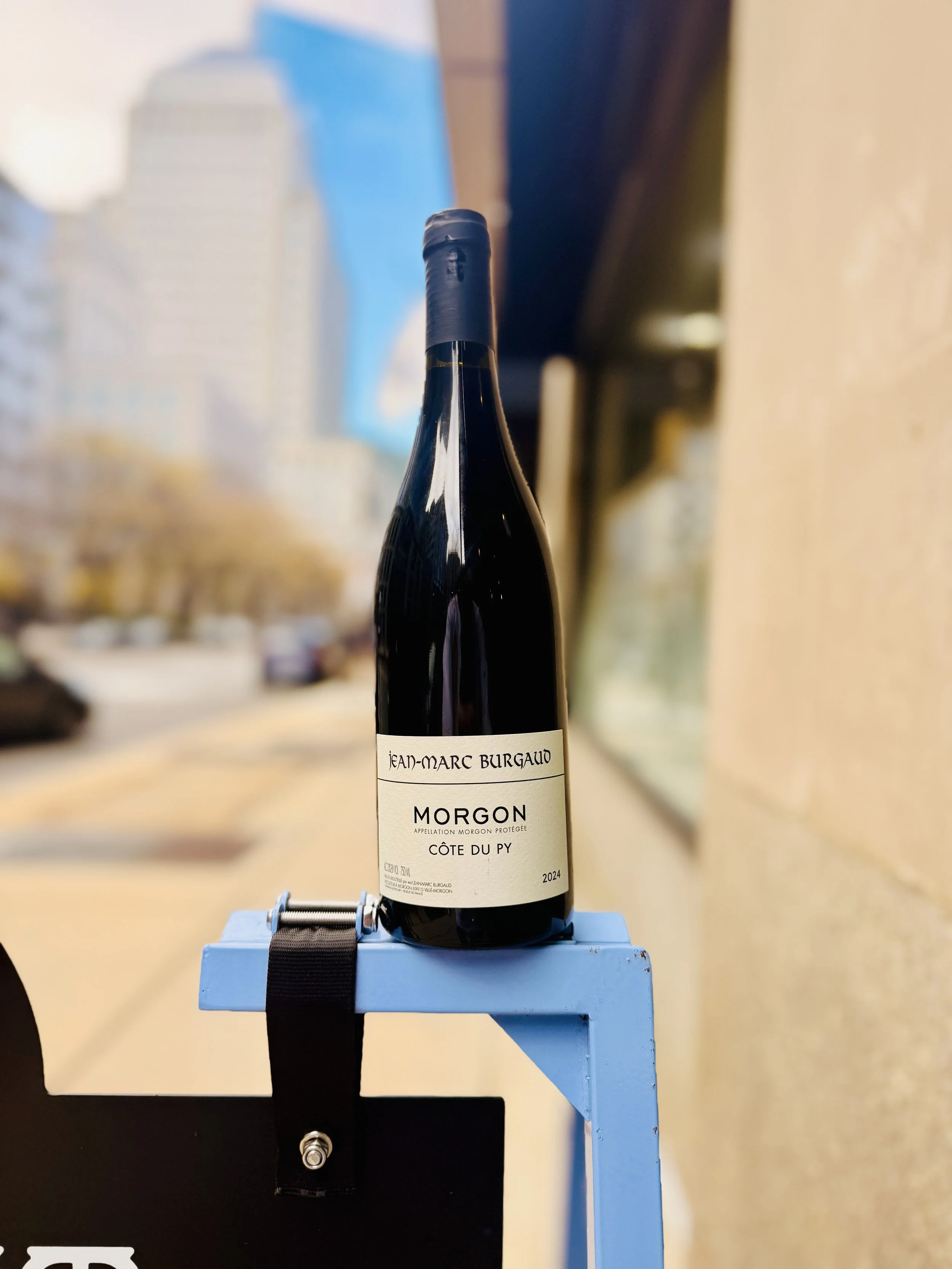
Pictured: Jean-Marc Burgaud Morgon Côte du Py 2024
Jean-Marc Burgaud Morgon Côte du Py 2024
“Gamay has a difficult relationship with oak,” Jean-Marc Burgaud says, so his Côte du Py ages in concrete. He started the estate with his wife, Christine, in 1989, and a Burgundy magazine has called him “Monsieur Côte du Py.” The 2024 that I’ve put in this month’s club is the first vintage under the new rule that only vines on top of the hill can use the name—most of his qualified. About half a hectare around the family house didn’t, and it now goes into a new wine called Heritage, which we haven’t tasted.
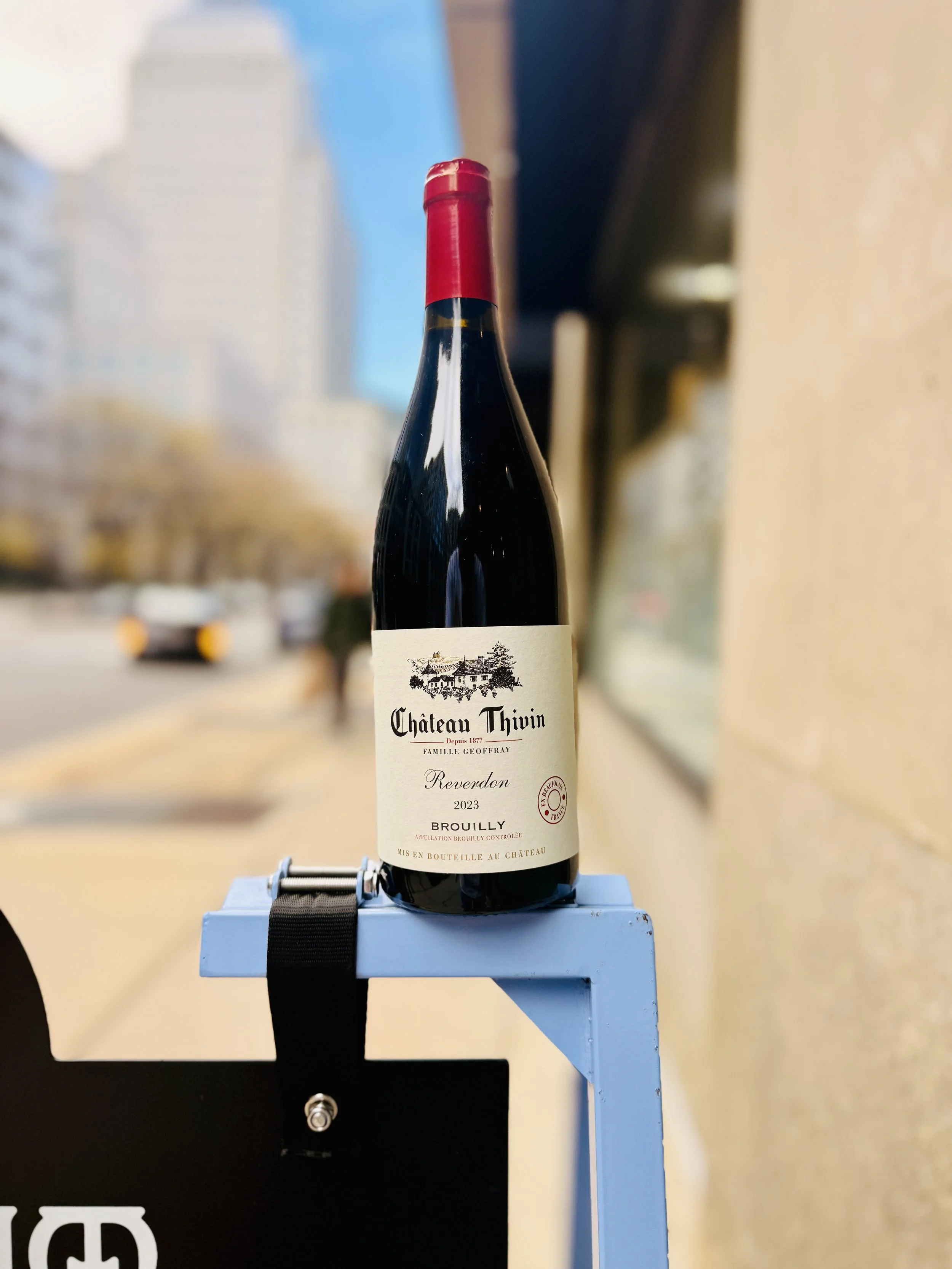
Pictured: Château Thivin Brouilly Reverdon 2023
Château Thivin Brouilly Reverdon 2023
The Geoffrays bought Château Thivin in 1877 with two hectares of vines. It’s the oldest estate on Mont Brouilly, and in the 1930s the family helped create the Côte de Brouilly appellation. Reverdon comes from pink granite low on that same hill, a site Kermit Lynch compares to good Fleurie. It’s labeled plain Brouilly, and given Thivin’s growing reputation for making exceptional wine, Reverdon follows the same spirit as the Gang of Four, dedicated to shining a spotlight on a wine that showcases value alongside quality, bringing more people into the fold to enjoy the fantastic wines this region has to offer.
One More, If You’re Curious
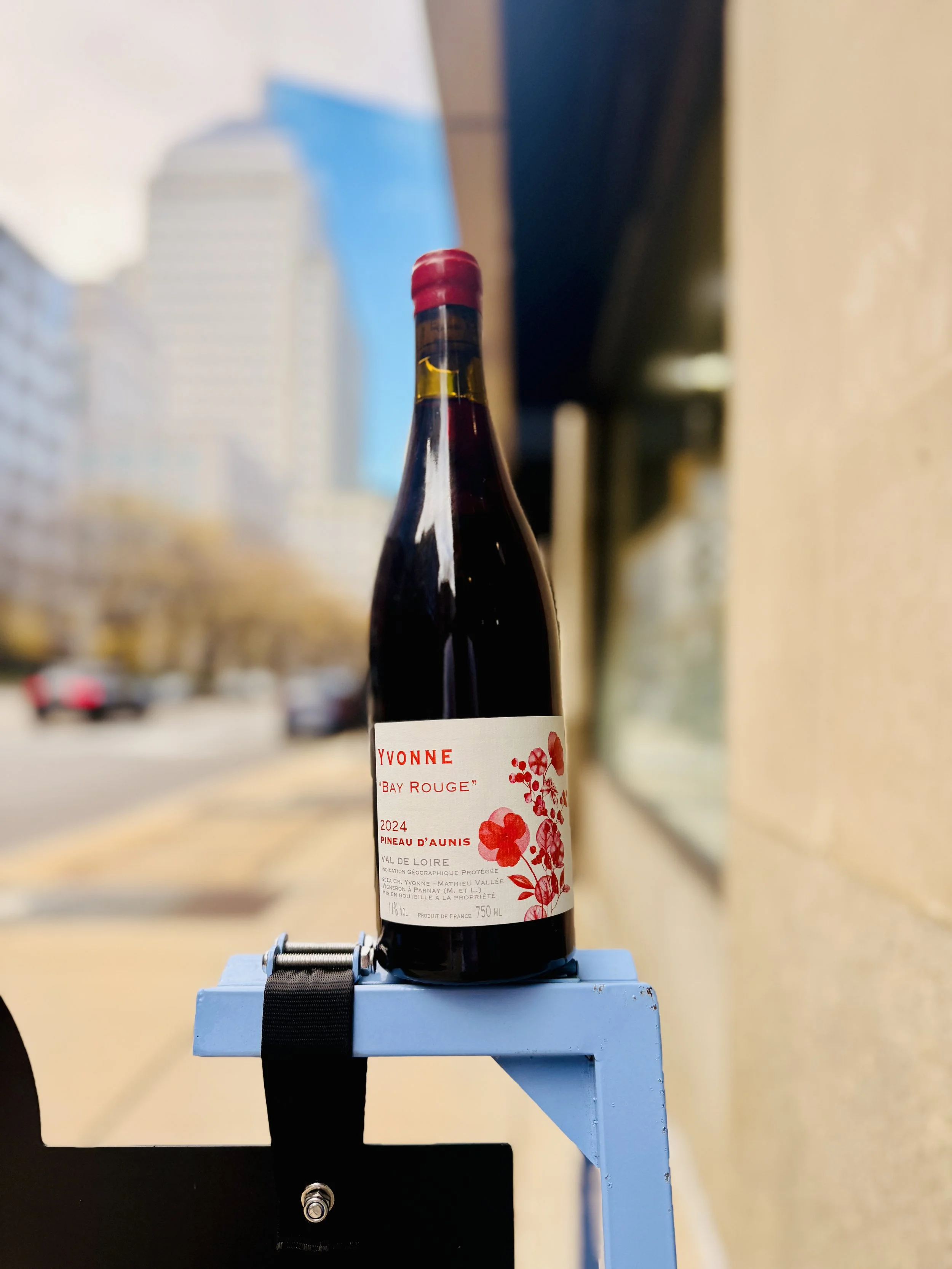
Pictured: Château Yvonne “Bay Rouge” 2024
Château Yvonne “Bay Rouge” 2024
Consider this a second helping. Chateau Yvonne’s “Bay Rouge” is not included in this month’s club because I’m loathe to abandon a theme, but I’ll admit it was difficult cutting it from the options. “Bay Rouge” is the kind of wine that us in the industry go crazy for.
Château Yvonne is in Parnay, a village a few steps from the Loire that has grown vines since the Middle Ages, when the Abbey of Fontevraud held sway there. The château’s vineyard had been abandoned for a long time when Yvonne and Jean-François Lamunière moved in, in 1997, and replanted it with help from Françoise Foucault of Clos Rougeard. In 2007 it passed to Mathieu Vallée, a grower’s son from Saint-Nicolas-de-Bourgueil who had left to work as an engineer. He kept the name.
Yvonne’s reputation rests on Cabernet Franc and Chenin. Bay Rouge is the side project. It’s all Pineau d’Aunis, a grape the Saumur rules won’t let into a red bottle, so it goes out as IGP Val de Loire. Pineau d’Aunis was once the most popular grape in the Loire. It nearly disappeared in the early 1970s, and about 475 hectares are left, most of them up the Loir, the smaller river with the confusingly similar name.
The grape comes with a royal story. Henry III of England supposedly loved it and started shipping it home in 1246, and some writers call it the original claret. In 2014 a historian named Henri Galinié went through the records and concluded that a 19th-century Anjou historian had made it up. So this month’s mailing has two medieval rulers: one who really tried to wipe out a grape, and one who got written into another grape’s story after the fact.
The 2024 was farmed organically, picked by hand and partly destemmed. Right after the cork comes out, it can smell a little closed. Give it a few minutes, and it opens into cherry, wild strawberry, and redcurrant, with the pepper the grape is known for.
Only ten cases made it into Massachusetts and we got one, if you’re interested in adding it on to this month’s club, give me a shout, its $37 a bottle.