Bacco’s Wine Club March 2026
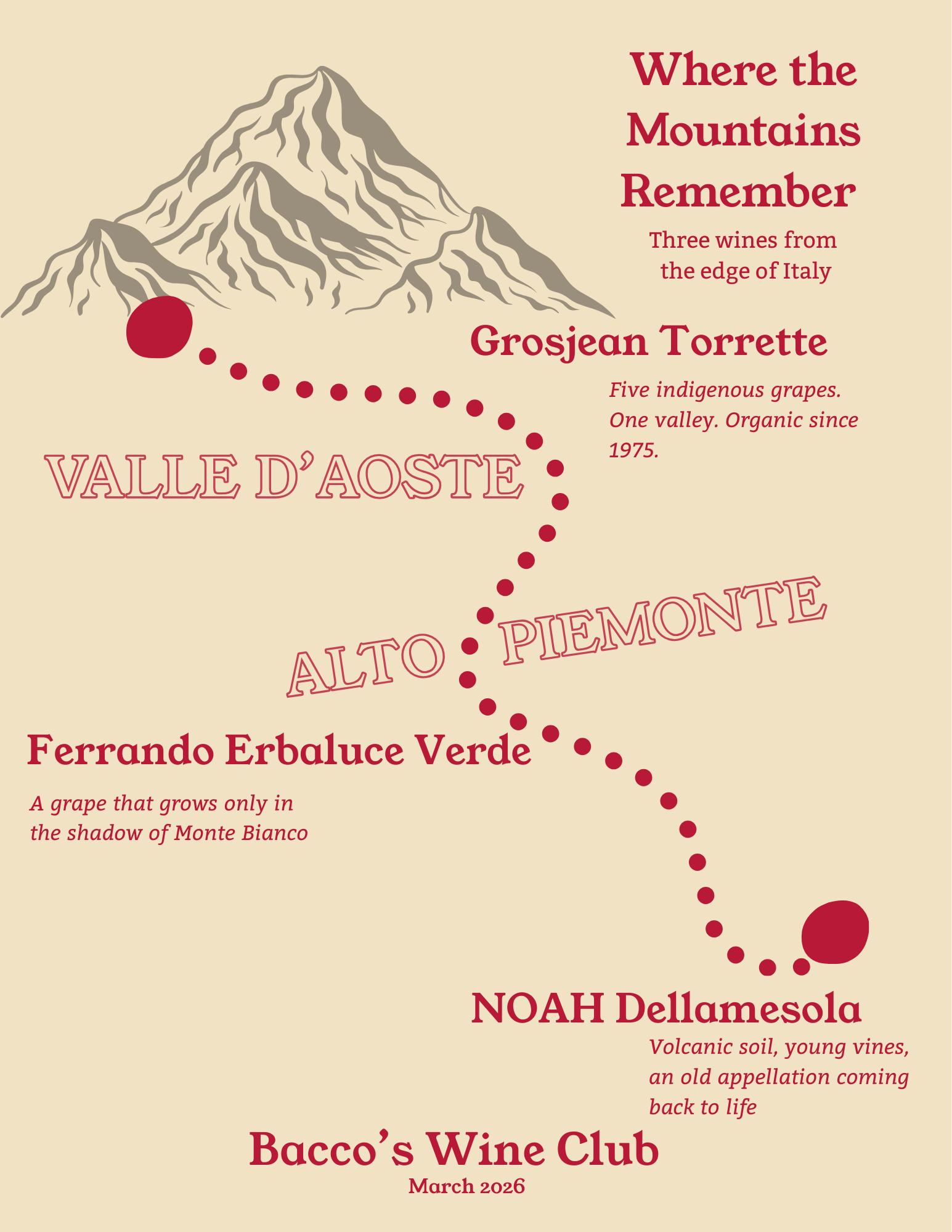
Where the Mountains Remember:
Three Wines from the Edge of Italy
If you drive north through Piedmont long enough, the landscape begins to betray its own reputation. The manicured slopes of the Langhe—those photogenic, world-famous vineyards that bankroll the region’s mythology—fall away behind you. The hills steepen. The air sharpens. Stone walls appear along the roadsides, ancient and irregular, built by people who understood that farming here was not an investment but an argument with gravity.
This is Alto Piemonte and the Valle d’Aosta: the northernmost edge of Italian wine, where the Alps press down so close that vineyards grow in the literal shadows of Monte Bianco and Gran Paradiso. It is a place that most of the wine world forgot for the better part of a century, and where the people who stayed—or who chose to come back—did so out of something more stubborn than ambition. It is, in other words, exactly the kind of place we go looking for.
This month’s three wines come from this territory. They arrive through Rosenthal Wine Merchant, Neal Rosenthal’s four-decade-old importing house in New York, which has made a quiet career of finding exactly these producers—the ones who farm impossibly steep terrain, who work with grapes no one else bothers with, and who make wines that could not plausibly come from anywhere else on Earth. Rosenthal does all his work on a handshake. He has never signed a contract with a supplier. The Ferrando family, whose Erbaluce opens this month’s selection, was the very first estate he imported back in January of 1980, when Carema and Erbaluce were names unknown to virtually anyone who didn’t live within fifty kilometers of Turin.
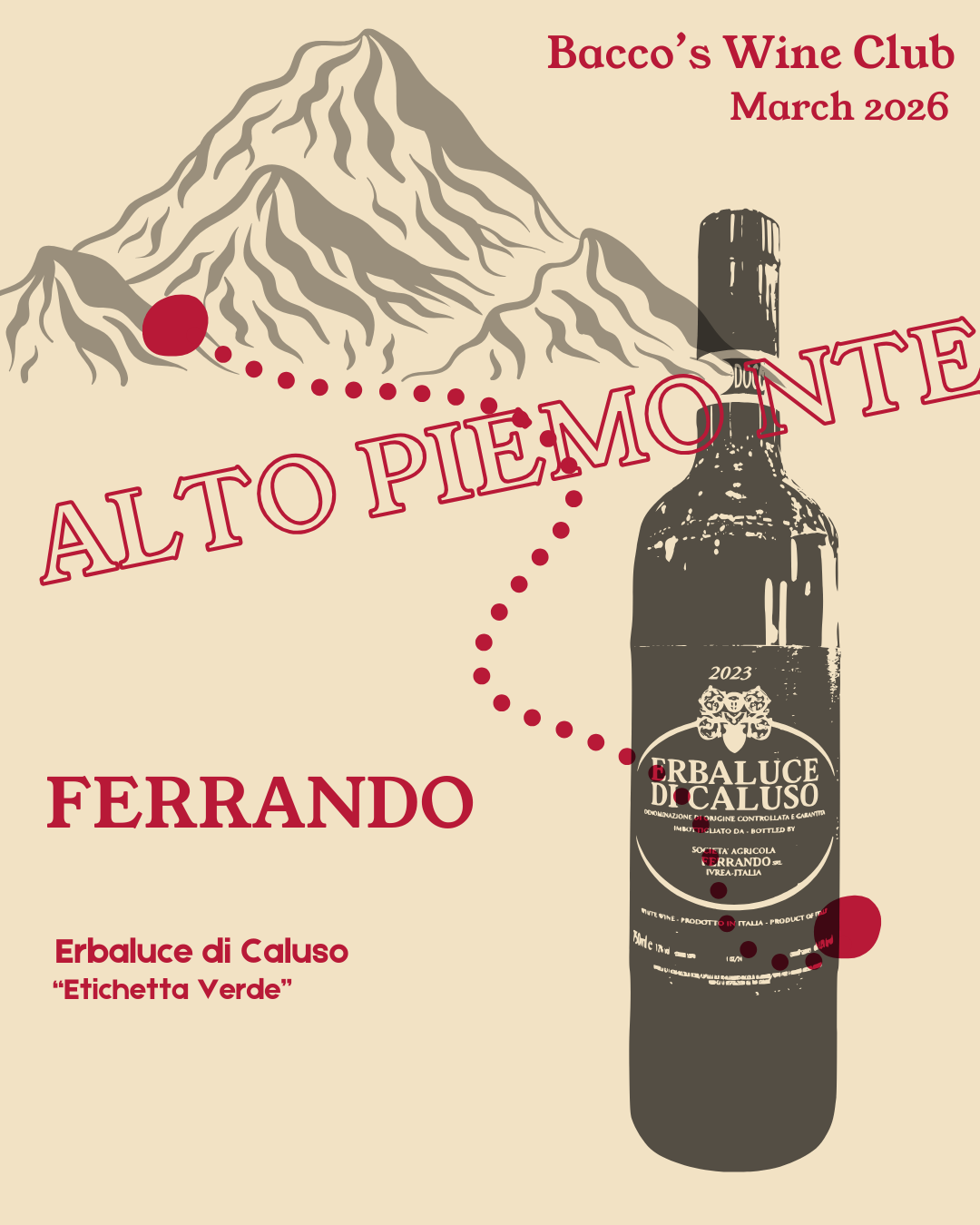
Ferrando Erbaluce di Caluso “Etichetta Verde” (Cascina Cariola) 2023
The Ferrando family has been making wine since 1890, when the first Giuseppe Ferrando arrived in the town of Ivrea from Acqui with the intention of introducing Piedmontese wines to the Valle d’Aosta. Five generations later, Roberto Ferrando—who his father Luigi once said carries the whole weight of the operation on his shoulders—continues to farm Nebbiolo on the vertiginous terraces of Carema and Erbaluce on the morainic plains of Caluso, about forty-five minutes north of Turin.
The Erbaluce grape is an ancient white variety that exists only in this alpine corner of Piedmont. It cannot be successfully cultivated anywhere else—not for lack of trying, but because its particular genius is calibrated to a very specific set of conditions: sandy, calcium-poor, morainic soils descended from the crystalline massifs of Monte Rosa and Monte Bianco; the wide diurnal temperature swings of the Canavese; and the long, slow autumns that allow harvest to stretch into October without sacrificing the grape’s natural, almost architectural acidity.
Ferrando Erbaluce di Caluso “Etichetta Verde” (Cascina Cariola) 2023 comes from a single vineyard in the village of Piverone. Around six thousand bottles are produced each year, of which the American market sees fewer than half. Fermented in stainless steel at controlled temperatures, bottled nine to twelve months after harvest, then held further before release—the wine is an exercise in transparency. It is bright and floral, with a mineral spine that owes everything to those ancient glacial soils. You sense citrus peel, white stone fruit, something almost saline on the finish. It is the kind of wine that makes you reconsider what Italian white wine can be when it isn’t trying to be anything other than a perfect expression of where it was grown.
At the table: This is a wine that loves simplicity. A plate of burrata with good olive oil and flaky salt. Seared branzino with lemon and capers. Risotto with spring peas. The acidity is the engine here—it cuts through richness without overpowering delicate flavors, which makes it an unexpectedly versatile dinner wine. If you keep any of our Italian tinned fish on hand, this is its ideal companion.
The Nitty Gritty:
Country: Italy
Region: Piedmont
Subregion: Caluso, Canavese (Alto Piemonte)
Farming: Traditional, low-intervention
Soil: Morainic, sandy, calcium-poor — glacial deposits from the Monte Rosa, Monte Bianco, and Gran Paradiso massifs
Varietal: 100% Erbaluce
Elevation: Alpine foothills of the Canavese
Style: Bright, mineral, high-acid alpine white
Production: Single vineyard (Cascina Cariola, Piverone). ~6,000 bottles/year. Stainless steel fermentation, bottled 9–12 months after harvest. Fifth-generation family estate, founded 1890.
Pictured: Fattoria Moretto Lambrusco Grasparossa di Castelvetro Secco
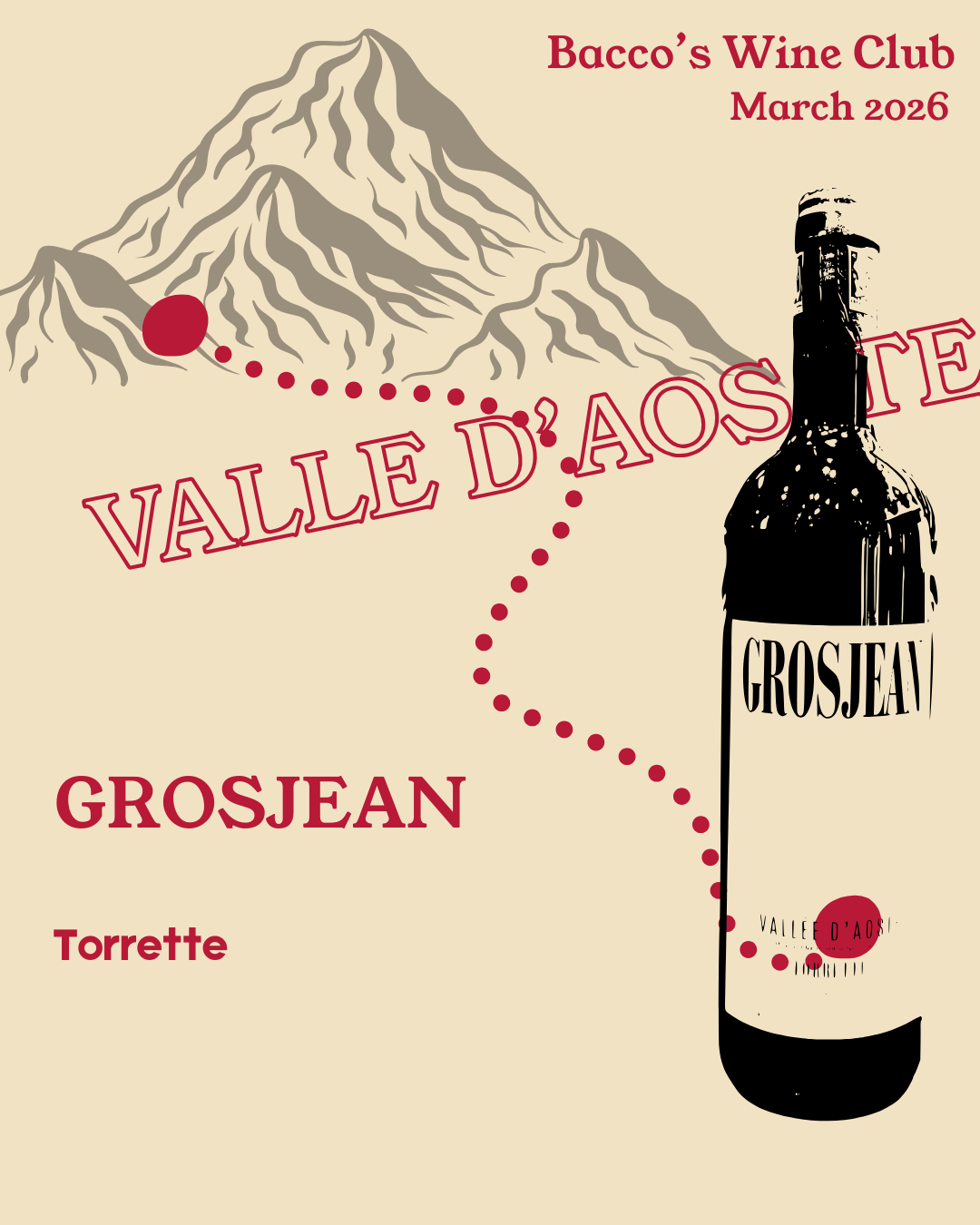
Grosjean Torrette Valle d’Aosta 2023
Cross the border into the Valle d’Aosta—Italy’s smallest wine region, a long, narrow valley carved by the extreme northwestern Alps—and the scale of everything contracts. The vineyards are smaller, steeper, more precarious. The grape varieties are ones that even serious wine people may never have encountered: Petit Rouge, Fumin, Cornalin, Vien de Nus, Premetta, Mayolet. They are indigenous to this valley and essentially nonexistent beyond it. The word used here is “heroic” viticulture, which is not a marketing term but a bureaucratic designation acknowledging the physical extremity of the farming. Everything is done by hand. There is no alternative.
The Grosjean family traces its roots to the village of Fornet, high in the mountain passes of the Valgrisenche—a village now buried under the waters of the Beauregard dam. They raised cattle. During the summers, they came down to lower altitudes to cultivate grapes and chestnuts, stocking up on wine to last the long winters. In 1969, Dauphin Grosjean—the patriarch, and yes, that is his real name—was persuaded by a friend to present his wine at a local exposition. The quality was immediately recognized, and it changed the direction of the family. His five sons—Vincent, Giorgio, Marco, Fernando, and Eraldo—each took on a role in the expanding estate. Today, the third generation—Hervé, Didier, Simon, and Marco—runs the operation from the hamlet of Ollignan, on the border of Quart and Saint Christophe.
They have been farming organically since 1975—a full thirty-six years before they received official certification in 2011, making them the first certified organic estate in the entire Valle d’Aosta. No pesticides, no herbicides, only organic fertilizers. Indigenous yeasts for fermentation. Neal Rosenthal, who has visited this valley for decades, once wrote of the region: “There’s nothing better in the world than these valleys.” The Grosjeans quote him on their own website, which tells you something about the nature of the relationship.
Grosjean Torrette Valle d’Aosta 2023 is a blend built around Petit Rouge—about eighty percent—with smaller portions of Vien de Nus, Fumin, Cornalin, and Mayolet: a coalition of indigenous grapes that, taken together, offer a miniature portrait of the valley itself. The vineyards sit between 550 and 650 meters above sea level, trained in the Guyot system and draped down the terraced hillside. The wine is aged in both stainless steel and oak casks. It is charming when young—snappy red fruit, a line of crushed-rock minerality, high acidity that keeps everything vibrant—but it deepens with time. The traditional pairing is Fontina cheese and cured meats, which is to say, the food that the people who make this wine actually eat
At the table: Think Alpine comfort food. Fontina melted over polenta. A board of our cured meats—bresaola, coppa, lardo—with rye crackers. It’s also a beautiful match for roasted chicken with herbs, or a hearty minestrone on a night when March is still acting like winter. Serve it with a slight chill—fifteen minutes in the fridge before opening—and the fruit lifts right off the glass.
The Nitty Gritty:
Country: Italy
Region: Valle d'Aosta
Subregion: Quart / Saint Christophe
Farming: Certified organic (Ecocert, 2011 — practicing since 1975)
Soil: Sandy, shallow depth, abundant stone residue
Varietal: Petit Rouge 80%, Vien de Nus, Fumin, Cornalin, Mayolet
Elevation: 550–650m, terraced hillside
Style: Alpine red, bright acidity, crushed-rock minerality
Production: Indigenous yeast fermentation. Aged in stainless steel and oak casks. First certified organic estate in the Valle d'Aosta. Third-generation family estate, founded 1969.
Pictured: Claude-Emmanuel and Louis-Benoît Desvignes of Louis Claude Desvignes
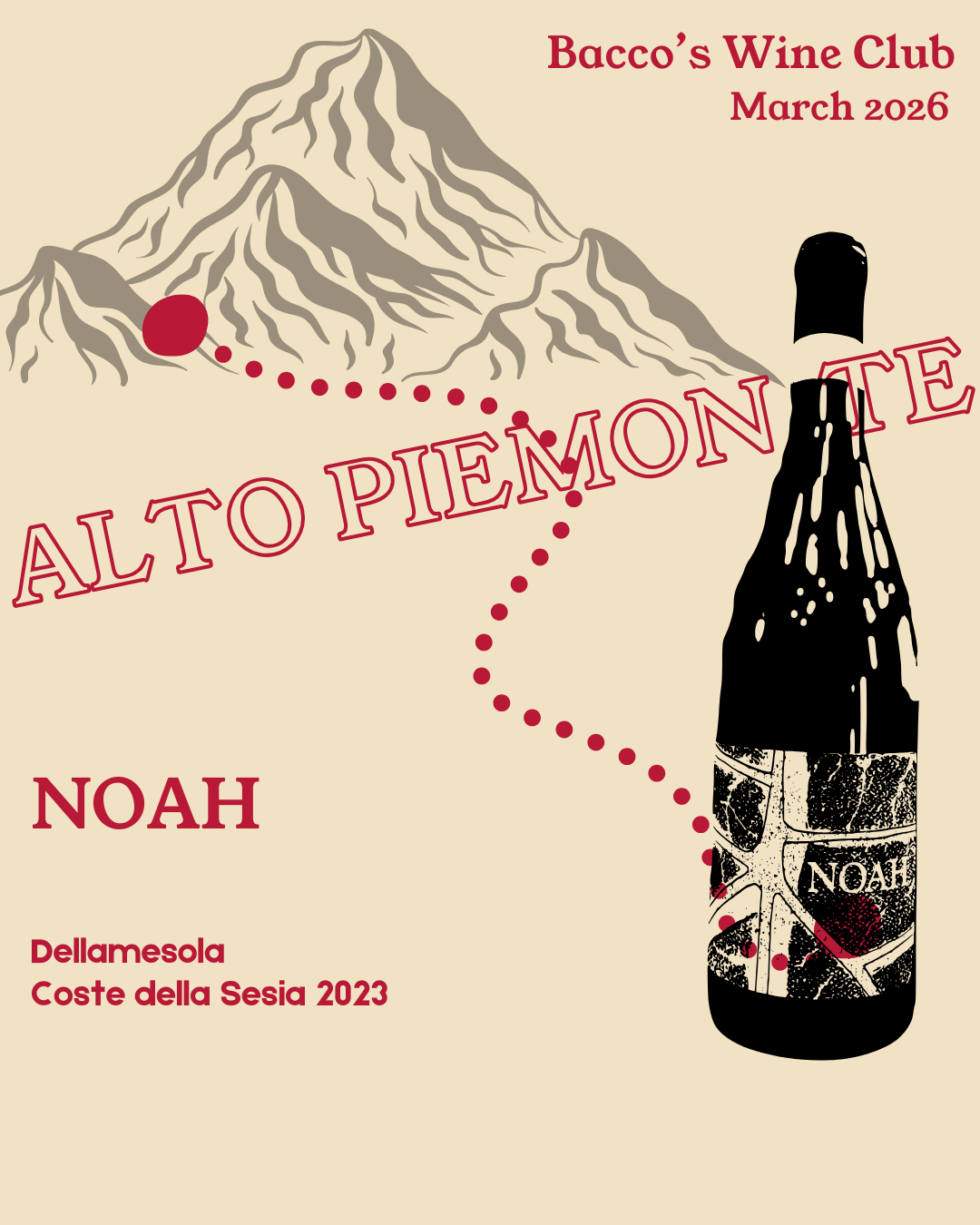
NOAH “Dellamesola” Coste della Sesia 2023
Andrea Mosca was an architect. He gave it up. About fifteen years ago, he and his wife, Giovanna Pepe Diaz, bought just under five hectares of vineyard in and around the village of Brusnengo, in the heart of the Bramaterra appellation, and named the project after their son, Francesco Noah. They are renovating a farmhouse there. They make wine. That is the story, and it is both simple and representative of something much larger happening across the Alto Piemonte.
Before the Second World War, the Alto Piemonte was one of the most important wine regions in Italy. Then the factories came—the industrial boom of the postwar years drew workers out of the hills and into the cities—and the vineyards were abandoned. For decades, the terraces crumbled and the vines went wild. Only recently has a younger generation begun returning, drawn by the realization that what was left behind was not a ruin but an inheritance. The word “Bramaterra” itself is believed to come from the Italian “bramare la terra”—to long for the land. It is a tiny appellation, roughly twenty-eight hectares spread across several communes, with no more than a handful of active producers. The soil is red volcanic porphyry, which gives the wines a mineral intensity that distinguishes them from the marine sands of neighboring Lessona.
Rosenthal has been with NOAH since the beginning, adding the estate in 2015 and importing every vintage since the debut 2011 bottling. Andrea’s approach is traditional and low-intervention: indigenous yeasts, aging in large neutral Slavonian oak, minimal sulfur. The oldest Croatina vines on the property are seventy years old and trained in the local maggiorina trellising system. Everything is harvested by hand between late September and late October.
NOAH “Dellamesola” Coste della Sesia 2023 takes its name from Andrea’s particular zone of Brusnengo. It is a blend of Nebbiolo—the majority—with Vespolina and Croatina, aged for a year in large Slavonian oak and bottled with minimal sulfur. If the Bramaterra is the estate’s serious, long-aging statement, the Dellamesola is its friendlier introduction: open-knit, built around a core of vivid dark red fruit and a subtle floral character, with the volcanic mineral thrust of Bramaterra delivered on a more immediately luscious frame. It is the kind of wine that makes you understand, in a single glass, why people are paying attention to the Alto Piemonte again—and why some of Piedmont’s most notable producers from the Langhe have begun investing in the area, sensing that the momentum is only beginning.
At the table: This is your Sunday red. Braised short ribs. A slow-cooked ragù over pappardelle. Aged hard cheeses—Piave, Parmigiano, pecorino. It has the tannic structure to stand up to rich, meaty dishes but enough freshness that it won’t flatten a simple bowl of pasta with tomato sauce. Decant it for twenty minutes if you can wait that long.
The Nitty Gritty:
Country: Italy
Region: Piedmont
Subregion: Brusnengo (Alto Piemonte, Bramaterra zone)
Farming: Organic-leaning, minimal intervention
Soil: Red volcanic porphyry
Varietal: Nebbiolo 80%, Vespolina 10%, Croatina 10%
Elevation: Rolling volcanic hills of the upper Piemonte
Style: Medium-bodied, volcanic mineral, floral, traditional Alto Piemonte
Production: Indigenous yeasts, aged 12 months in large neutral Slavonian oak botti. Minimal sulfur. Hand-harvested. Estate founded 2010
What connects these three wines is not a grape variety or a single appellation but a shared geography of extremity—altitude, slope, cold—and a shared insistence on specificity. The Ferrando Erbaluce could not come from anywhere but the morainic hills of Caluso. The Grosjean Torrette could not come from anywhere but the high terraces above Quart. The NOAH Dellamesola could not come from anywhere but the volcanic soils of Brusnengo. In a wine market increasingly organized around familiar names and interchangeable flavors, these are wines that resist abstraction. They taste like places. They taste like the decisions of particular families to stay, or to return, or to start over on land that most people had written off.
Neal Rosenthal once described his philosophy in a single line: “I want to know where these grapes came from.” That impulse—not for brand recognition or critical scores, but for origin, for the irreducible specificity of a place—is what brings wines like these into a shop like ours. The mountains of northern Italy have been making wine for over two thousand years. The pergola trellising in Carema dates to the Roman legions. The Grosjean family has been in the Valle d’Aosta for four centuries. What’s new is that you can drink the wines here, in Boston, this month, and that someone thought you’d want to.
We did. We do.