Bacco’s Wine Club September 2026
Loire, Loir, and the Long Way Around
Here's something I notice every year: the light changes before the temperature does. Sometime in early September the late-afternoon sun starts coming in lower across St. James Ave, and people walk in asking for "something for fall" while it's still eighty degrees out. They're not wrong. They're just early.
My answer is almost always the same two grapes: Chenin Blanc and Cabernet Franc. The Loire built its identity on them, and they track the season better than anything else I know. Honeyed and mineral one week, structured and cool the next. This month is three bottles from that valley, made by three people who got there by very different roads.
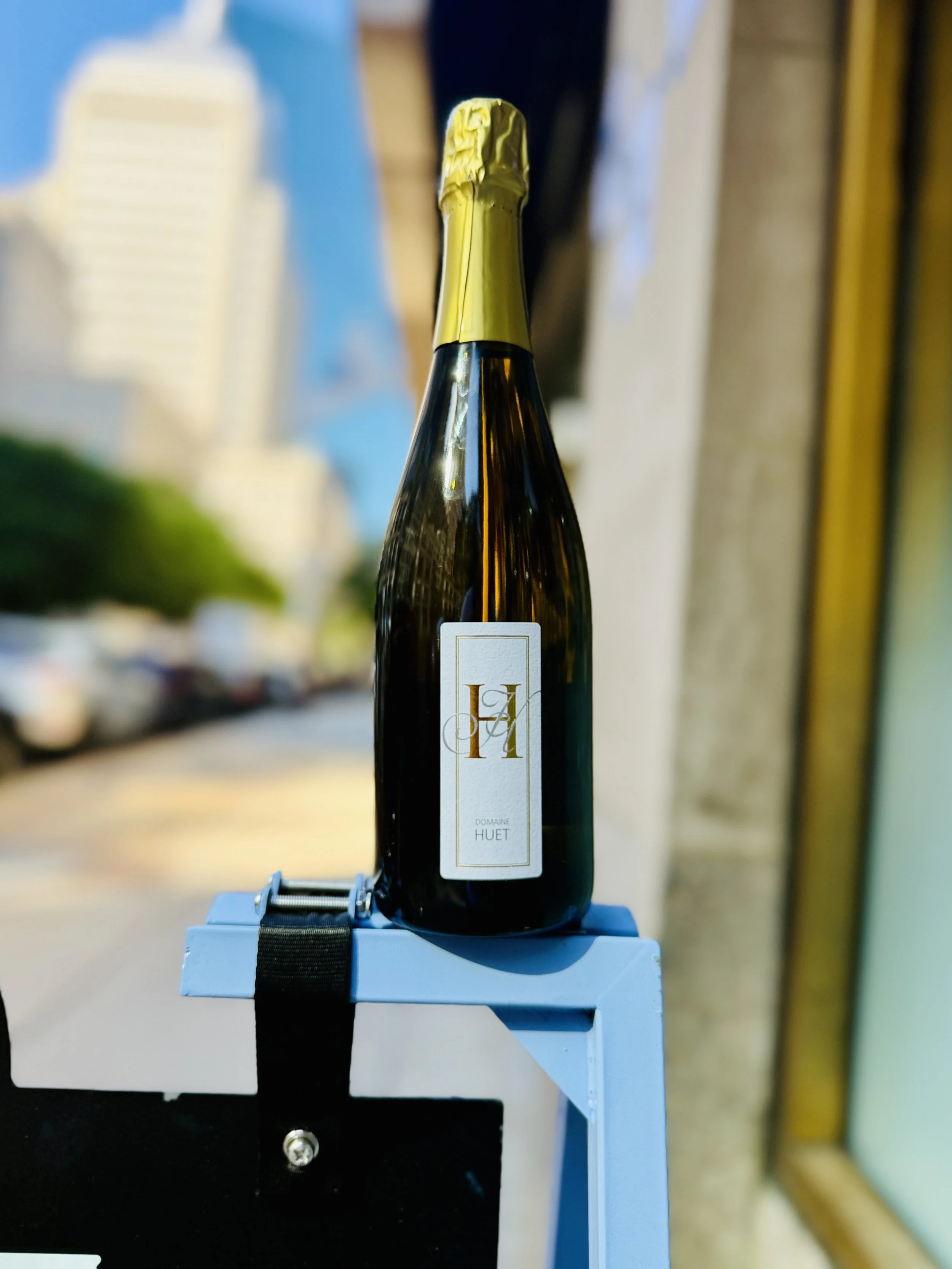
Pictured: Domaine Huet Pétillant Vouvray 2019
Domaine Huet Pétillant Vouvray 2019
You'll hear that Huet has been the reference point for serious Chenin since 1928. You'll hear it so often it stops meaning anything, so start with the person instead. Victor Huet was running a bistro in Paris when he came home from the war in bad health and moved to Vouvray, where he bought a single vineyard, Le Haut-Lieu. His son Gaston worked alongside him from the beginning and spent the next half-century making the name.
The part I find more interesting comes later. Gaston's son-in-law, Noël Pinguet, was living in Paris too until Gaston talked him into coming back. In the late 1980s Pinguet heard a grower named François Bouchet make the case for biodynamics at a conference. He tried it on the 1988 vintage, liked what he saw, and had every vineyard converted by 1990. That was decades before it became a selling point. When Gaston died in 2002, the estate had to be sold to cover the inheritance taxes. The Hwang family bought it, and the people who made the wine stayed. The name on the deed changed; the cellar team and the approach didn't.
The Pétillant draws on all three of the estate's great vineyards plus a few smaller parcels, and it spends years in the tuffeau cellars before release. Nobody there is in a hurry. What comes out is baked apple, chalk, and a mousse softer than you'd expect if Champagne is your reference point. Open it while it's still warm enough to sit outside.
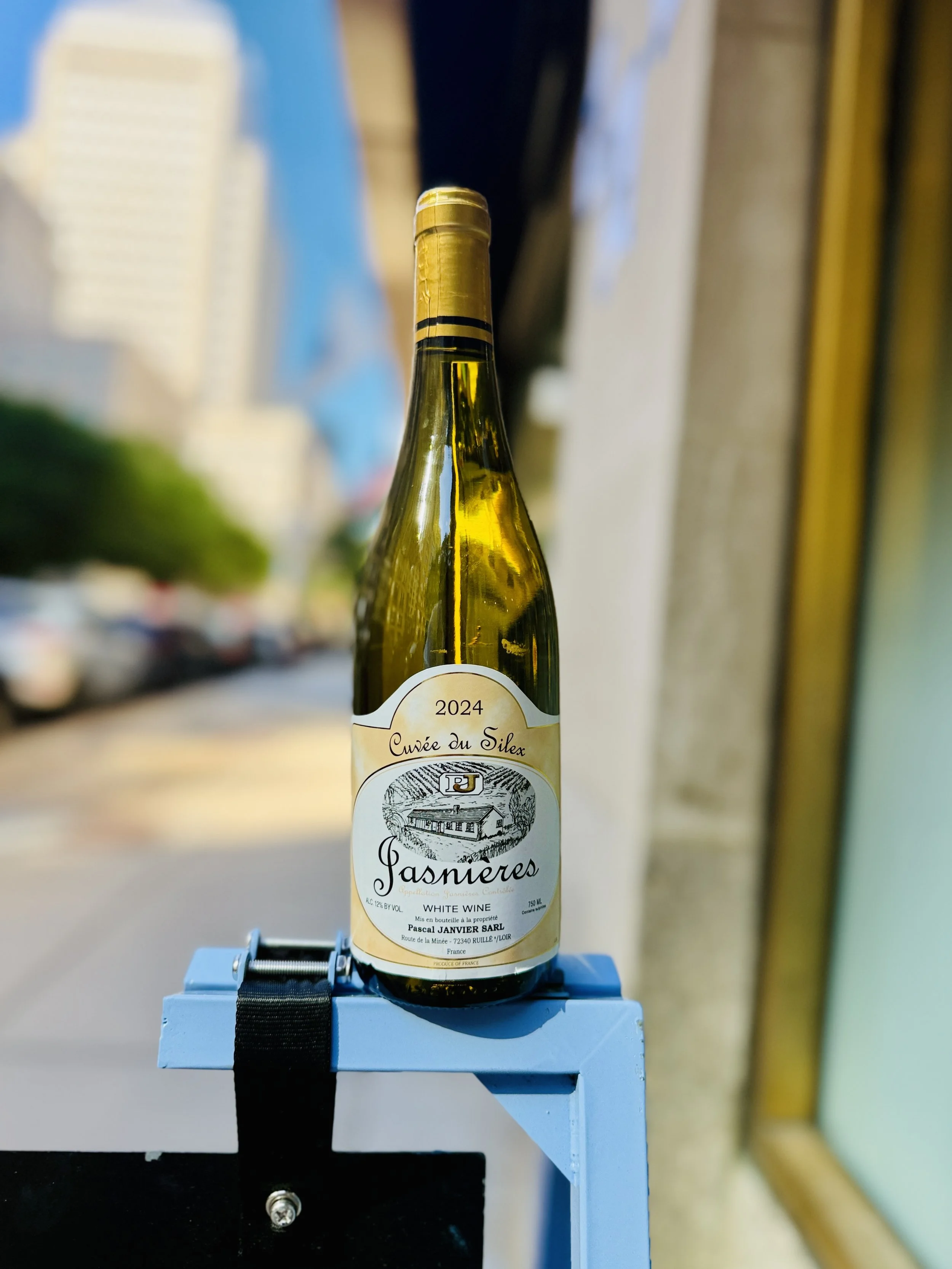
Pictured: Pascal Janvier, Jasnières "Cuvée du Silex" 2024
Pascal Janvier, Jasnières "Cuvée du Silex" 2024
Most people who know the Loire couldn't find Jasnières on a map, partly because it isn't on the Loire. It sits north of Tours on the Loir, no "e," a tributary with the coldest vineyards in the whole greater Loire region. Henri IV reportedly preferred these wines. Today the appellation is down to fewer than a hundred hectares and was close to disappearing entirely.
Pascal Janvier grew up surrounded by vines. His parents owned vineyard land but never made wine themselves, and he went to school to become a butcher. At thirty he changed course, enrolled in the viticulture school in Amboise, and started over. The people who know him describe a quiet, deliberate man, and the way he farms bears that out. He and his wife Dominique rent sixty-six separate parcels adding up to about nine hectares and work every one of them themselves. That's sixty-six sets of rows, slopes, and soil to learn, in a place where getting grapes ripe at all is a fight most years.
The Silex is named for the flint in those slopes, and you taste it first: wet stone and smoke, then guava and quince once the mineral has made its case. It's off-dry, closer to Vouvray than most Loire whites, but the finish runs colder and the acidity never lets the honey go soft. It tastes like the work of someone who chose this rather than inherited it.
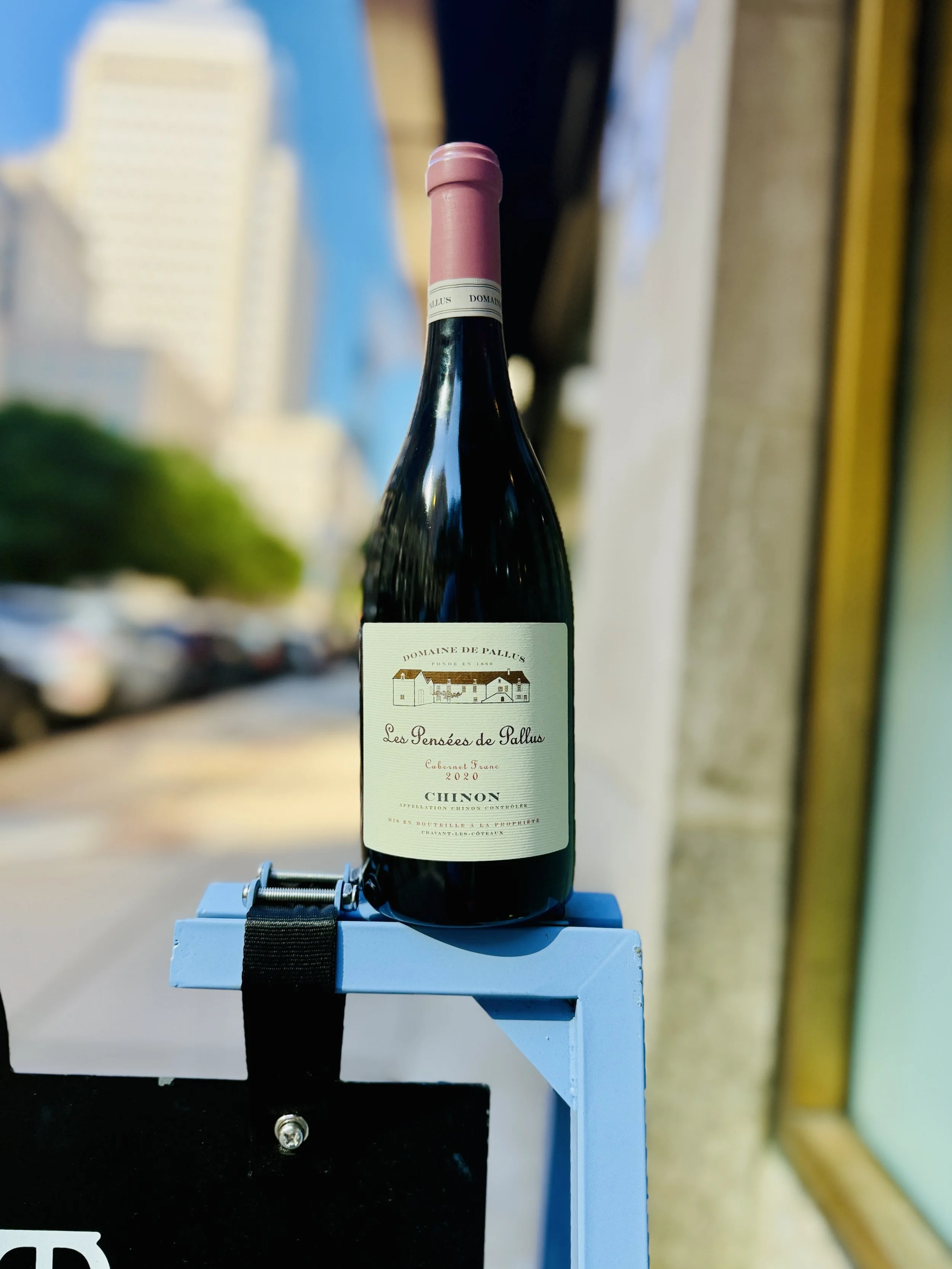
Pictured: Domaine de Pallus, "Les Pensées de Pallus" Chinon 2020
Domaine de Pallus, "Les Pensées de Pallus" Chinon 2020
Bertrand Sourdais grew up at Pallus, and then he left. He studied enology in Bordeaux and apprenticed at Mouton-Rothschild, at Santa Rita in Chile, and under Álvaro Palacios in Priorat. In 1999 he landed at Dominio de Atauta in Ribera del Duero, a winery with neglected, ungrafted old vines and his first job as head winemaker. It went well. His importers tell it this way: in a 2004 blind tasting run by France's Michel Bettane and Spain's José Peñín, his 2002 Atauta tied 1994 Vega Sicilia for Bettane's top red. Sourdais was twenty-five.
He could have stayed. He didn't. With his father nearing retirement, he came home to Cravant-les-Coteaux as the fifth generation on the estate. He brought back the habit Atauta had taught him, which was to question every step instead of doing it the way it had always been done. He cut yields, moved the vineyards toward biodynamics, and stretched macerations to a month or longer, well past what most Chinon gets. In 2013 he rebuilt Les Pensées entirely. What had been a blend of parcels became a single mid-slope terrace of sand and iron-rich gravel over limestone. He isn't the only one who came back, either. His brother Martin and sister-in-law Pauline left the bakery trade to return to Pallus.
The wine is still unmistakably Chinon: cassis, gravel, tree bark. There's just more frame underneath than the appellation usually shows this young. Grill something and open it now, or put it away for five years and see what the tannins do.
The Last Drop
Three producers, three relationships to home. Huet stayed put, even when the ownership didn't. Janvier stayed too, but came to the vines from another trade entirely. Sourdais left and came back different.
September does something similar: familiar, and not quite how you remember it.
Bacco’s Wine Club August 2026
The Forgotten Corners:
Three Growers, One River Valley
Ask most people what the Mosel makes and they'll say Riesling before you finish the question. Fair enough — it's not wrong, exactly. It's just incomplete in a way that flattens a river valley with a lot more going on than the postcard suggests.
The Mosel isn't one thing. It's slate in the middle stretch and limestone up top. It's a handful of growers who never bothered grafting onto resistant rootstock because the vines they had were doing fine, thanks. It's a red grape from Burgundy and two from Bordeaux showing up in a rosé nobody asked for and everybody should try. This month is about the parts of that river that don't make the postcard — three growers who kept farming what everyone else walked away from, for reasons that have more to do with stubbornness than business sense.
None of these wines are trying to be the Riesling you already know. That's the whole point.
We start at the top of the river, where the map stops looking like the Mosel at all.
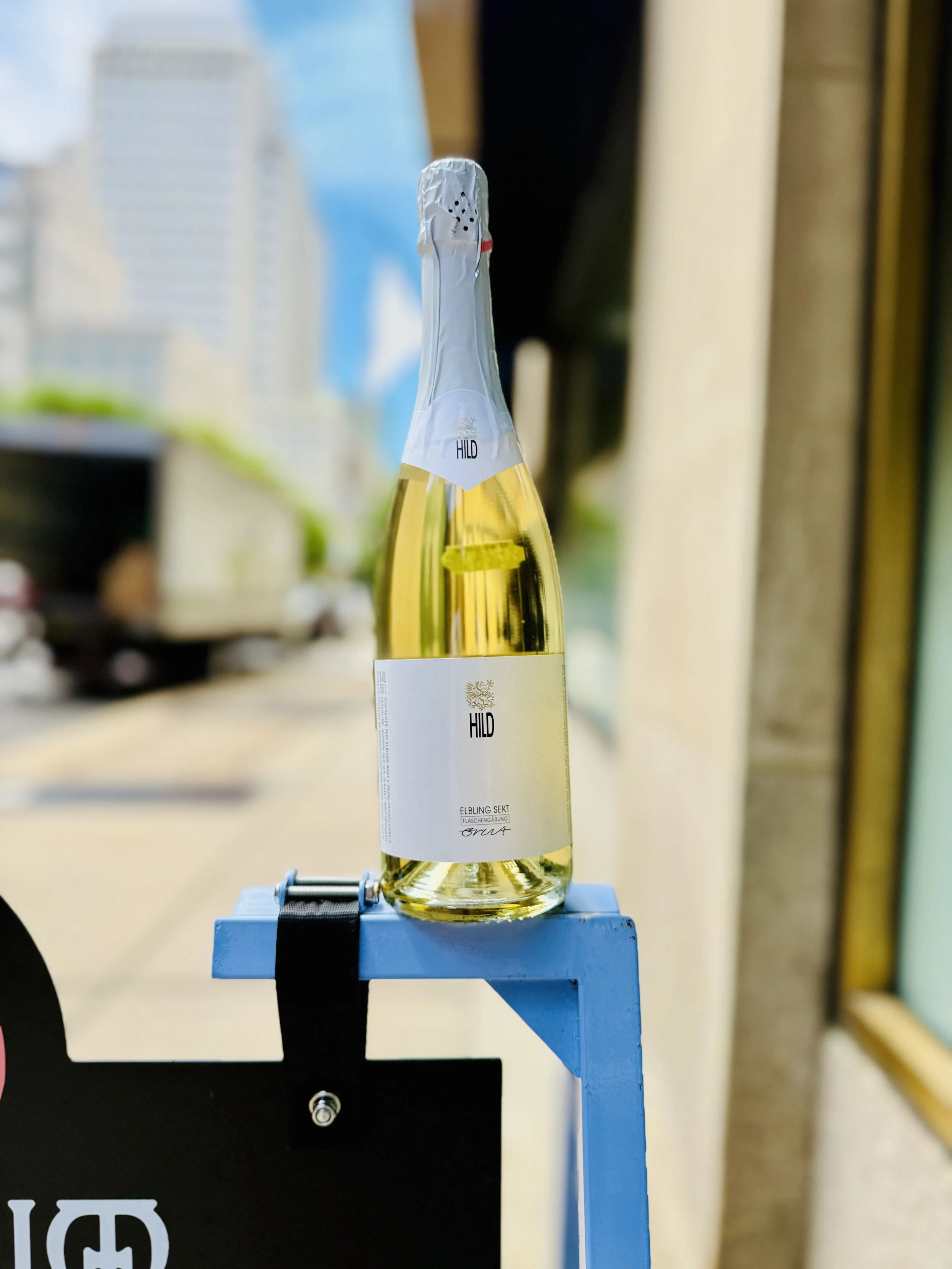
Pictured: Hild Elbing Sekt
Hild Elbing Sekt
Drive far enough upstream from the postcard villages and the slate runs out. In its place: limestone, chalk, the beginning of the same geological basin that eventually becomes Chablis and Sancerre a few hundred miles away. Nobody talks about the Obermosel. There's no marketing budget for it, no glossy import catalog copy. What there is instead is Elbling — one of the oldest grapes in Europe, and one most of the country stopped bothering with generations ago.
Matthias Hild farms about five hectares of it around the sleepy town of Wincheringen, working alongside his son Jonas on steep, terraced sites that make no financial sense to keep alive. He's been at this a long time, and he's exacting about it in a way that borders on obsessive — there's a story about him tasting an Elbling in the 1980s that had dipped under 8.5 grams of acid and wondering out loud whether it was still Elbling at all. That's the kind of standard he holds the grape to, and it shows.
The Sekt is Hild's simplest cuvée and arguably his best argument. It's made the way Champagne is made — extended lees aging, disgorged by hand, a touch of dosage — except the base wine is Elbling instead of Chardonnay or Pinot Noir, and the soil underneath is nothing like anywhere else on this river. What lands in the glass is lemon pith, quince, a chalky mineral snap that reads more Chablis than Mosel. It's not trying to impress you with complexity. It's trying to be exactly what it is: direct, sharp, and genuinely refreshing, in a way that a lot of more expensive sparkling wine forgets how to be.
Farming these old terraced parcels doesn't pay the way easier land would. Hild does it anyway, because somebody has to, and because he apparently can't imagine doing anything else.
From limestone we drop back down into slate — into the part of the Mosel that actually looks like the postcard, except farmed by two people who've spent twenty years refusing to take any shortcuts.
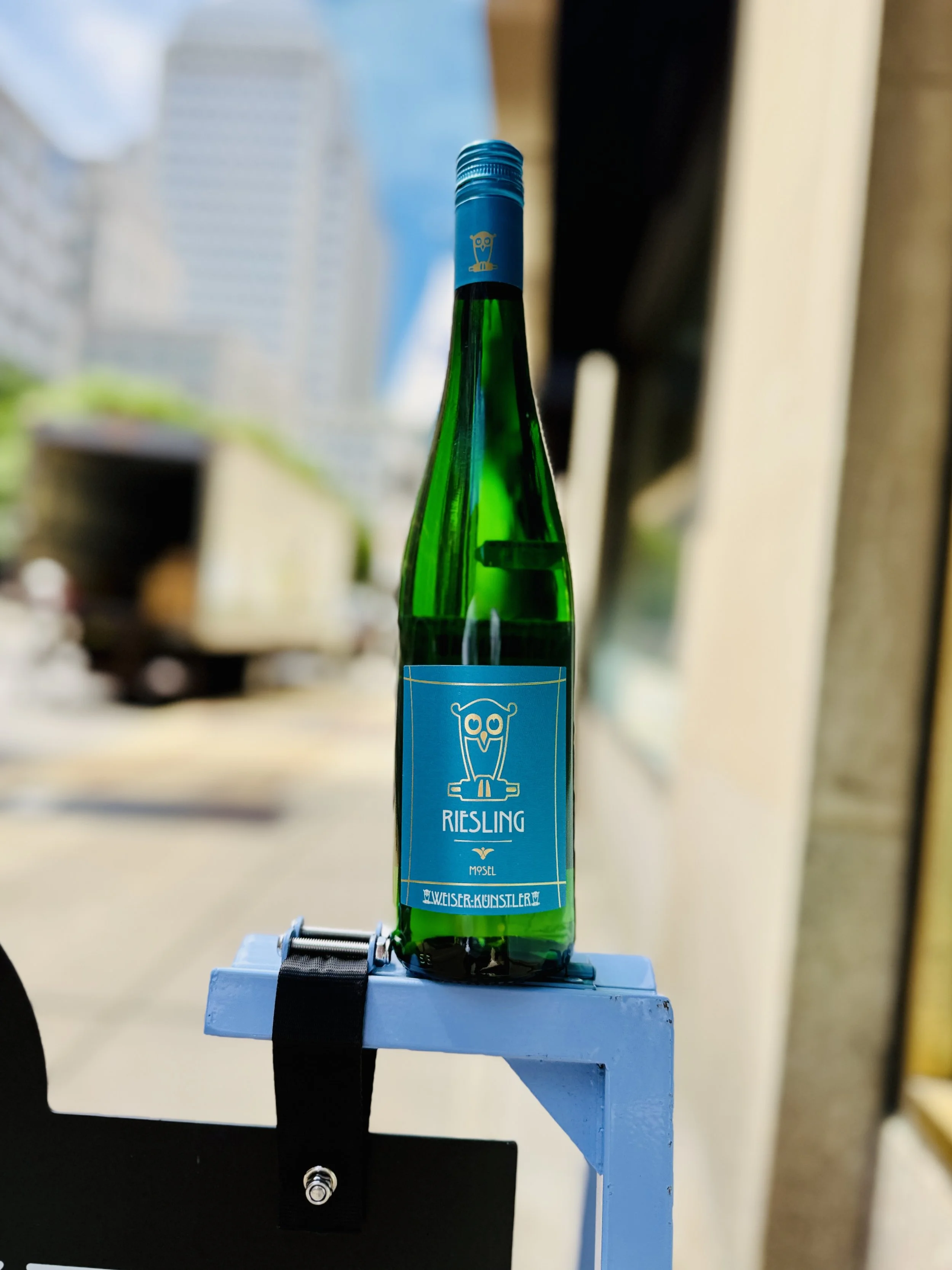
Pictured: KWeiser-Künstler Estate Riesling Feinherb
Weiser-Künstler Estate Riesling Feinherb
Konstantin Weiser and Alexandra Künstler didn't inherit an estate. They built one, starting in 2005 with a lease on 1.8 hectares of steep, ungrafted vines in the village of Enkirch — no family name behind them, no cellar full of equipment, just a conviction that the old sites around them were worth saving. Twenty years later they farm around 4.2 hectares, still entirely Riesling, still mostly ungrafted vines on slopes that top out near 70% grade. Konstantin trained under serious company — Immich-Batterieberg, Leitz, Minges — before deciding he'd rather work impossibly steep slate by hand than do anything easier.
Their core sites — Ellergrub, Gaispfad, Steffensberg — all carried Grand Cru status on the historic 1897 Mosel classification map, the same document Ernst Loosen spent years studying. These are not obscure vineyards because they're bad. They're obscure because they're brutal to farm, and most people gave up on them a long time ago.
This is the house wine — the one made in the largest volume, sourced primarily from their holdings in Trabacher Taubenhaus and supplemented from elsewhere on the estate. Barely off-dry, built on the kind of acidity that makes the residual sugar read as weight rather than sweetness. Peach, tangerine, a little ginger, and a saline finish that keeps snapping back into focus. Mosel Fine Wine Review doesn't treat this as a starter wine — they've called it a great estate wine outright, full stop, not an entry point to something better.
That's the case for it here: the same ungrafted, hand-farmed, impossibly steep-slope pedigree as their single-vineyard bottlings, at a fraction of the price. It's Riesling doing what Riesling does best without asking you to think too hard about it.
Last stop, same river, a different grower who decided the Mosel didn't have to be a white wine's problem.
The Man Who Farms What Nobody Else Wants
Ulli Stein, working now alongside his protégé Philip Lardot, has spent his career on parcels of Mosel slate that share three things in common: they're difficult to work, they're commercially unknown, and Ulli loves them. That's not marketing language — that's close to his own description of why he keeps at it. In 2010 he published a manifesto warning about the disappearance of the region's two-thousand-year-old viticultural tradition. He never grafted his vines onto phylloxera-resistant rootstock, even when it would have made his life easier. Today he farms roughly ten percent of all the ungrafted vines left standing in Germany.
Winemaking with Ulli stays out of the way. No imposed style, no attempt to project an idea onto the fruit — just a relentless preference for cut over size, for wines that stay dry and alive rather than heavy and sweet.
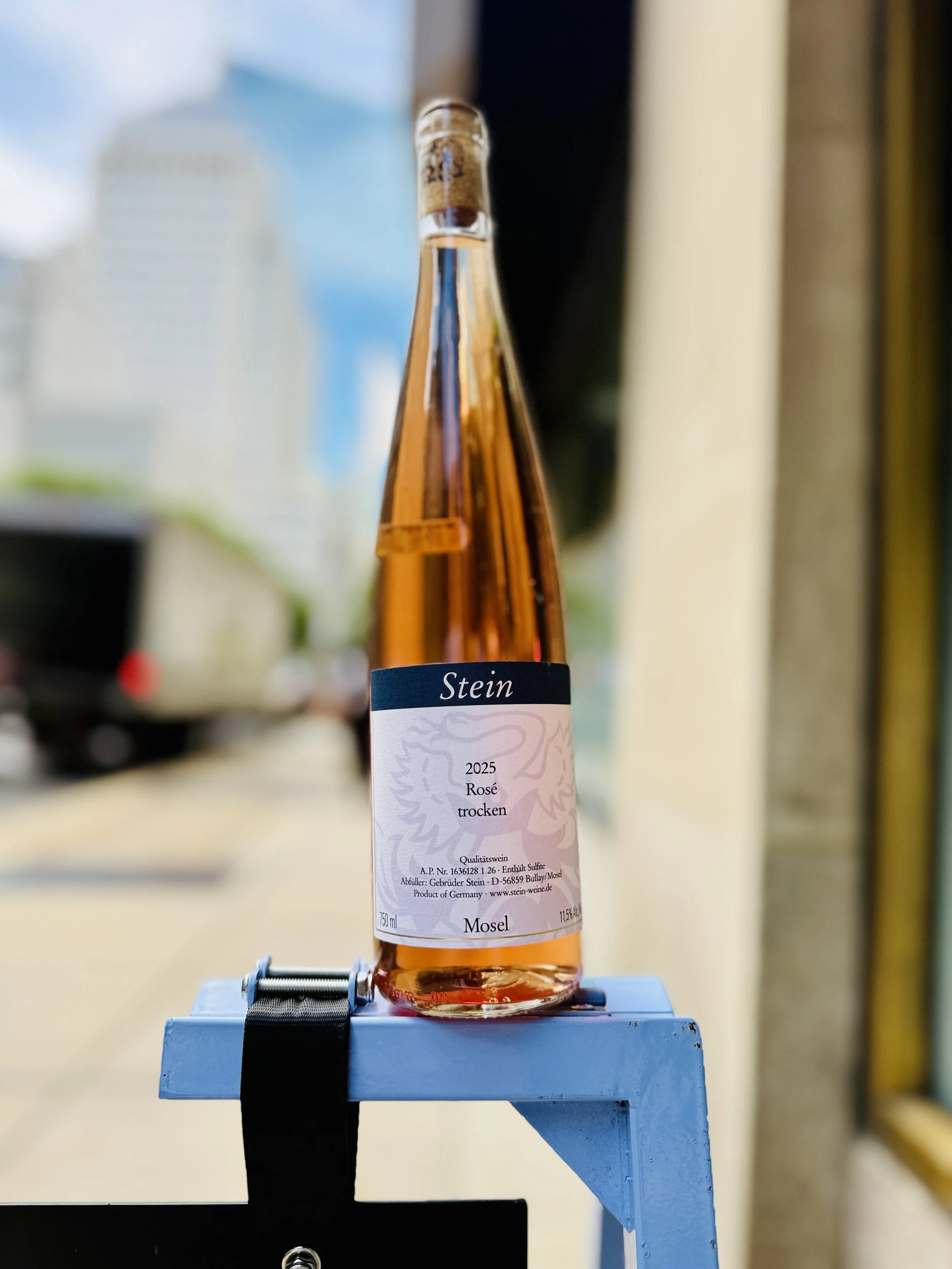
Pictured: Stein Trocken Rose
Stein Rose Trocken
This is the wine in the lineup least interested in following the rules. It's Pinot Noir with roughly 20% Cabernet Sauvignon and Merlot folded in — grapes Ulli had to fight the Mosel authorities just to legally plant, on slate soils that are supposed to belong exclusively to Riesling and Pinot. (The region banned red wine production outright from 1933 to 1986; Ulli's persistence was part of what got that ban lifted.) The rosé itself is a mix of saignée and direct press, raised entirely in stainless steel, with nothing added to soften it. Bone dry, mineral, built on tension rather than fruit. It's not a poolside rosé. It's a Mosel wine that happens to be pink, made by a man who's never been especially interested in doing things the expected way.
The Last Drop
Three wines, three grapes, one river that refuses to be summed up in a single word. Limestone Elbling that tastes nothing like the Mosel is supposed to. Ungrafted Riesling farmed by two people who started with nothing. A red-grape rosé from a man who's spent his life keeping vines alive that everyone else wrote off decades ago.
None of these wines are famous. That's not an accident — it's the entire reason they're here.
Bacco’s Wine Club June 2026
The Hard Way: Farming Wines in all the Tough Places
Here's something I've noticed over the years. You can read a restaurant wine list the way you read a face. Give it thirty seconds and you know whether someone actually made decisions or just filled slots. Mass-market Albariño, generic Montepulciano d'Abruzzo, three Napa Cabs that exist to justify the price point — that's a list built around liability management. Nobody's passionate, nobody's curious, and the kitchen is probably the same.
But then you see a Lalama. Or a Telescópico. Or a Treixadura from a producer who built their winery into a Galician hillside. And you know. You know that someone who works there loves wine — not the idea of wine, not the margin on wine — actually loves it. These aren't wines that end up on a list by accident. They're not on anyone's push sheet. No distributor rep is leading with them. Someone sought them out, made a case for them, and put their credibility on the line.
I first saw Lalama on a list at Spoke Wine Bar, my favorite restaurant. Didn't know the wine. Ordered it because I trusted the room. That's the deal these wines make with you.
There's a version of Spain that exists in the American wine imagination — Rioja, Ribera del Duero, maybe Priorat if you've been paying attention. Big tannins, sun-baked extraction, price points that apologize for nothing. The wine equivalent of a bullfight poster.
This club is about the other Spain. The one you find when you turn off the highway.
Northwest Galicia is wet, green, and chaotic in ways the rest of the Iberian Peninsula isn't. It feels more like a Celtic fringe than a Mediterranean wine country — fog that won't lift, granite everywhere, rivers cutting through gorges so steep you wonder why anyone thought to plant vines here at all. The answer, it turns out, is that the Romans did. And before the Romans, probably someone else. You don't build stone terraces on a sixty-degree slope for the fun of it. You do it because something worth having is up there.
Javier Dominguez came to the Quiroga-Bibei subzone — the most remote eastern corner of Ribeira Sacra — around the turn of this century, when most people were moving away from places like this. His family bought a 140-hectare estate in a valley where the rivers Bibei and Sil converge, and he proceeded to spend the next two decades doing something Galicians call viticultura heroica. That's not marketing language. That's an acknowledgment that working these slopes — harvesting by hand on gradients that would challenge a mountain goat, moving wine by gravity through a facility built into the hillside — requires a specific kind of stubbornness.
He brought in Sara Pérez and René Barbier as consultants. If those names mean something to you — Priorat, the generation that rebuilt that region from rubble — you start to understand the ambition here.
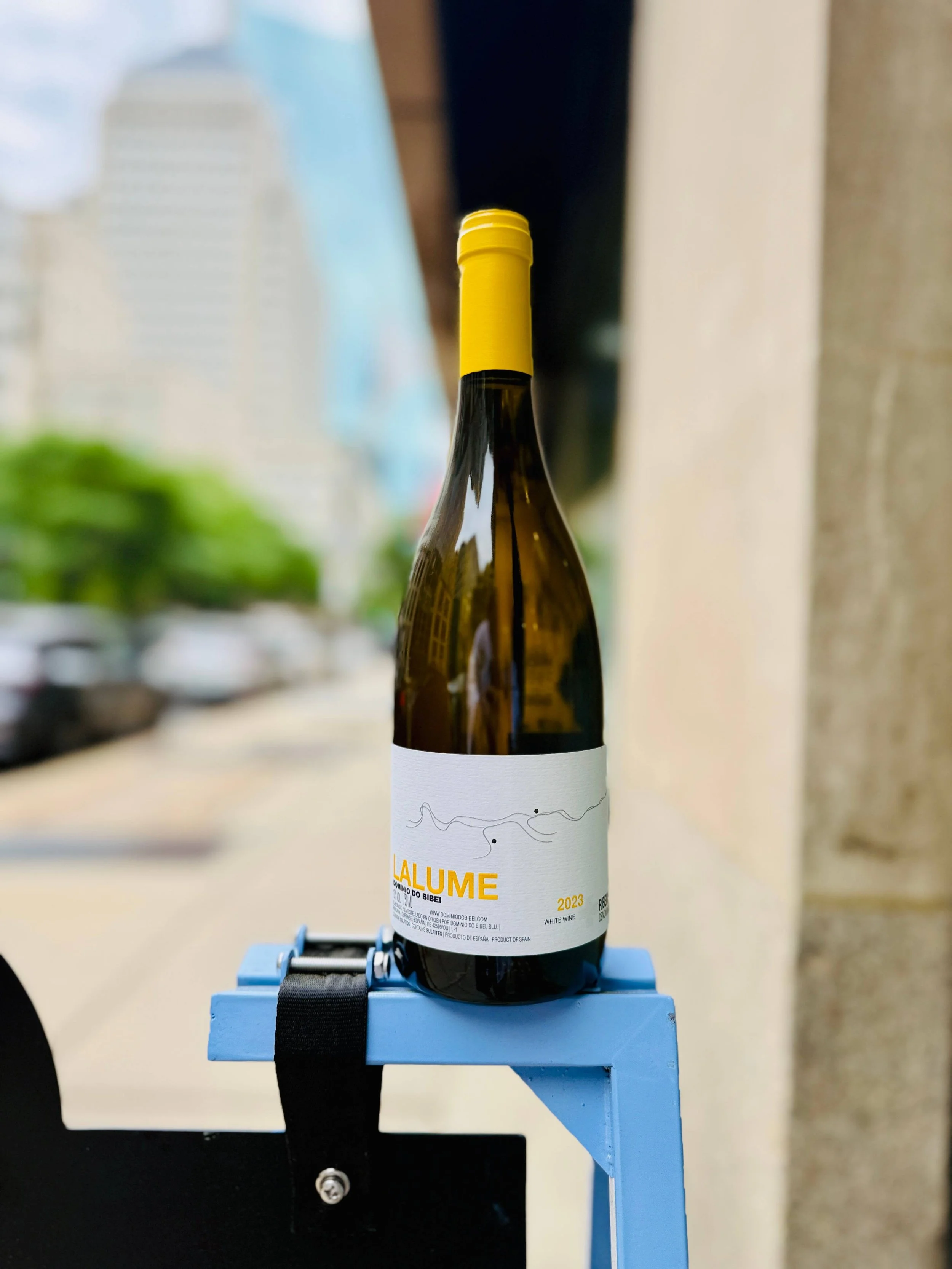
Domaine do Bibei Lalume Blanco
The Lalume Blanco is from Ribeiro, Galicia's other white-wine appellation, which historically has lived in the shadow of Rías Baixas and its relentless Albariño monoculture. Ribeiro's signature grape is Treixadura — known locally, without irony, as the Queen of Ribeiro. It's naturally lower in acid than Albariño, rounder in texture, which is why it's traditionally blended with sharper partners: a little Godello, some Albariño, small amounts of Caíño Blanco, Loureira, Torrontés. The Lalume is exactly that — Treixadura leading, the others providing structure and lift.
What Dominguez does with it is worth paying attention to. The wine ferments in a mix of oak barrels, large foudres, concrete eggs, and stainless steel — no single vessel dominates, because no single vessel should. No malolactic fermentation, which keeps the whole thing alive. The result is a white wine that takes a few minutes in the glass to wake up (this is not a complaint), and then rewards you with something that doesn't taste like anything you expected from Spain: stone fruit, yellow flowers, a mineral note that feels almost saline, an herbal thing running underneath.
If your frame of reference for Spanish white wine is Albariño on a summer patio, this will recalibrate you. It should.
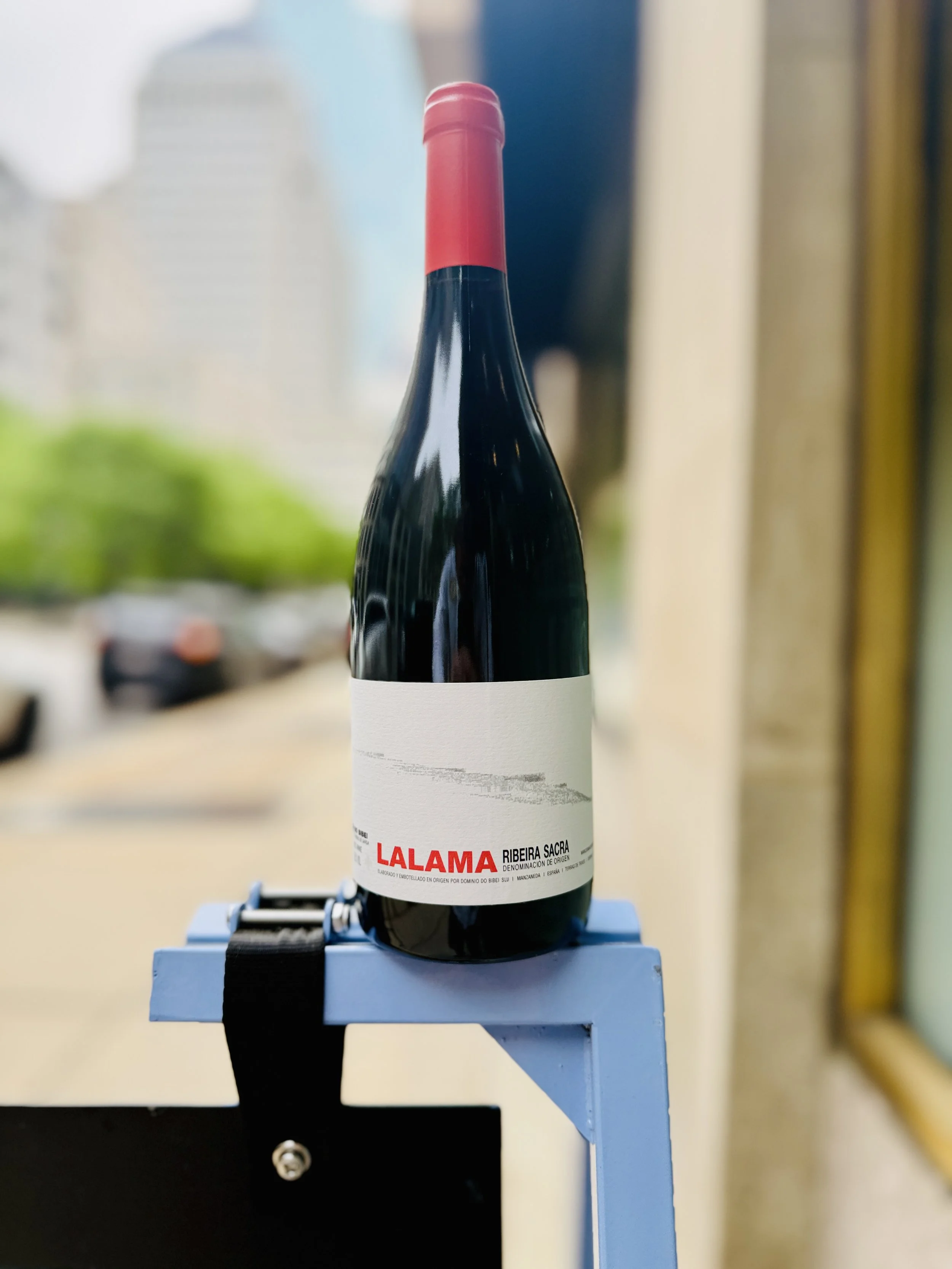
Pictured: Domaine do Bibei Lalama
Domaine do Bibei Lalama
The Lalama is the red, and it comes from the part of the estate that will make you understand the word heroic all over again. Steep, north-facing terraces. Slate and granite with flecks of quartz and iron. Vines at anywhere from 200 to 700 meters above sea level, harvested by hand because there is no other way.
Mencía is the main grape here — that dark, earthy, slightly ferrous variety that northern Spain does better than anywhere else on earth — blended with indigenous partners like Mouratón, Brancellao, and Sousón. They're vinified separately, each one prized for what it specifically adds, then brought together. The wine goes into old barrels and large neutral vessels, nothing that interferes with the fruit, and it rests until it's ready. You will not find a winemaker's fingerprint in this bottle. That's the point. What you find instead is the hillside.
Now we turn east, toward a place most Spanish wine drinkers couldn't locate on a map, and that's precisely the point.
Valdejalón sits in Aragón, wedged between the more famous Campo de Borja and Calatayud, in the triangle between Zaragoza and the Ebro valley. The climate is Mediterranean continental — dry as a bone, sun-baked, punished by a wind called El Cierzo that tears down from the Pyrenees. Nobody moved here to make wine. Nobody built a lifestyle brand here. For most of the twentieth century, the old vines in these mountains existed primarily to be sold in bulk to cooperatives, or not sold at all.
Fernando Mora was an engineer in the wind industry when he fell into wine hard enough to change his life. He wrote his Master of Wine thesis on Garnacha classification in Campo de Borja — the academic equivalent of deciding your life's work will be in an underfunded library in a city no one visits. After he earned his MW, he came back to Aragón and, with his partner Mario López, started Frontonio in 2008. They made wine in the back room of a small bulk-wine winery. They called themselves a "garage winery" because that was accurate.
The winery is named after Saint Frontonio, the patron saint of Épila, the town where they work. The legend: he was beheaded by the Romans. His body was buried. His severed head was thrown into the Ebro River. It swam upstream.
Fernando thought that was a good name for a project.
The work at Frontonio is essentially archaeological. They've spent nearly two decades tracking down plots of ancient Garnacha — some of them 50, 60, 80 years old — owned by elderly farmers who've been tending them all their lives. Some of those farmers won't sell, because without their vines they have nothing to live for. Frontonio waits. They offer care and respect and sometimes just time. They are, as of today, the only winery bottling wine under the Valdejalón designation. An entire wine region, one producer.
Pictured: Illahe Pinot Noir 2023
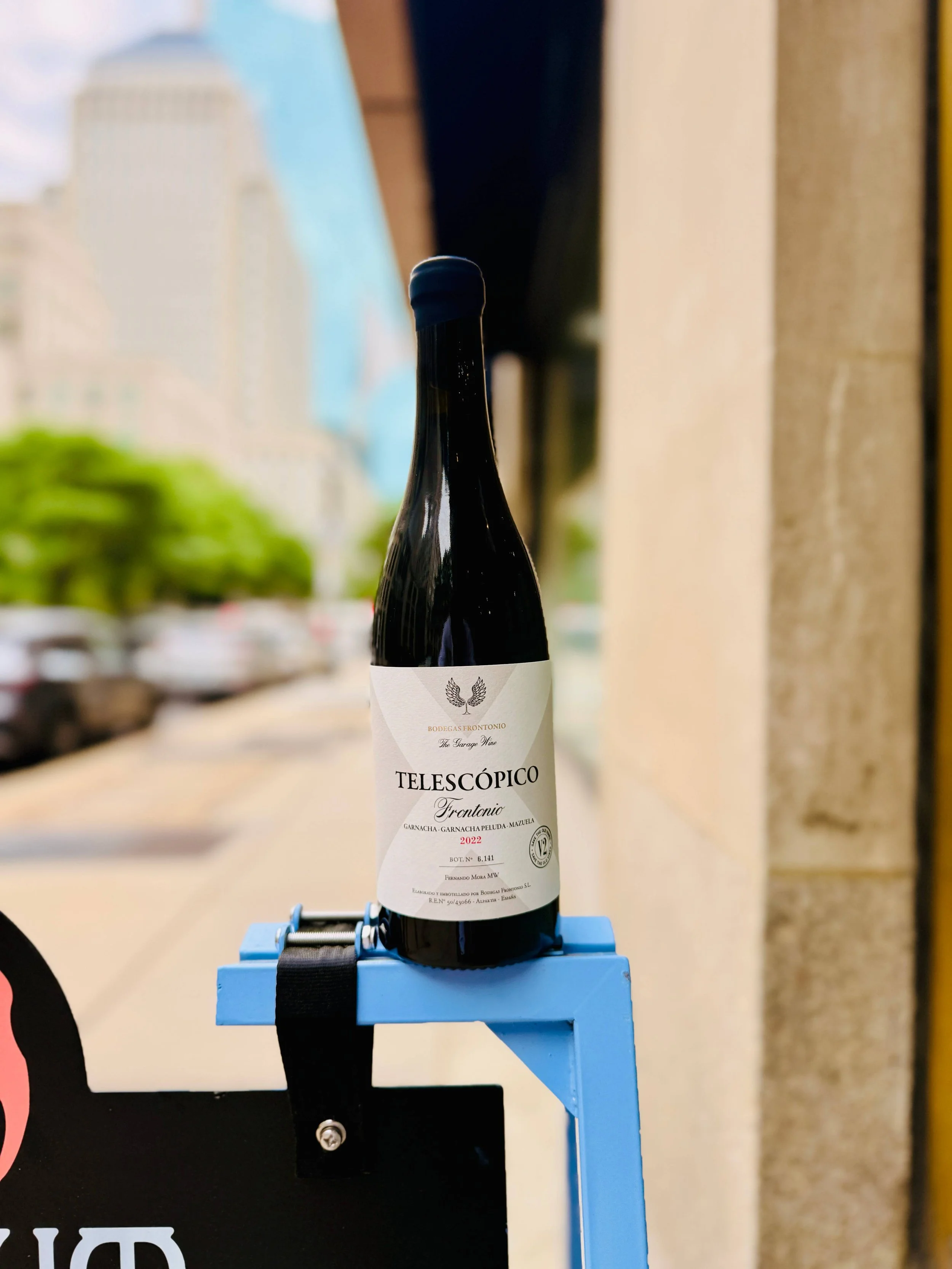
Bodega Frontonio ‘Telescopico’ Garnacha
The Telescópico is Frontonio's "village wine" in the Burgundian sense — a step up from the regional, a step below the single vineyards. The blend is Garnacha Fina, Garnacha Peluda (a downy, heat-tolerant biotype), and Mazuela, the local name for Carignan, from 50-plus-year-old vines on slate and clay-limestone at 500 to 600 meters. Everything is farmed organically. The grapes go into cement vats with indigenous yeasts, macerate for five weeks, and then spend thirteen months in large used foudres and 500-liter barrels.
What you get in the glass is nothing like the Garnacha that built Aragón's reputation for cheap, jammy, extracted red wine. This is precise, dark-fruited, mineral. Red currant, dried rose, a thread of herbs that probably has a name in Spanish I don't know. It drinks with a lightness that belies its depth — the high altitude, the old vines, the long maceration quietly doing its work.
The Last Drop
Three bottles from two regions, two winemakers, one conviction: that the hard way is the right way, and that what you're drinking is proof.
You're not drinking prestige here. You're drinking places that stayed forgotten long enough to be worth finding.
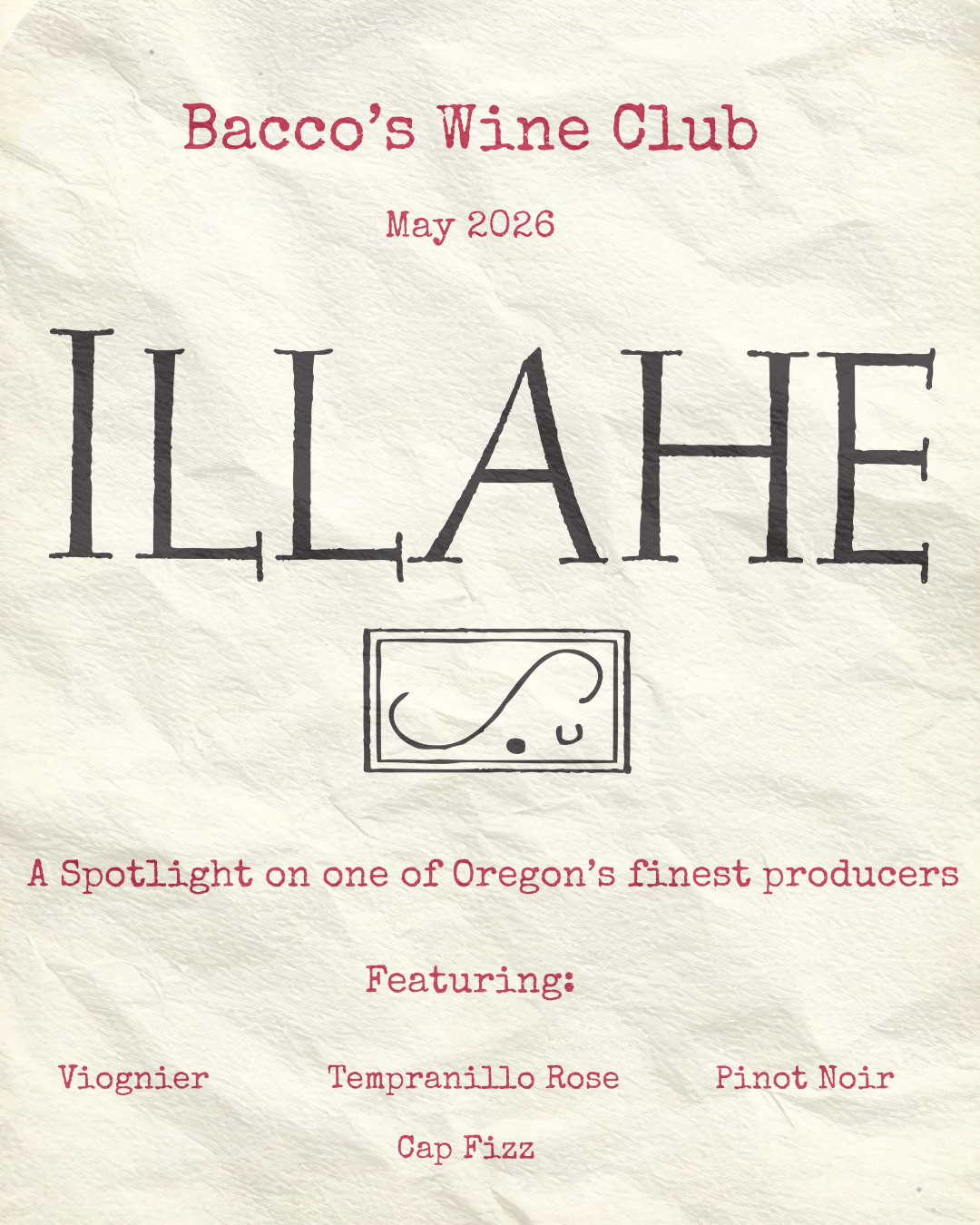
Bacco’s Wine Club May 2026
Growing Places: How a Cherry Farmer Remade the Edge of Willamette Valley
Oregon's Willamette Valley has been selling the same story for a while now: cool climate, elegant Pinot Noir, Burgundy's Pacific cousin. It's not a bad story. But it leaves out a lot of what's actually happening out there, and Illahe is a good example of what gets left out.
The vineyard starts with Lowell Ford, who made a trip to Germany and Austria in the late 1970s, fell in love with the white varieties he found there, came home, and got out of the cherry business. He started planting grapes on the family farm in West Salem — Grüner Veltliner, Müller-Thurgau, Pinot Gris — at a moment when Oregon wine meant one thing to most people, and that thing was Pinot Noir. The whites worked. Pinot Noir proved challenging at that site. So Lowell kept looking. In 2000 he bought an 80-acre property in Dallas, Oregon — a south-facing hillside on marine sedimentary soils over ancient volcanic bedrock — and began planting his Pinot vineyard. His son Brad, who had studied the Classics before turning to wine, made the first vintage in 2006.
They named the winery Illahe — Chinook for "earth," "place," or "soil" — because it felt like the Northwest word for terroir. That's a fair description of what they're after. The vineyard is dry-farmed and LIVE-certified, catches the Van Duzer corridor winds each evening off the Pacific, and is still run by the Ford family as a working farm. The spirit of experimentation Lowell brought back from Europe — plant what interests you, see what the site can do — never left.
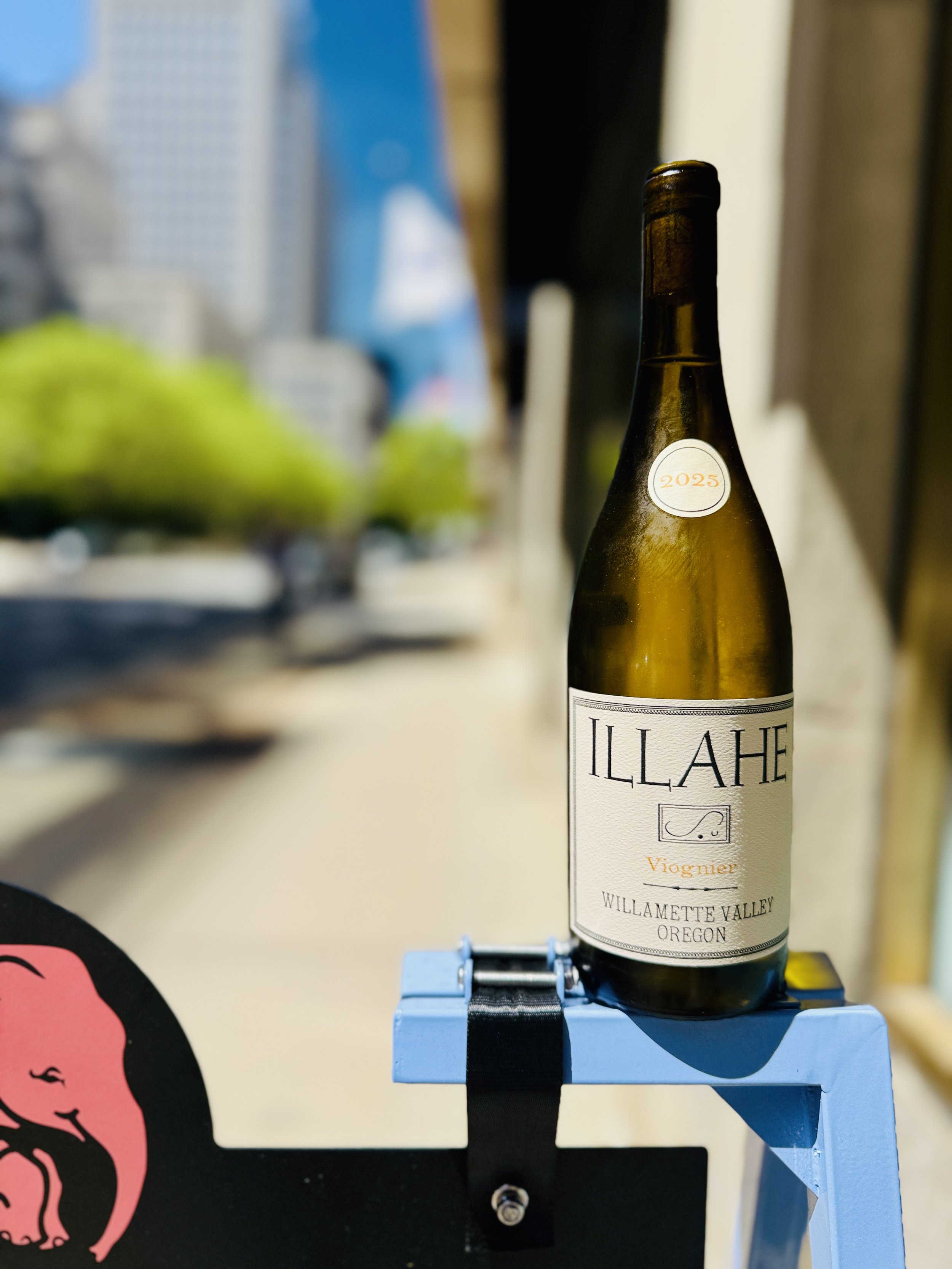
Illahe Viognier 2024
The Viognier 2024 is the hardest sell on paper and the easiest sell in the glass. Viognier is a minefield — it tips from floral and textural to flabby and overdone faster than almost any other variety. The Van Duzer winds keep enough acidity here to hold everything together: warm days push the fruit toward apricot and white peach, cool evenings keep the wine from losing its shape. The Viognier is destemmed and skin-soaked overnight before a cool ferment in stainless steel or neutral oak — no oak you'll notice in the finished wine, just generous texture and a little orange blossom thread that doesn't announce itself. If you know someone stuck between Pinot Grigio and something more interesting, this is where to point them.
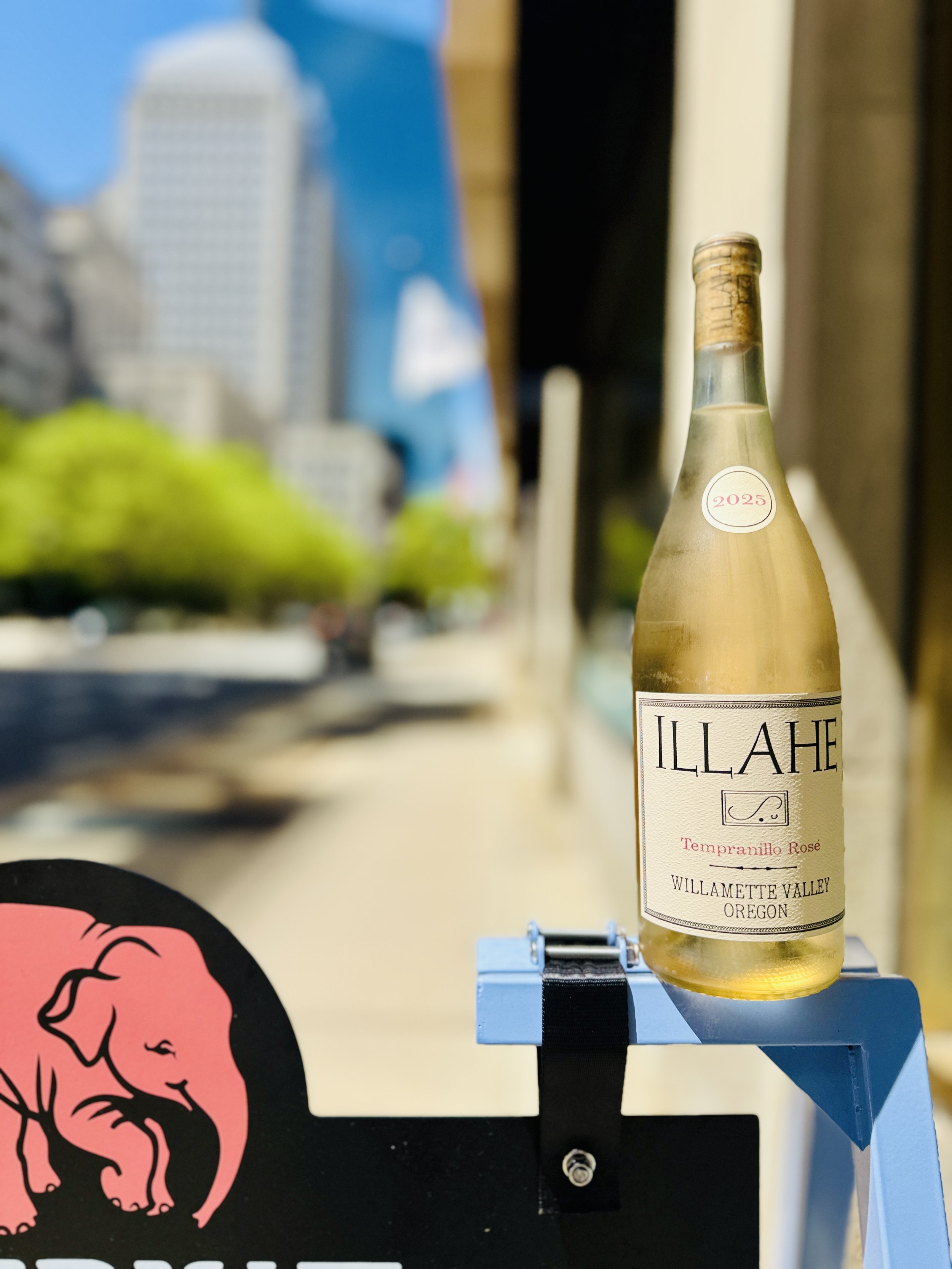
Pictured: Illahe Tempranillo Rose 2025
Illahe Tempranillo Rose
The Tempranillo Rosé 2025 is the pivot. The Tempranillo is pressed whole-cluster and fermented in neutral oak — a winemaking decision that keeps the grape's natural structure intact through the process. Tempranillo doesn't surrender its identity through a light press the way some varieties do; you get real weight, a savory mid-palate, a dry finish that doesn't disappear against food. Pale copper in the glass, built for a table rather than a porch. Charcuterie, grilled fish, roasted peppers. It bridges the white and the red without feeling like it's just filling a slot, and it exists because Lowell decided thirty years ago that this hillside could grow things Oregon wasn't supposed to grow
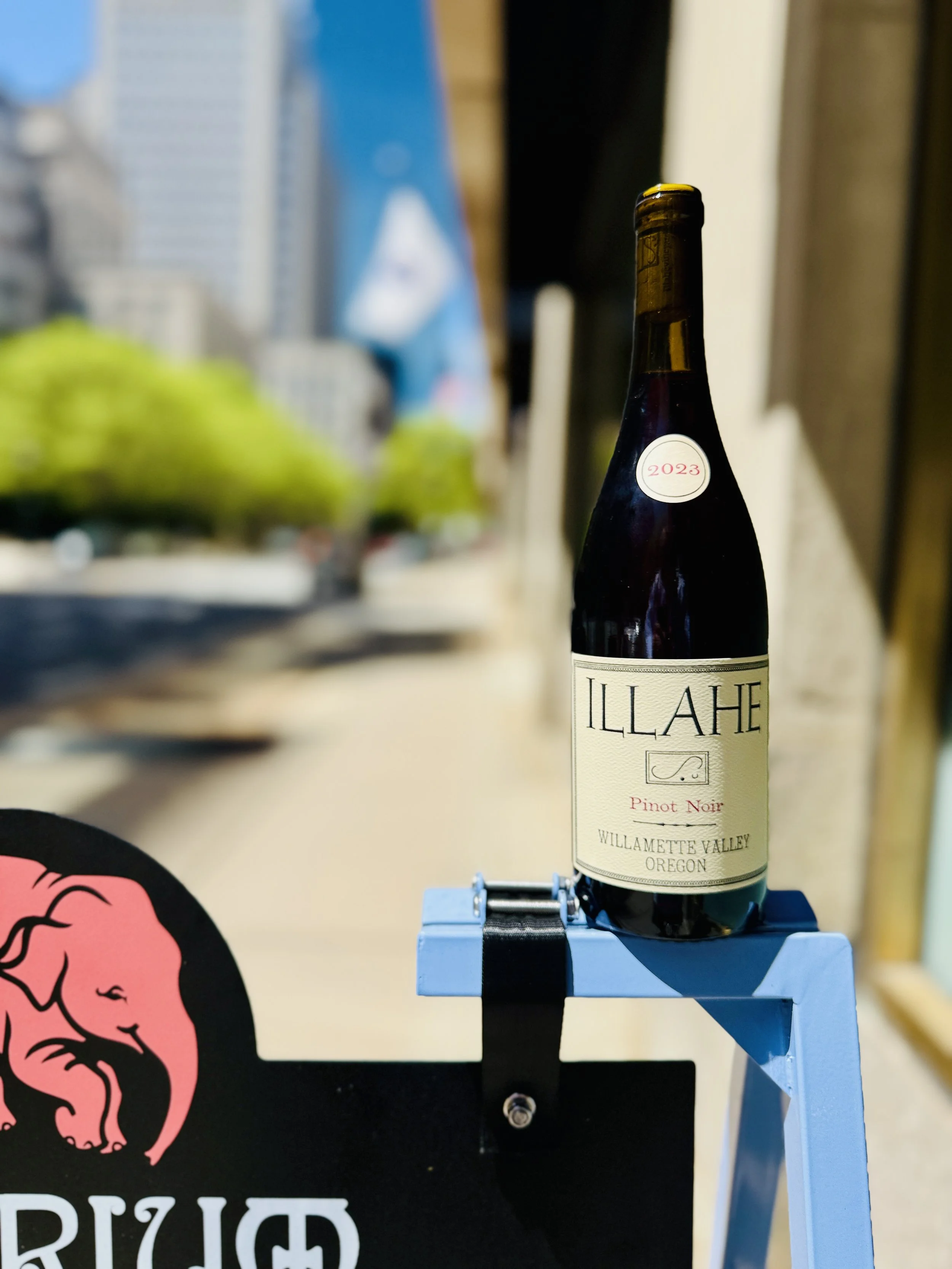
Pictured: Illahe Pinot Noir 2023
Illahe Pinot Noir
The Pinot Noir 2023 is where the story lands. When Brad took over the winery he had been to France and noticed the use of horses in the vineyard, something that wasn't happening to the same extent in Oregon. Illahe purchased a team of Percheron draft horses and began working with them to mow between the rows and bring fruit to the winery at harvest. That interest in working by hand deepened into something more deliberate. In 2011 Brad decided to make one wine — the 1899 Pinot Noir — using nothing that wouldn't have been available in 1899: no electricity, no stainless steel, no modern machinery. The wine is delivered to the distributor by mule-drawn stagecoach, canoe, and cargo bike on a 96-mile journey down the Willamette River. That wine isn't in your bag this month, but the philosophy behind it is in everything Illahe makes.
The 2023 Pinot is a different argument than the elegant, high-acid Willamette archetype — Polk County runs warm, 2023 ran warm, and the result is a Pinot with darker fruit and more apparent structure. Give it an hour open, serve it slightly cool, put it next to something with some fat. It has things to say and doesn't rush to say them.
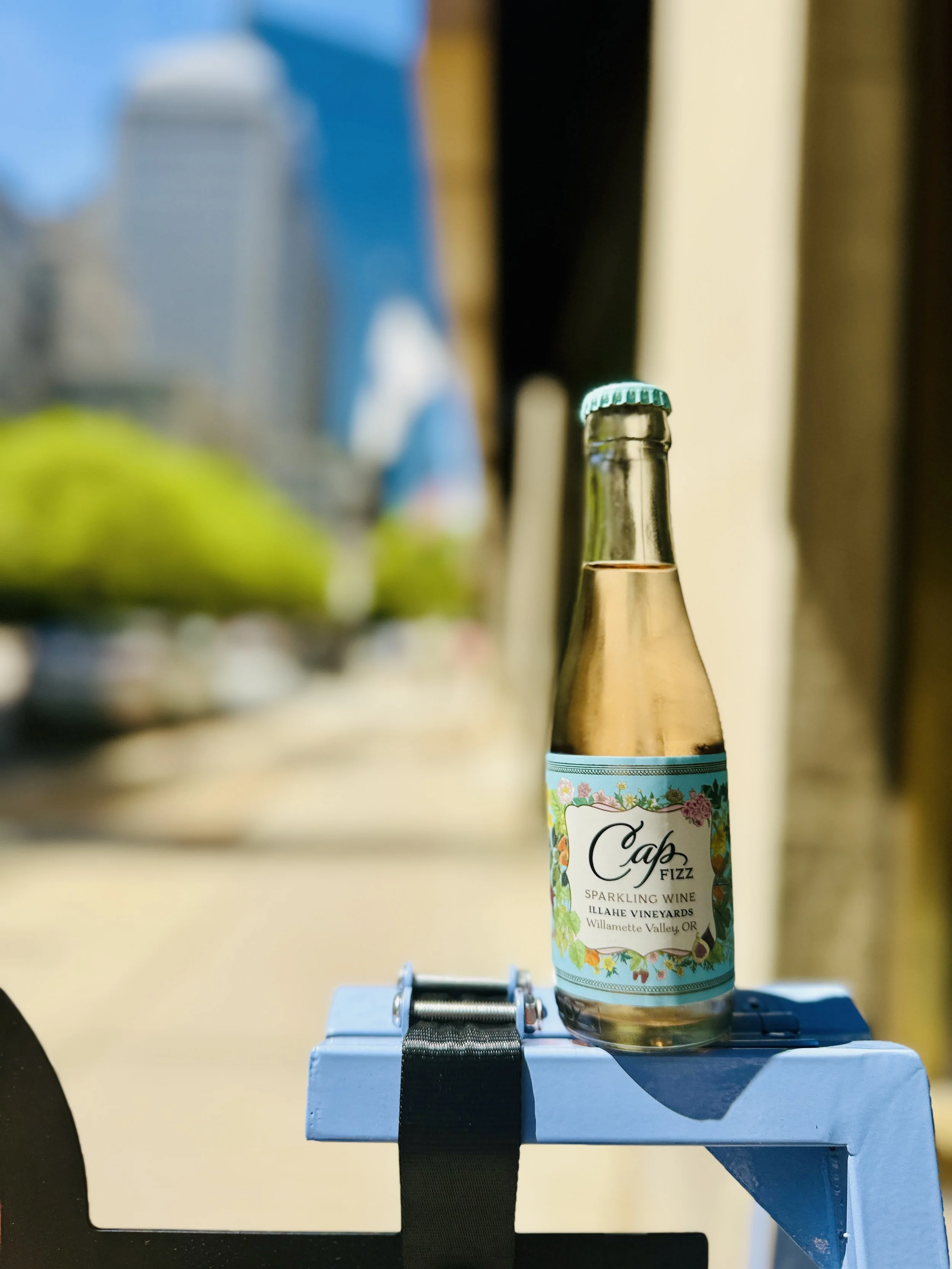
Illahe Cap Fizz
The Cap Fizz is a little bonus from me to you — Illahe's pét-nat, a tipple’s worth, meant for the moment before dinner when you need something in your hand. Drink it cold and immediately.
Bacco’s Wine Club April 2026
Back from the Brink:
Three Greek Grapes Rescued from Oblivion
The story of Greek wine in the twentieth century is mostly a story of forgetting. The industrial era arrived, and with it came pressure to plant varieties that yielded more, ripened faster, sold easier. The old grapes — the ones with names that didn't appear in any French textbook, the ones that had been growing on the same hillsides since antiquity — got pulled out. By the 1970s, a significant portion of Greece's indigenous viticultural heritage existed only in the memories of old farmers, or in a few neglected rows at the edges of vineyards that no one had gotten around to clearing yet.
This month's wine club is about three of those grapes. Not in a sentimental way. They're not in your bag because they survived — they're in your bag because, having survived, they turned out to be genuinely interesting.
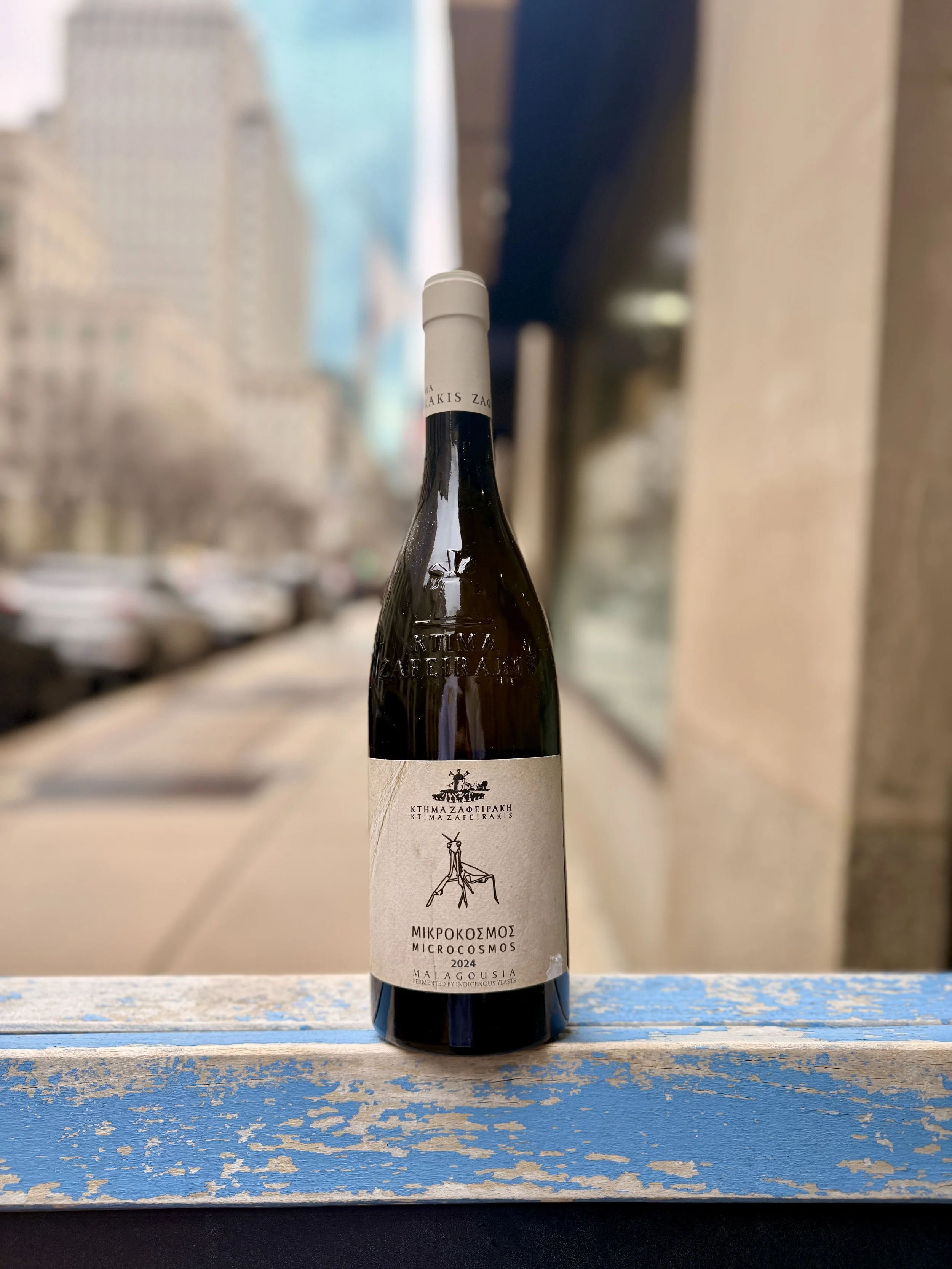
Zafeirakis Malagousia "Microcosmos" 2024 — Thessaly, Greece
Malagousia almost didn't make it. By the 1970s, it had been effectively abandoned across Greece, surviving only in a handful of old plots, its identity uncertain, its future nonexistent. A professor at the University of Thessaloniki named Vassilis Logothetis found some. He passed cuttings to a young student named Evangelos Gerovassiliou, who planted them at his estate in the Halkidiki Peninsula and, over the next two decades, quietly proved that this forgotten white grape could produce some of the most aromatic, distinctive wine in the country.
Today Malagousia is planted on roughly 7,500 acres across Greece. That's the full arc of rescue: near extinction to widespread cultivation in the span of forty years. The comeback story has been told.
What hasn't changed is how Malagousia smells. It's expressive in the way that Viognier or Gewürztraminer are expressive — orchard blossom, stone fruit, a floral quality that announces itself — but this bottling from Christos Zafeirakis is more restrained than those comparisons imply.
The Microcosmos comes from a single vineyard called Palaiomylos, "the old mill," on the slopes of Mount Olympus in Tyrnavos. The vines are approaching twenty years old. The soils are clay with a high flint concentration. It's certified organic, harvested in three passes, fermented with native yeasts, and bottled with minimal sulfur. The result is a wine with Malagousia's characteristic aromatics reined in by a cooler site — white peach, citrus blossom, a saline mineral thread, nothing blowsy about it.
Zafeirakis himself is worth knowing. He's a third-generation winemaker from Tyrnavos working on land his grandfather farmed, and his focus on the indigenous Thessalian varieties — Malagousia and Limniona — has made him one of the more closely watched producers in contemporary Greek wine.
Pictured: Fattoria Moretto Lambrusco Grasparossa di Castelvetro Secco
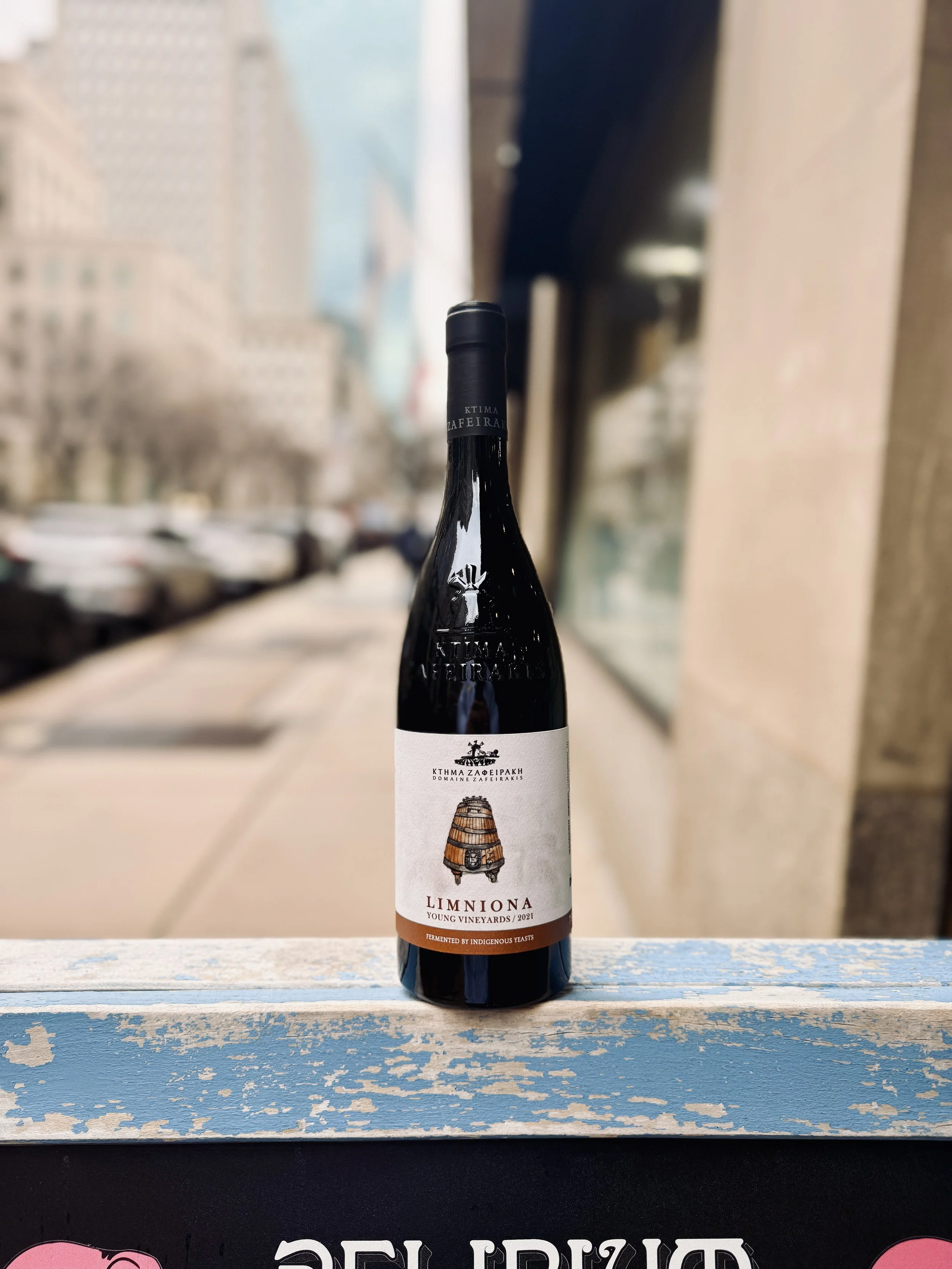
Zafeirakis Young Vines Limonia 2021 — Thessaly, Greece
If Malagousia's rescue was a gradual institutional effort, Limniona's is a more intimate story. This ancient red grape of Thessaly — possibly among the oldest cultivated varieties in Greece — had been reduced to a few elderly vines by the time a winemaker named Anastasios Ligas decided, in the 1990s, that it was worth saving. He located old plantings, propagated them, and eventually got Limniona back into commercial production. Without that single act of stubbornness, the grape almost certainly would have vanished.
What Ligas and, later, Zafeirakis proved is that Limniona is worth the effort. The grape produces a wine that gets compared to Pinot Noir in its structure and texture — medium-bodied, silky, perfumed, with red fruit, real acidity, and the kind of freshness that makes you reach for the glass again before you've quite registered doing it. The Zafeirakis Young Vineyards bottling comes from, as the name suggests, younger vines, and it has all the aromatic clarity and suppleness you'd expect from that — no rough edges, no austerity, just expressive, honest Thessalian red.
If the Malagousia is the approachable entry point into this club, the Limniona is the wine that makes you want to dig deeper.
Pictured: Claude-Emmanuel and Louis-Benoît Desvignes of Louis Claude Desvignes
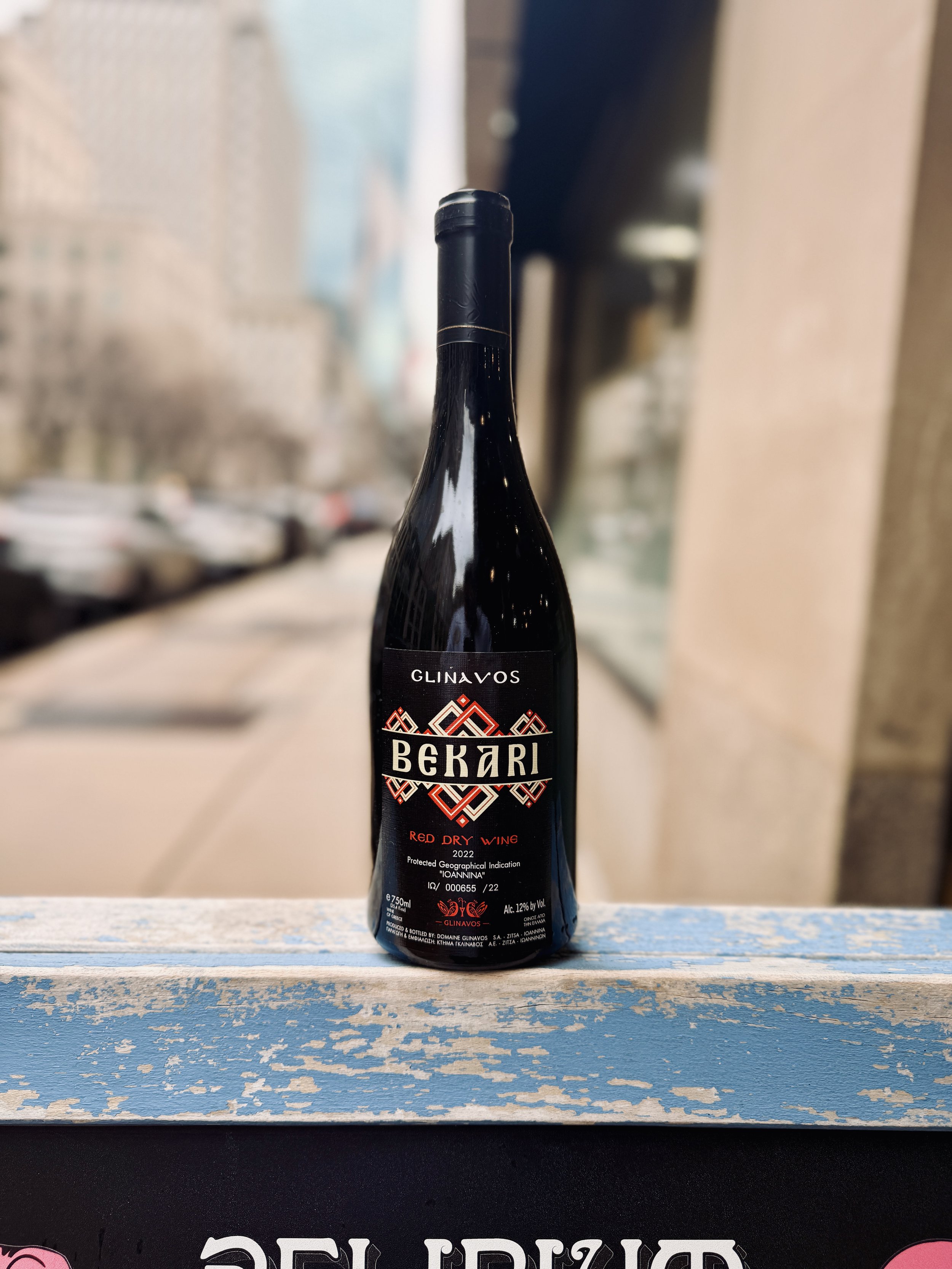
Glinavos Bekari 2022 — Epirus, Greece
The Zitsa PDO sits at 600 to 700 meters in the Pindus mountain range in northwestern Greece, on limestone slopes where the climate runs cold enough that reaching 12.5% alcohol is considered an achievement. This is not the Greece most people picture when they picture Greece. It reads more like the Alps than the Aegean — high, austere, shaped by elevation and cold winters and the kind of terrain that makes farming genuinely difficult.
Lefteris Glinavos founded his estate here in 1978 with a specific purpose: to revive the indigenous red varieties of Epirus, Vlahiko and Bekari, which had been reduced to bit players — blending grapes in Zitsa's traditional sparkling wines — and were in danger of disappearing altogether as a standalone varietal expression. He brought them back. The domaine is now entering a new chapter under his son Thomas, and recently came under the winemaking supervision of Apostolos Thymiopoulos, one of the most respected names in contemporary Greek wine.
Lord Byron stopped in Zitsa in 1809, on his first journey through Greece. He praised the wine, which tells you the tradition here is older than the crisis that nearly ended it.
The Bekari is 100% Bekari grape — the rarer expression, vinified separately from the Vlahiko. It's de-stemmed, fermented in oak vats for twelve days, and bottled dry. The profile is lighter-bodied than the geography might suggest: plum, dark berries, bright acidity, lacy minerality. The limestone and cold nights give it structure without weight. It's a wine that rewards a moment of attention. People lean forward when you explain it, and the wine earns that interest.
Three grapes that almost didn't survive. Three winemakers, across two generations, who decided that was unacceptable.
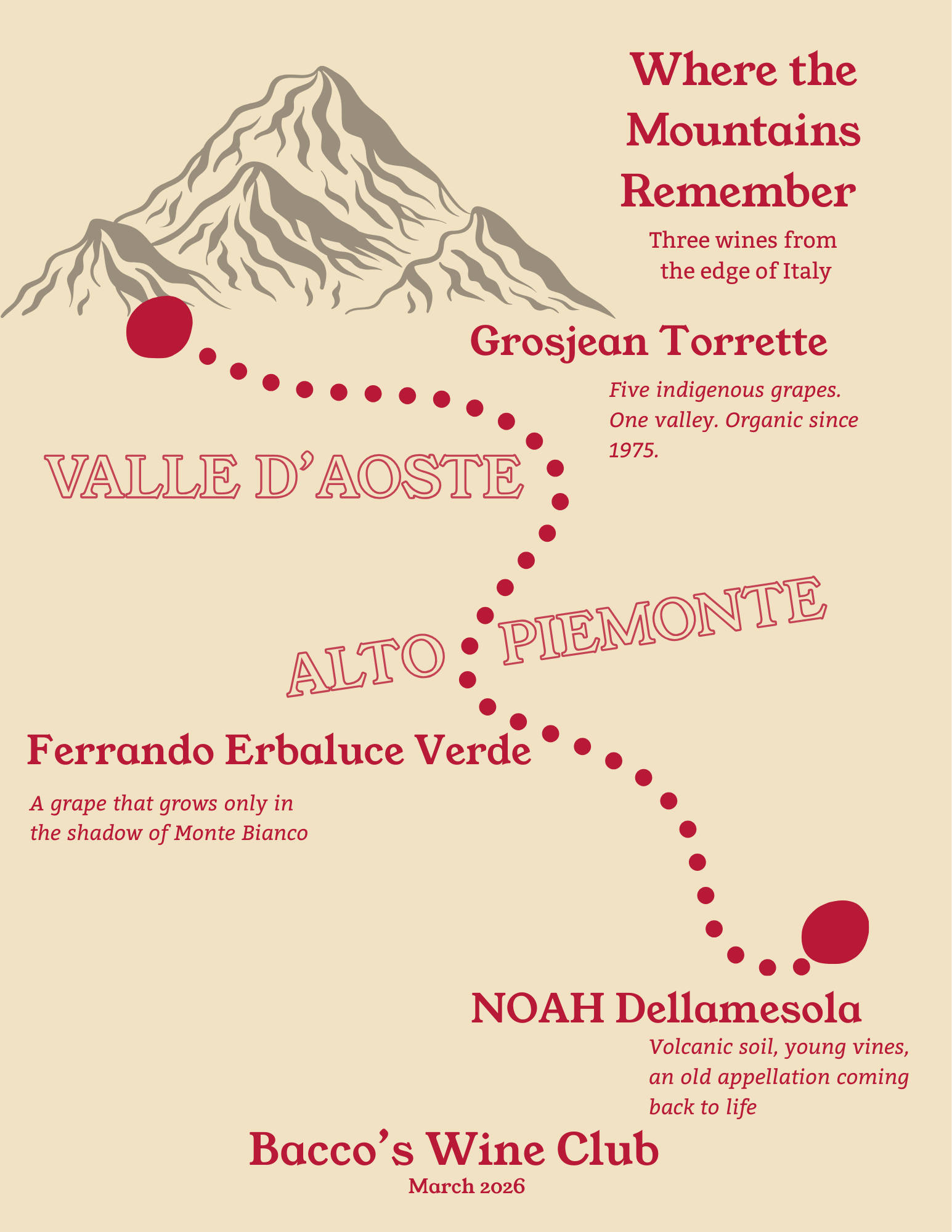
Bacco’s Wine Club March 2026
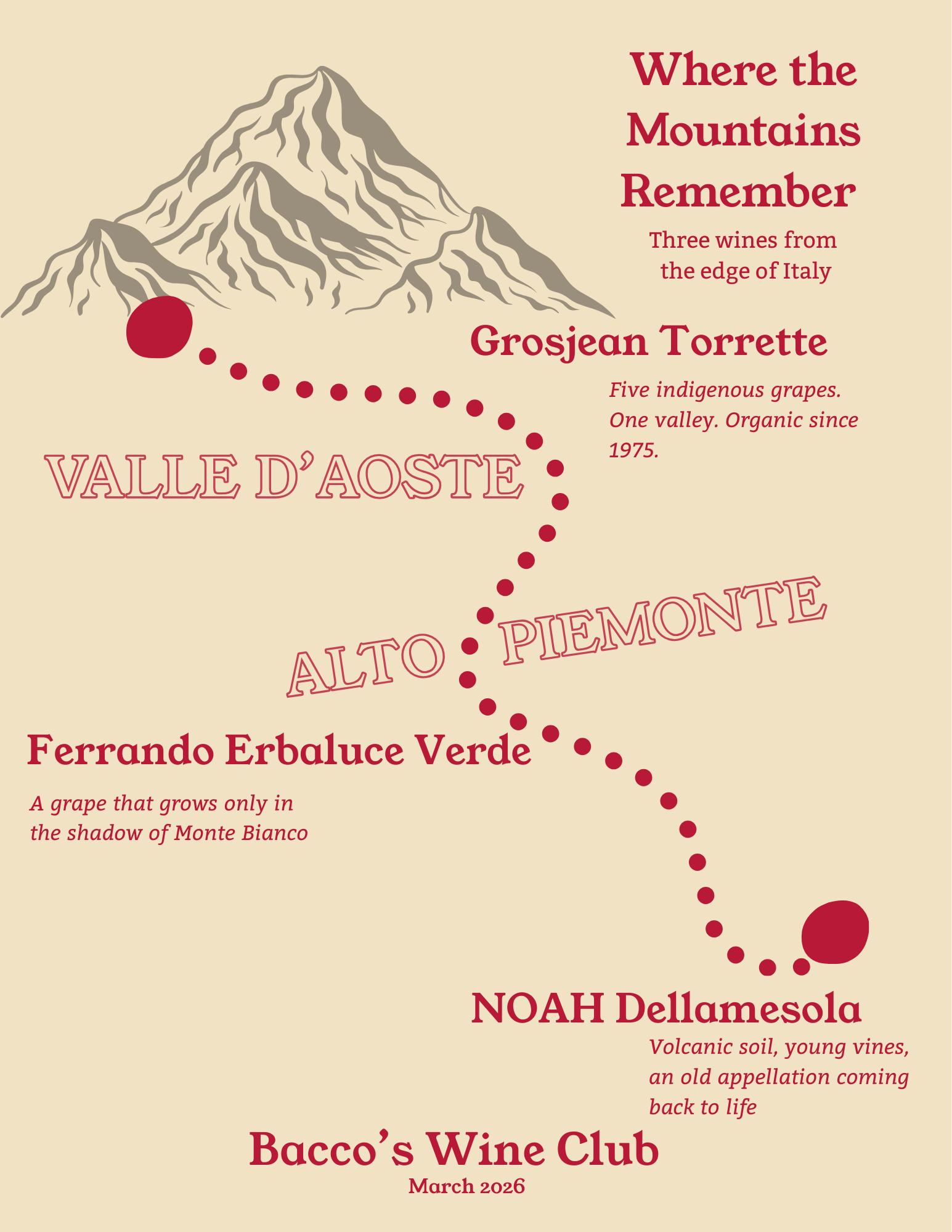
Where the Mountains Remember:
Three Wines from the Edge of Italy
If you drive north through Piedmont long enough, the landscape begins to betray its own reputation. The manicured slopes of the Langhe—those photogenic, world-famous vineyards that bankroll the region’s mythology—fall away behind you. The hills steepen. The air sharpens. Stone walls appear along the roadsides, ancient and irregular, built by people who understood that farming here was not an investment but an argument with gravity.
This is Alto Piemonte and the Valle d’Aosta: the northernmost edge of Italian wine, where the Alps press down so close that vineyards grow in the literal shadows of Monte Bianco and Gran Paradiso. It is a place that most of the wine world forgot for the better part of a century, and where the people who stayed—or who chose to come back—did so out of something more stubborn than ambition. It is, in other words, exactly the kind of place we go looking for.
This month’s three wines come from this territory. They arrive through Rosenthal Wine Merchant, Neal Rosenthal’s four-decade-old importing house in New York, which has made a quiet career of finding exactly these producers—the ones who farm impossibly steep terrain, who work with grapes no one else bothers with, and who make wines that could not plausibly come from anywhere else on Earth. Rosenthal does all his work on a handshake. He has never signed a contract with a supplier. The Ferrando family, whose Erbaluce opens this month’s selection, was the very first estate he imported back in January of 1980, when Carema and Erbaluce were names unknown to virtually anyone who didn’t live within fifty kilometers of Turin.
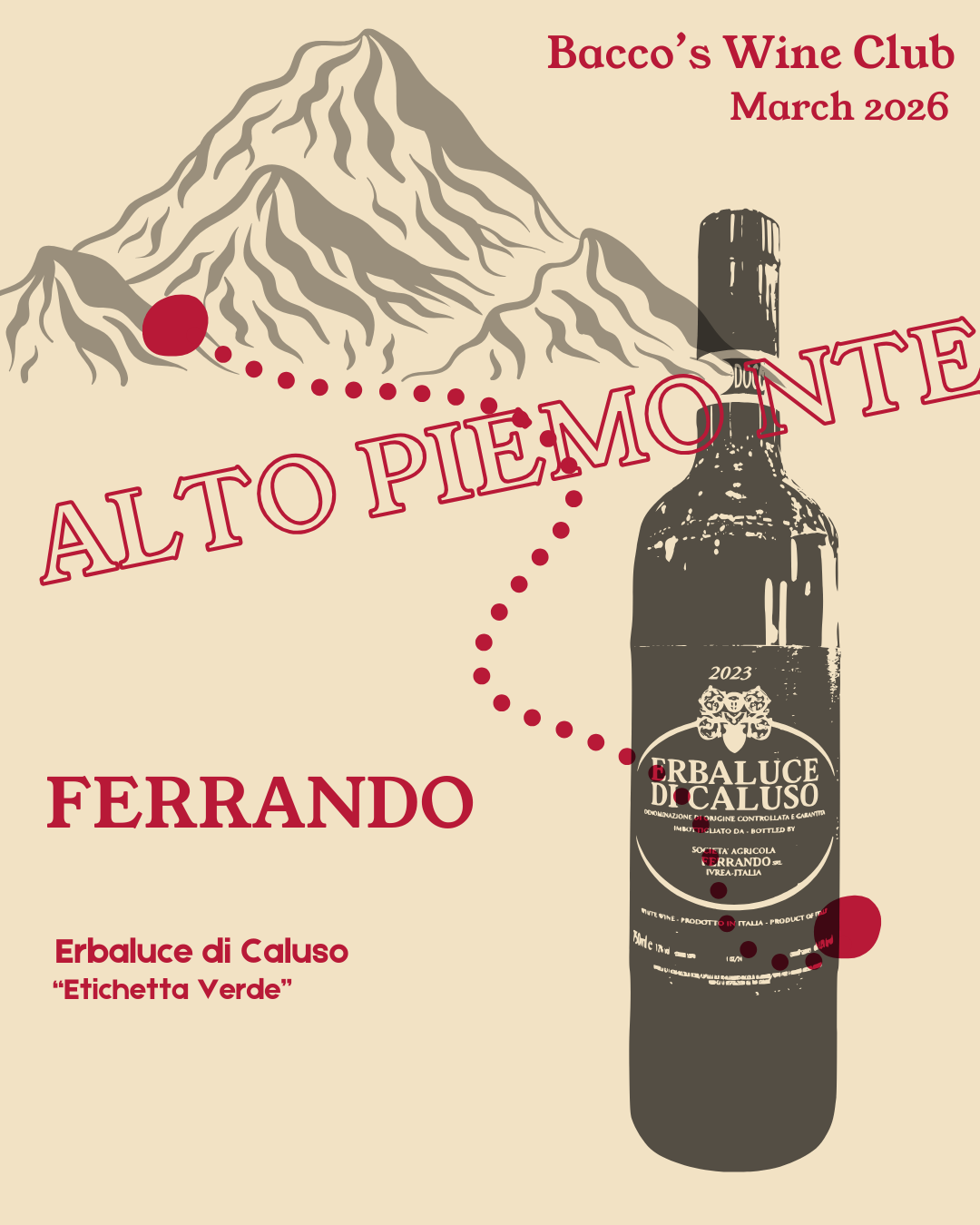
Ferrando Erbaluce di Caluso “Etichetta Verde” (Cascina Cariola) 2023
The Ferrando family has been making wine since 1890, when the first Giuseppe Ferrando arrived in the town of Ivrea from Acqui with the intention of introducing Piedmontese wines to the Valle d’Aosta. Five generations later, Roberto Ferrando—who his father Luigi once said carries the whole weight of the operation on his shoulders—continues to farm Nebbiolo on the vertiginous terraces of Carema and Erbaluce on the morainic plains of Caluso, about forty-five minutes north of Turin.
The Erbaluce grape is an ancient white variety that exists only in this alpine corner of Piedmont. It cannot be successfully cultivated anywhere else—not for lack of trying, but because its particular genius is calibrated to a very specific set of conditions: sandy, calcium-poor, morainic soils descended from the crystalline massifs of Monte Rosa and Monte Bianco; the wide diurnal temperature swings of the Canavese; and the long, slow autumns that allow harvest to stretch into October without sacrificing the grape’s natural, almost architectural acidity.
Ferrando Erbaluce di Caluso “Etichetta Verde” (Cascina Cariola) 2023 comes from a single vineyard in the village of Piverone. Around six thousand bottles are produced each year, of which the American market sees fewer than half. Fermented in stainless steel at controlled temperatures, bottled nine to twelve months after harvest, then held further before release—the wine is an exercise in transparency. It is bright and floral, with a mineral spine that owes everything to those ancient glacial soils. You sense citrus peel, white stone fruit, something almost saline on the finish. It is the kind of wine that makes you reconsider what Italian white wine can be when it isn’t trying to be anything other than a perfect expression of where it was grown.
At the table: This is a wine that loves simplicity. A plate of burrata with good olive oil and flaky salt. Seared branzino with lemon and capers. Risotto with spring peas. The acidity is the engine here—it cuts through richness without overpowering delicate flavors, which makes it an unexpectedly versatile dinner wine. If you keep any of our Italian tinned fish on hand, this is its ideal companion.
The Nitty Gritty:
Country: Italy
Region: Piedmont
Subregion: Caluso, Canavese (Alto Piemonte)
Farming: Traditional, low-intervention
Soil: Morainic, sandy, calcium-poor — glacial deposits from the Monte Rosa, Monte Bianco, and Gran Paradiso massifs
Varietal: 100% Erbaluce
Elevation: Alpine foothills of the Canavese
Style: Bright, mineral, high-acid alpine white
Production: Single vineyard (Cascina Cariola, Piverone). ~6,000 bottles/year. Stainless steel fermentation, bottled 9–12 months after harvest. Fifth-generation family estate, founded 1890.
Pictured: Fattoria Moretto Lambrusco Grasparossa di Castelvetro Secco
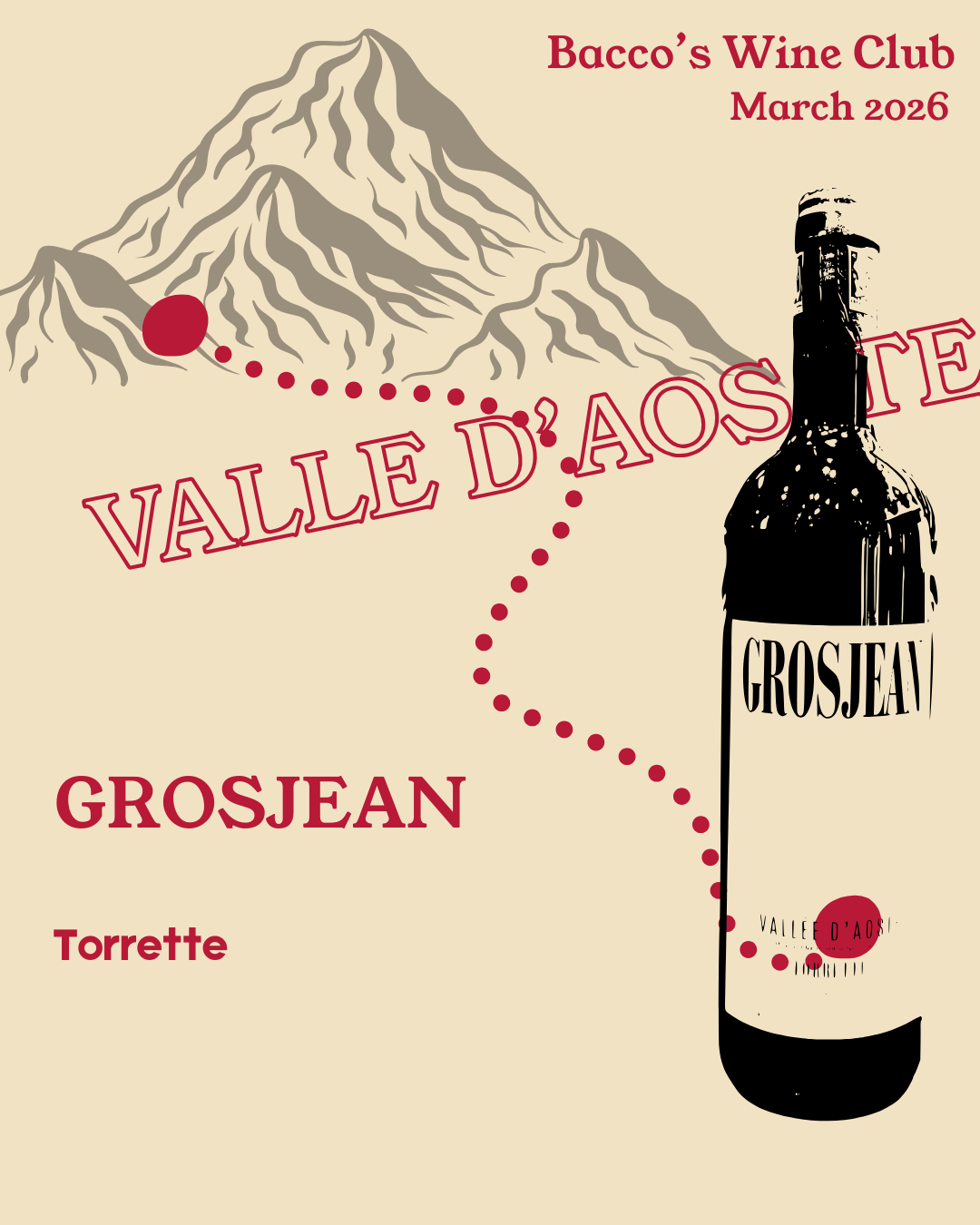
Grosjean Torrette Valle d’Aosta 2023
Cross the border into the Valle d’Aosta—Italy’s smallest wine region, a long, narrow valley carved by the extreme northwestern Alps—and the scale of everything contracts. The vineyards are smaller, steeper, more precarious. The grape varieties are ones that even serious wine people may never have encountered: Petit Rouge, Fumin, Cornalin, Vien de Nus, Premetta, Mayolet. They are indigenous to this valley and essentially nonexistent beyond it. The word used here is “heroic” viticulture, which is not a marketing term but a bureaucratic designation acknowledging the physical extremity of the farming. Everything is done by hand. There is no alternative.
The Grosjean family traces its roots to the village of Fornet, high in the mountain passes of the Valgrisenche—a village now buried under the waters of the Beauregard dam. They raised cattle. During the summers, they came down to lower altitudes to cultivate grapes and chestnuts, stocking up on wine to last the long winters. In 1969, Dauphin Grosjean—the patriarch, and yes, that is his real name—was persuaded by a friend to present his wine at a local exposition. The quality was immediately recognized, and it changed the direction of the family. His five sons—Vincent, Giorgio, Marco, Fernando, and Eraldo—each took on a role in the expanding estate. Today, the third generation—Hervé, Didier, Simon, and Marco—runs the operation from the hamlet of Ollignan, on the border of Quart and Saint Christophe.
They have been farming organically since 1975—a full thirty-six years before they received official certification in 2011, making them the first certified organic estate in the entire Valle d’Aosta. No pesticides, no herbicides, only organic fertilizers. Indigenous yeasts for fermentation. Neal Rosenthal, who has visited this valley for decades, once wrote of the region: “There’s nothing better in the world than these valleys.” The Grosjeans quote him on their own website, which tells you something about the nature of the relationship.
Grosjean Torrette Valle d’Aosta 2023 is a blend built around Petit Rouge—about eighty percent—with smaller portions of Vien de Nus, Fumin, Cornalin, and Mayolet: a coalition of indigenous grapes that, taken together, offer a miniature portrait of the valley itself. The vineyards sit between 550 and 650 meters above sea level, trained in the Guyot system and draped down the terraced hillside. The wine is aged in both stainless steel and oak casks. It is charming when young—snappy red fruit, a line of crushed-rock minerality, high acidity that keeps everything vibrant—but it deepens with time. The traditional pairing is Fontina cheese and cured meats, which is to say, the food that the people who make this wine actually eat
At the table: Think Alpine comfort food. Fontina melted over polenta. A board of our cured meats—bresaola, coppa, lardo—with rye crackers. It’s also a beautiful match for roasted chicken with herbs, or a hearty minestrone on a night when March is still acting like winter. Serve it with a slight chill—fifteen minutes in the fridge before opening—and the fruit lifts right off the glass.
The Nitty Gritty:
Country: Italy
Region: Valle d'Aosta
Subregion: Quart / Saint Christophe
Farming: Certified organic (Ecocert, 2011 — practicing since 1975)
Soil: Sandy, shallow depth, abundant stone residue
Varietal: Petit Rouge 80%, Vien de Nus, Fumin, Cornalin, Mayolet
Elevation: 550–650m, terraced hillside
Style: Alpine red, bright acidity, crushed-rock minerality
Production: Indigenous yeast fermentation. Aged in stainless steel and oak casks. First certified organic estate in the Valle d'Aosta. Third-generation family estate, founded 1969.
Pictured: Claude-Emmanuel and Louis-Benoît Desvignes of Louis Claude Desvignes
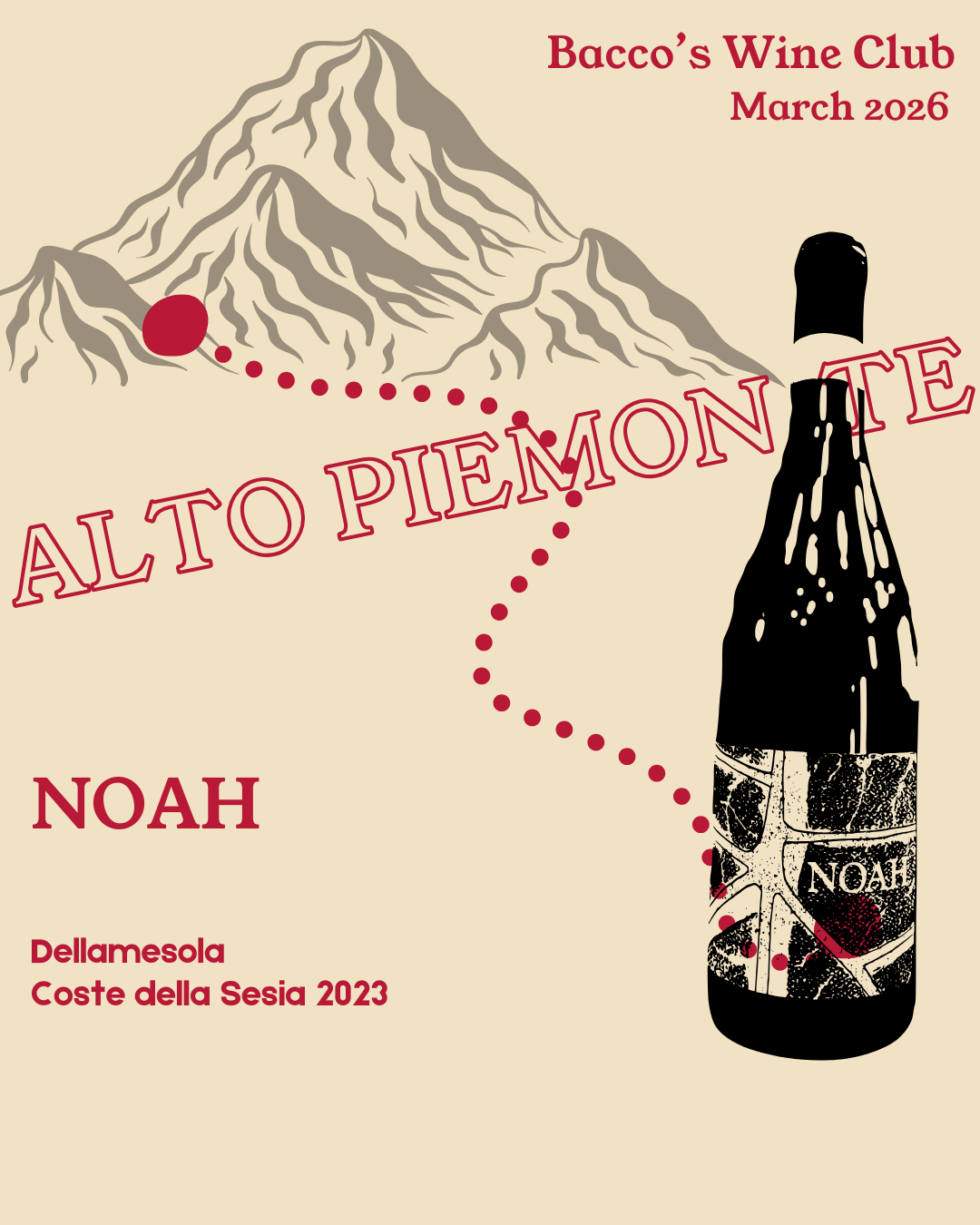
NOAH “Dellamesola” Coste della Sesia 2023
Andrea Mosca was an architect. He gave it up. About fifteen years ago, he and his wife, Giovanna Pepe Diaz, bought just under five hectares of vineyard in and around the village of Brusnengo, in the heart of the Bramaterra appellation, and named the project after their son, Francesco Noah. They are renovating a farmhouse there. They make wine. That is the story, and it is both simple and representative of something much larger happening across the Alto Piemonte.
Before the Second World War, the Alto Piemonte was one of the most important wine regions in Italy. Then the factories came—the industrial boom of the postwar years drew workers out of the hills and into the cities—and the vineyards were abandoned. For decades, the terraces crumbled and the vines went wild. Only recently has a younger generation begun returning, drawn by the realization that what was left behind was not a ruin but an inheritance. The word “Bramaterra” itself is believed to come from the Italian “bramare la terra”—to long for the land. It is a tiny appellation, roughly twenty-eight hectares spread across several communes, with no more than a handful of active producers. The soil is red volcanic porphyry, which gives the wines a mineral intensity that distinguishes them from the marine sands of neighboring Lessona.
Rosenthal has been with NOAH since the beginning, adding the estate in 2015 and importing every vintage since the debut 2011 bottling. Andrea’s approach is traditional and low-intervention: indigenous yeasts, aging in large neutral Slavonian oak, minimal sulfur. The oldest Croatina vines on the property are seventy years old and trained in the local maggiorina trellising system. Everything is harvested by hand between late September and late October.
NOAH “Dellamesola” Coste della Sesia 2023 takes its name from Andrea’s particular zone of Brusnengo. It is a blend of Nebbiolo—the majority—with Vespolina and Croatina, aged for a year in large Slavonian oak and bottled with minimal sulfur. If the Bramaterra is the estate’s serious, long-aging statement, the Dellamesola is its friendlier introduction: open-knit, built around a core of vivid dark red fruit and a subtle floral character, with the volcanic mineral thrust of Bramaterra delivered on a more immediately luscious frame. It is the kind of wine that makes you understand, in a single glass, why people are paying attention to the Alto Piemonte again—and why some of Piedmont’s most notable producers from the Langhe have begun investing in the area, sensing that the momentum is only beginning.
At the table: This is your Sunday red. Braised short ribs. A slow-cooked ragù over pappardelle. Aged hard cheeses—Piave, Parmigiano, pecorino. It has the tannic structure to stand up to rich, meaty dishes but enough freshness that it won’t flatten a simple bowl of pasta with tomato sauce. Decant it for twenty minutes if you can wait that long.
The Nitty Gritty:
Country: Italy
Region: Piedmont
Subregion: Brusnengo (Alto Piemonte, Bramaterra zone)
Farming: Organic-leaning, minimal intervention
Soil: Red volcanic porphyry
Varietal: Nebbiolo 80%, Vespolina 10%, Croatina 10%
Elevation: Rolling volcanic hills of the upper Piemonte
Style: Medium-bodied, volcanic mineral, floral, traditional Alto Piemonte
Production: Indigenous yeasts, aged 12 months in large neutral Slavonian oak botti. Minimal sulfur. Hand-harvested. Estate founded 2010
What connects these three wines is not a grape variety or a single appellation but a shared geography of extremity—altitude, slope, cold—and a shared insistence on specificity. The Ferrando Erbaluce could not come from anywhere but the morainic hills of Caluso. The Grosjean Torrette could not come from anywhere but the high terraces above Quart. The NOAH Dellamesola could not come from anywhere but the volcanic soils of Brusnengo. In a wine market increasingly organized around familiar names and interchangeable flavors, these are wines that resist abstraction. They taste like places. They taste like the decisions of particular families to stay, or to return, or to start over on land that most people had written off.
Neal Rosenthal once described his philosophy in a single line: “I want to know where these grapes came from.” That impulse—not for brand recognition or critical scores, but for origin, for the irreducible specificity of a place—is what brings wines like these into a shop like ours. The mountains of northern Italy have been making wine for over two thousand years. The pergola trellising in Carema dates to the Roman legions. The Grosjean family has been in the Valle d’Aosta for four centuries. What’s new is that you can drink the wines here, in Boston, this month, and that someone thought you’d want to.
We did. We do.
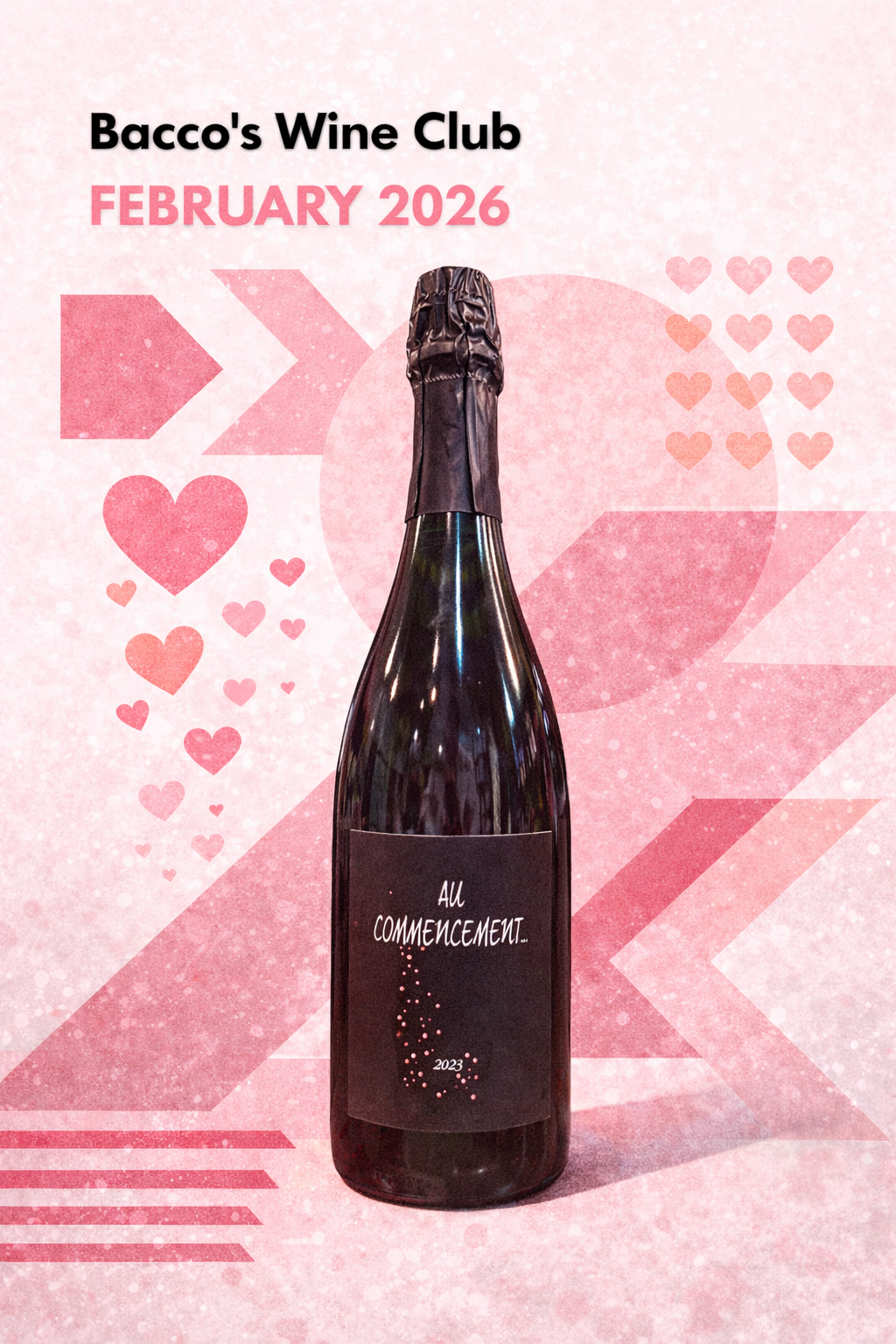
Bacco’s Wine Club February 2026
"Love Stories: A Valentine's Wine Club"
This February, we're celebrating love in all its forms: the love between partners who build dreams together, the love passed down through generations, and the love affair between winemaker and land.
These three bottles tell three love stories—from a secret Umbrian estate built by a couple who left everything behind, to alpine vineyards tended by husband and wife for seven generations, to a passionate Finger Lakes partnership proving that love conquers all (even difficult grapes).
Pour a glass. Share with someone you love. Toast to beginnings, partnerships, and the passion that makes great wine possible.
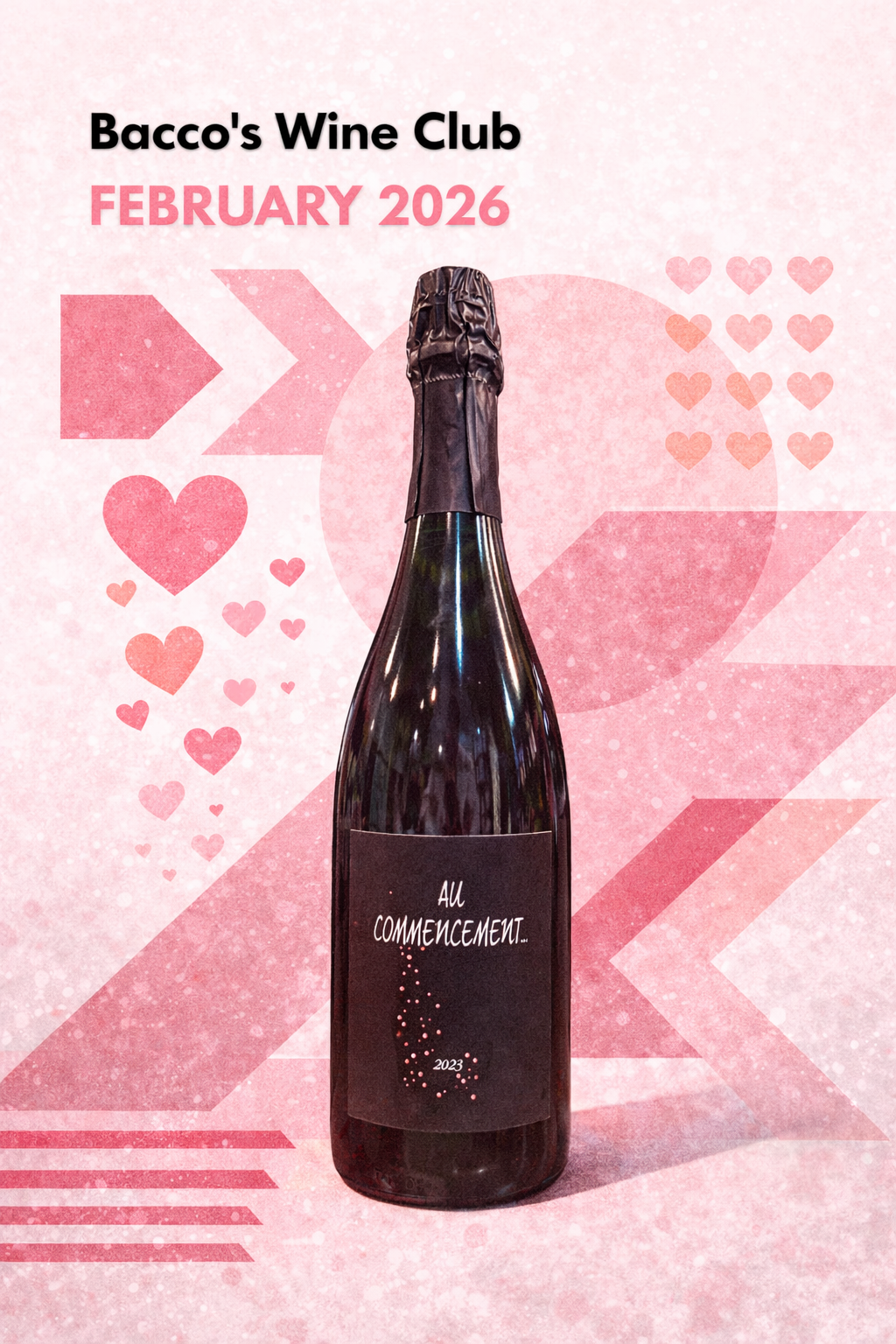
Pictured: Renardat-Fache Au Commencement
Renardat-Fache - Bugey-Cerdon ‘Au Commencement’ 2023
Au Commencement—"In the Beginning."
The name alone tells you what this wine is about: new starts, first loves, and the kind of leap that changes everything. For Elie and Christelle Renardat, that beginning happened generations ago, but they tend it every day.
The Renardat family has farmed the alpine foothills of Bugey, tucked between Lyon and Geneva, for seven generations. This is France's overlooked corner—too small for fame, too remote for trends, and too devoted to place to care. The Bugey region is wet, cool, and difficult, the kind of terroir that punishes shortcuts and rewards patience. The Renardats farm organically and biodynamically, not because it's fashionable, but because it's how their grandparents did it, and their grandparents before them.
Elie and Christelle work the vineyards together, husband and wife in constant conversation with the land. Their estate is tiny—just three hectares of old-vine Gamay, Poulsard, and Chardonnay—but what comes from it is something rare: wines that taste like the place they're from, made by people who love that place enough to never leave.
Au Commencement isn't made every year. Production is minuscule, released only in vintages deemed worthy. It's a drier, more structured wine than their famous Cerdon du Bugey rosé—a blend of Gamay and Poulsard fermented naturally using the méthode ancestrale. The 2023 vintage was a response to hardship: after difficult weather in 2024, the Renardats chose to bottle what they had with care rather than force what wasn't there. That restraint is love, too.
Chilled and poured into a glass, Au Commencement tastes like alpine mornings: bright, brisk, alive. It's the kind of wine that reminds you why people fall in love with this work in the first place.
The Nitty Gritty:
Country: France
Region: Bugey-Cerdon
Farming: Organic and Biodynamic (certified)
Soil: Alpine foothills, limestone-influenced
Varietal: 50% Gamay, 50% Poulsard
Method: Méthode ancestrale (natural sparkling)
Production: Not made every year; minuscule production
Style: Dry, structured, lightly sparkling
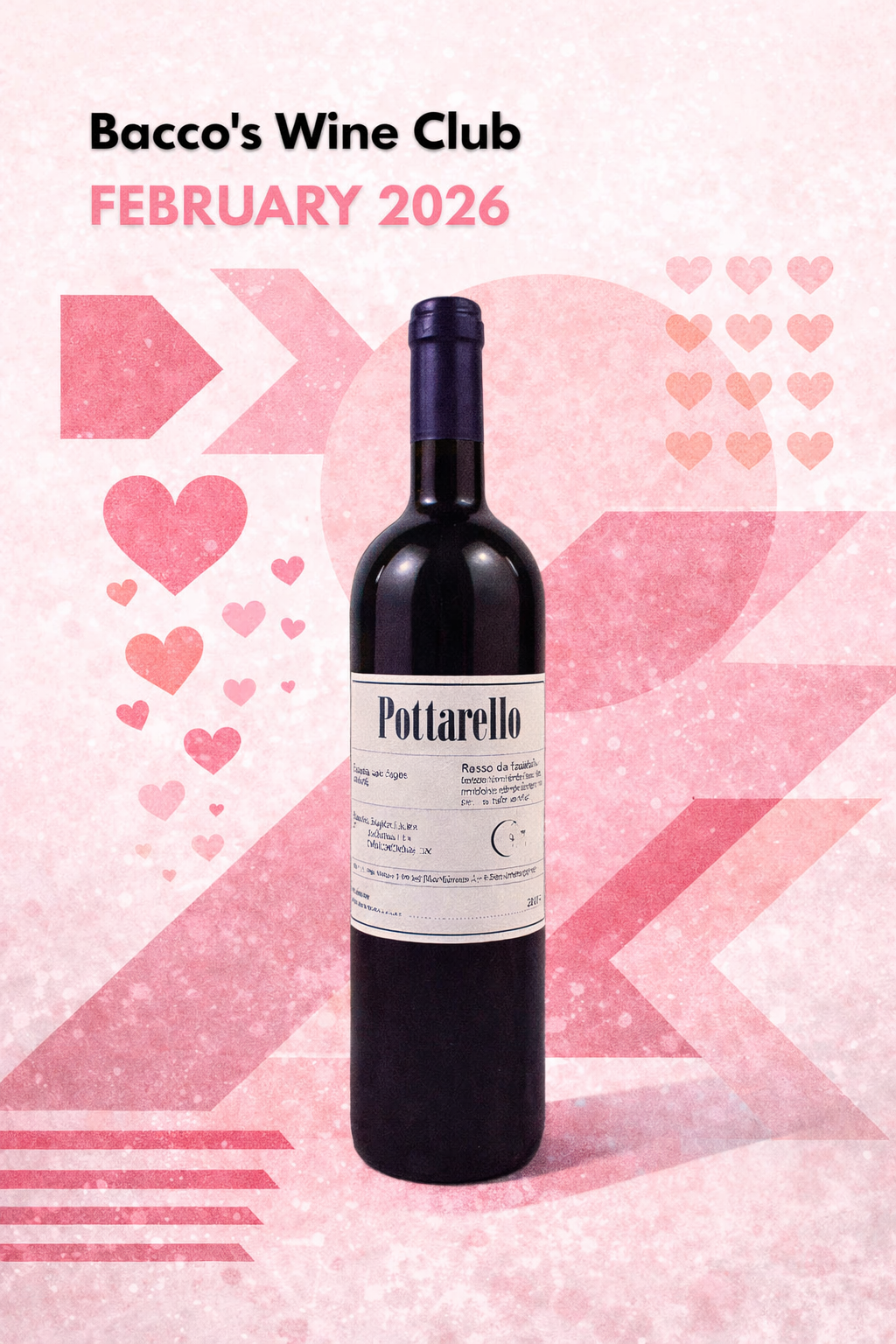
Pictured: Fattoria Moretto Lambrusco Grasparossa di Castelvetro Secco
La Segreta - Pottarello Umbria Rosso 2021
Some love stories begin with a question: What if we left everything behind?
For Lorenzo de Monaco and Eileen Holland, that question became a reality in 2009. Lorenzo, born in Italy, had built a life in Boston running Italian bike tours. Eileen, a native Bostonian drawn to art history and the classical world, had already spent time at the Peggy Guggenheim Museum in Venice. But the pull of something deeper—a life rooted in land, tradition, and purpose—brought them to a hidden corner of Umbria, between Todi and Perugia.
They called it La Segreta—"the secret." And it was: a 70-acre nature preserve surrounded by the Tiber River Valley, untouched and overlooked, accessible only if you already knew it was there. No GPS could find it. That remoteness became the point. They purchased the land, moved their family, and began the slow work of building something together: restoring old farmhouses, planting vineyards in 2008, and learning to make wine from scratch.
The estate produces just a handful of wines, each named by the local dialect: Cinino ("little one"), Pottarello ("kid" or "rascal"), and Marmocchio ("rascal"). The Pottarello—their middle wine—comes from younger Sangiovese vines but loses nothing in seriousness. Hand-harvested, naturally fermented, and aged in French oak, it's a wine of grip and earth, built for the table and for patience.
What makes La Segreta remarkable isn't scale or fame—it's the love that built it. A couple who chose each other, chose this land, and chose to stay. The wine tastes like that choice: honest, grounded, and made for sharing.
The Nitty Gritty:
Country: Italy
Region: Umbria
Subregion: Todi DOC
Farming: Organic (certified)
Soil: Clay, mineral-rich
Elevation: 300 meters
Varietal: 80% Sangiovese, 10% Malvasia Nera, 10% Colorino
Aging: 12 months in French oak (mostly used tonneaux), 9 months in bottle
Production: Hand-harvested, natural fermentation

Pictured: Claude-Emmanuel and Louis-Benoît Desvignes of Louis Claude Desvignes
Love doesn't always look like romance. Sometimes it looks like belief—stubborn, singular, and willing to prove the world wrong.
Forge Cellars is a partnership born of that belief: the conviction that the Finger Lakes, carved by glaciers and shaped by deep, cold water, could produce Pinot Noir worthy of Burgundy's attention. Not imitation Burgundy. Not "New World" fruit bombs. But something real, rooted, and alive with place.
The partnership began with Rick Rainey and Louis Barruol, two winemakers who saw what others hadn't: that the steep slopes around Seneca Lake—with their shale, limestone, and glacial till—shared something fundamental with the great sites of Europe. The lakes themselves act as thermal regulators, cooling the vineyards in summer and moderating winter's bite. The result is a long, slow-growing season that gives Pinot Noir time to develop complexity without losing its spine.
Forge Cellars works with some of the Finger Lakes' most promising vineyards, farming sustainably and intervening minimally. The Classique Pinot Noir is their vision distilled: cool-climate elegance, mineral-driven structure, and a transparency that lets the vintage speak. There's red fruit here—cherry, cranberry, wild strawberry—but it's framed by stone, earth, and a fine-boned acidity that makes you reach for another glass.
This is a wine made by people in love with a place that most of the wine world still overlooks. That love is an act of defiance, and it tastes like the future.
The Nitty Gritty:
Country: United States
Region: Finger Lakes, New York
Subregion: Seneca Lake
Farming: Sustainable
Soil: Glacial till, shale, limestone
Varietal: 100% Pinot Noir
Elevation: Steep lakeside slopes
Style: Cool-climate, mineral-driven, Burgundian in spirit
Production: Small-lot, minimal intervention
TASTING NOTES & PAIRINGS:
AU COMMENCEMENT (Bugey)
Tasting: Bright red berries, cranberry, subtle alpine herbs, fine bubbles, dry finish. Lively, fresh, brisk.
Pairing: Oysters, charcuterie, grilled salmon, strawberries and cream.
POTTARELLO (Umbria)
Tasting: Dark cherry, wild herbs, tobacco, earthy grip. Structured but approachable, with a rustic Italian soul.
Pairing: Grilled ribeye, wild mushroom risotto, pasta with ragu, aged pecorino.
FORGE CLASSIQUE PINOT NOIR (Finger Lakes)
Tasting: Red cherry, cranberry, wild strawberry, wet stone, fine tannins, mineral finish. Elegant, transparent, cool-climate precision.
Pairing: Duck breast with cherry gastrique, roasted salmon with herbs, mushroom tart, soft cheeses.
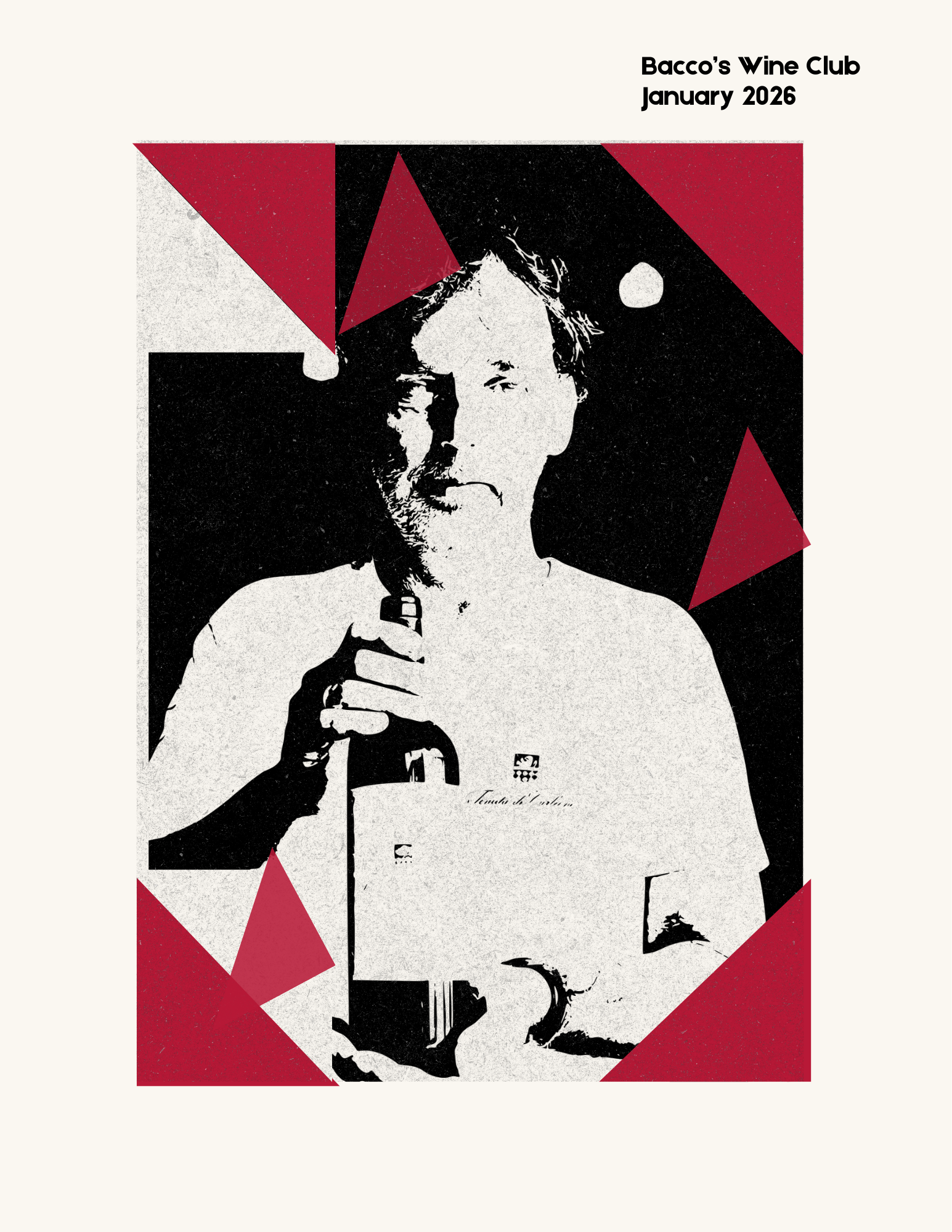
Bacco’s Wine Club January 2026
Tenuta di Carleone - Il Randagio Toscana Rosso 2022
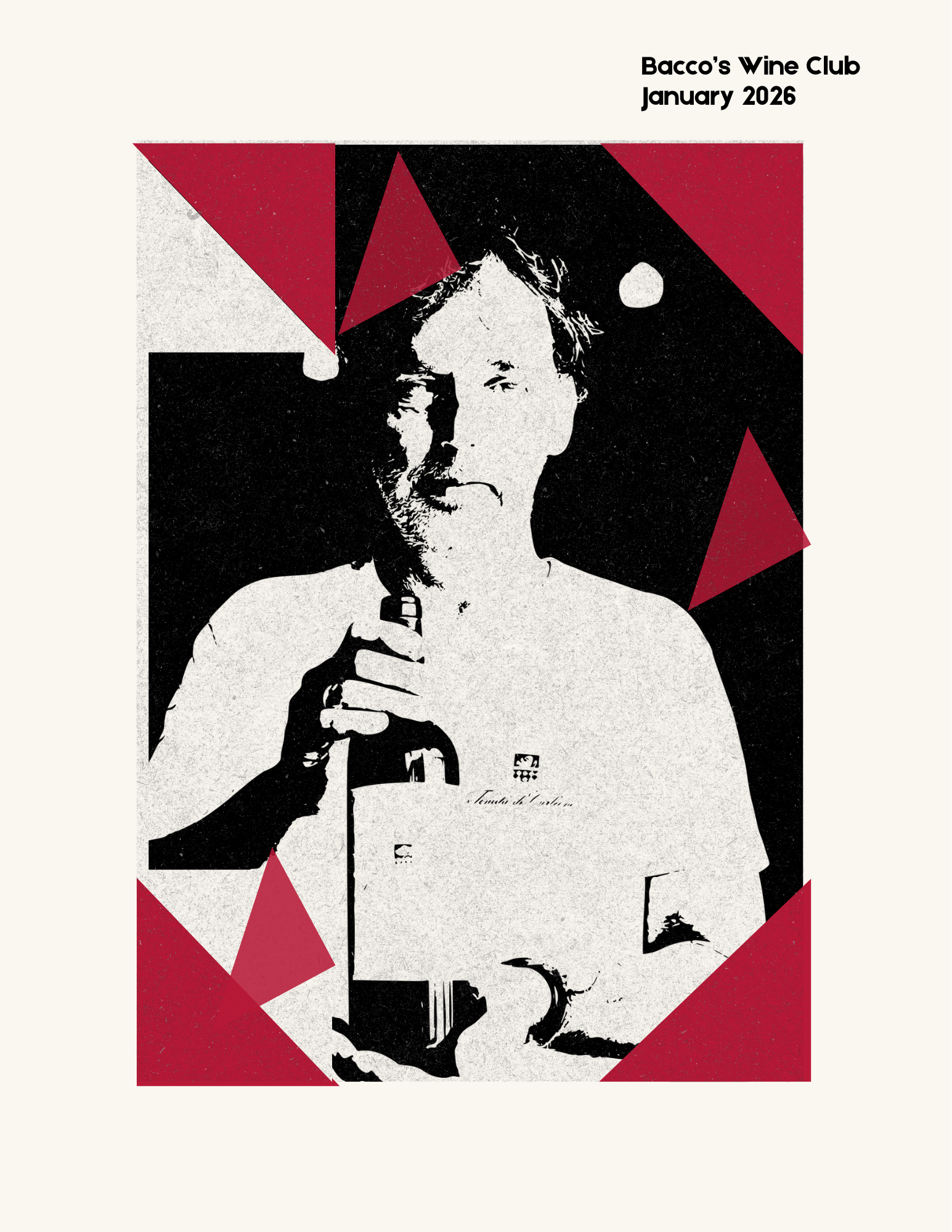
Pictured: Sean O’Callagan of Tenuta di Carleone
Sean O’Callaghan—who’ll describe himself, with a wink, as a “one-eyed rascal”—works in rarefied air in the Tuscan countryside, quite literally. Tenuta di Carleone sits in Radda, the highest subzone of Chianti Classico, where elevation brings cooler temperatures, longer growing seasons, and a natural sense of lift. It’s a place that tends to reward transparency over amplitude—wines with line, brightness, and detail rather than bulk.
O’Callaghan first made his name in Chianti at Riecine before building Tenuta di Carleone as a tightly focused, two-person project. His core wines—his Chianti offerings—lean fully into Sangiovese, and the point is not to modernize the grape but to let Radda speak clearly through it. We’ve had the pleasure of featuring his Chianti Classico in the club in the past, and this time around, we’re putting the spotlight on Il Randagio, or “the stray”, due to its focus on the two non-native varietals of the region, Cabernet Franc and Merlot.
In a warmer zone, that blend can easily drift into something plush, sweet-fruited, and oak-led. Here, at altitude, it lands differently. Il Randagio keeps the profile taut and savory: Cabernet Franc’s herbal lift and graphite-like edge, Merlot bringing shape and mid-palate without turning the wine soft. The result feels more “composed” than showy—Tuscan in its structure and dryness, but not trying to play the Chianti Classico game.
In other words, this isn’t your ordinary Super Tuscan.
The Nitty Gritty:
Country: Italy
Region: Tuscany
Subregion: Chianti
Farming: Organic, Biodynamic
Soil: Alberese Limestone and Galestro Sandstone
Blend: 50% Cabernet Franc 50% Merlot
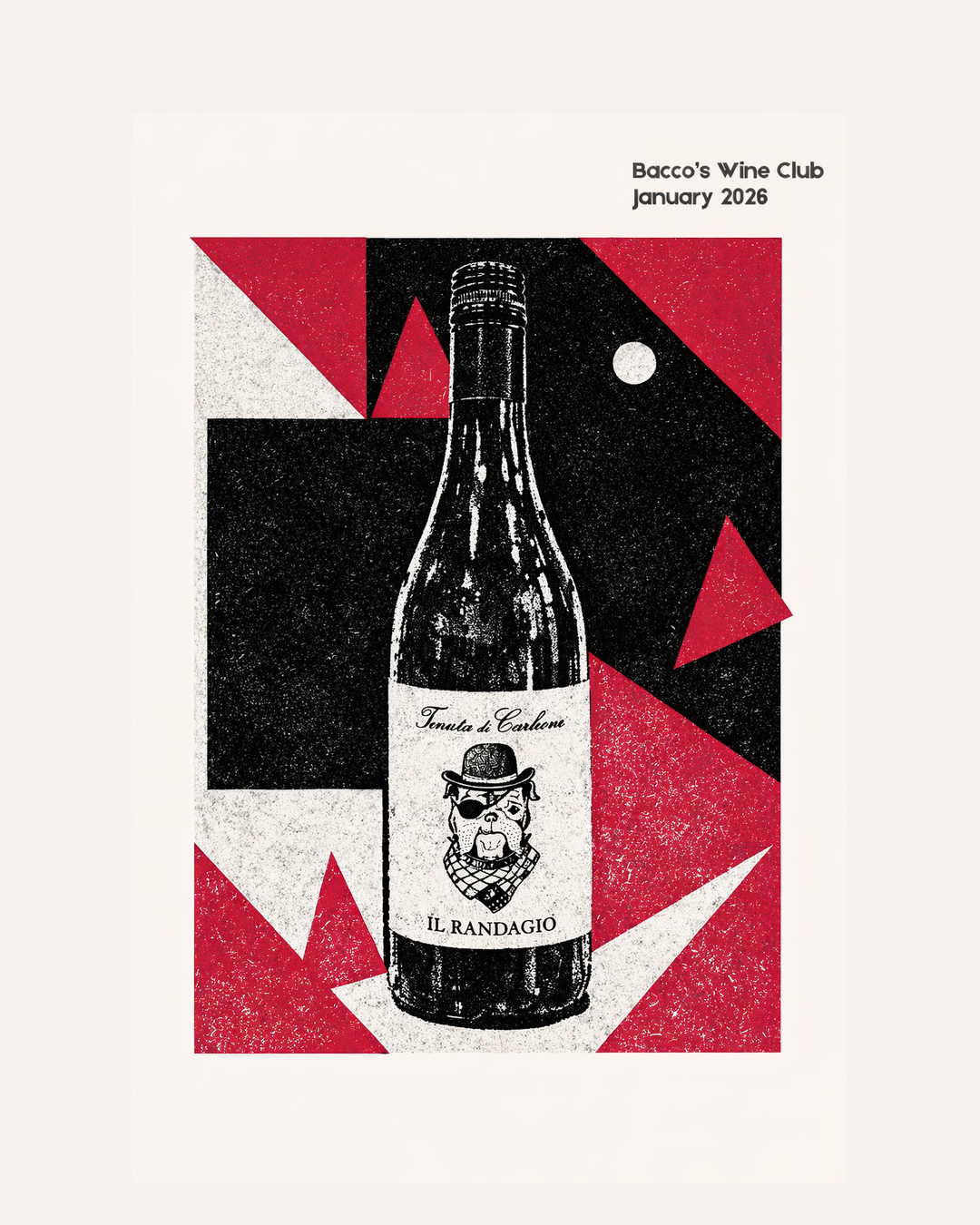
Pictured: Tenuta di Carleone Il Randagio Toscana Rosso 2022
Fattoria Moretto - Lambrusco Grasparossa di Castelvetro Secco 2024
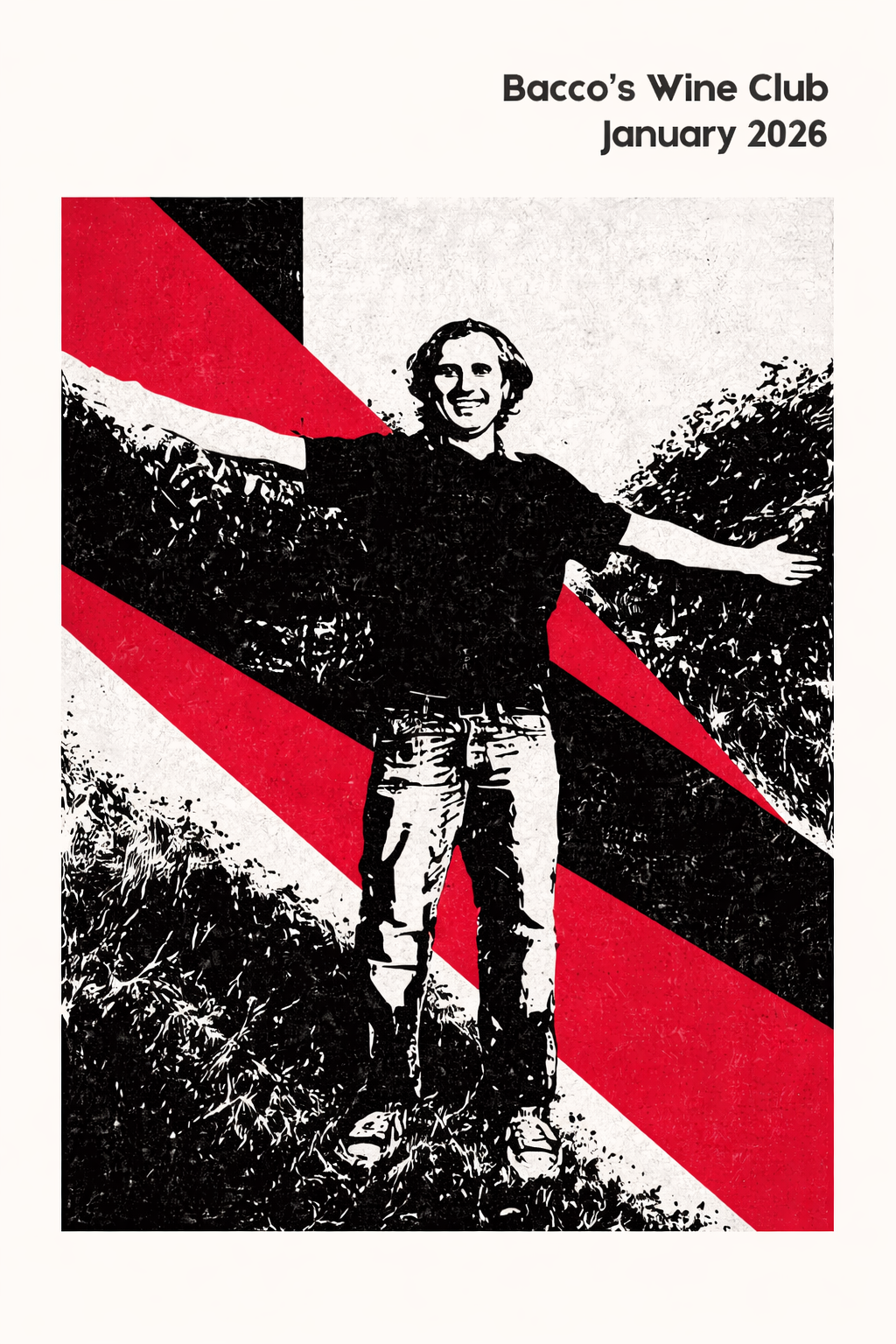
Pictured: Fausto Altariva of Fattoria Moretto
“Moretto is to Lambrusco what Tempier and Terrebrune are to rosé. It reminds me of the best reds of Bandol and Tuscany, with herbs like thyme, and a sort of dusty mineral quality, like you find in some of the top Bordeaux and Tuscan wines.”
Lambrusco is used to being the butt of the joke—the also-ran to Prosecco, and more often derided than Franciacorta, Italy’s official answer to Champagne. But in the right hands, Lambrusco is something altogether different: a wine of real purpose and deep local identity, shaped by food, place, and tradition. Nowhere does that matter more than in Emilia-Romagna, the heartland of Italian cuisine, where Lambrusco has always been a table wine first and a sparkling curiosity second.
Fattoria Moretto began as a passion project for Domenico Altariva in the early 1970s, when he started planting vineyards dedicated to Lambrusco Grasparossa, one of the historic varieties of the region and indigenous to Castelvetro. Sitting just outside Modena, Castelvetro’s hills and clay-rich soils give Grasparossa its signature depth and structure—more intensity and grip than other Lambrusco styles, and a natural affinity for dry, food-driven wines.
What started as a modest husband-and-wife operation grew slowly, guided less by ambition than by continuity. The Altarriva family worked the land as their parents had before them, farming naturally, avoiding pesticides, and trusting the strength of their vineyard sites rather than chasing yield or polish. That commitment shows clearly in the wines today: Lambrusco that is dry, savory, and grounded, with dark fruit, gentle tannin, and a brisk, cleansing finish that makes immediate sense at the table.
Moretto’s Lambrusco Grasparossa di Castelvetro Secco isn’t interested in rewriting the category—it’s interested in reminding you what it can be when treated seriously. Chilled, poured generously, and paired with food, it becomes less a novelty and more a necessity: a wine built for prosciutto, Parmigiano, rich pastas, and the everyday rhythms of a meal shared.
The Nitty Gritty:
Country: Italy
Region: Emilia-Romagna
Subregion: Castelvetro
Farming: Organic
Soil: Alberese Limestone and Galestro Sandstone
Varietal: 100% Grasparossa
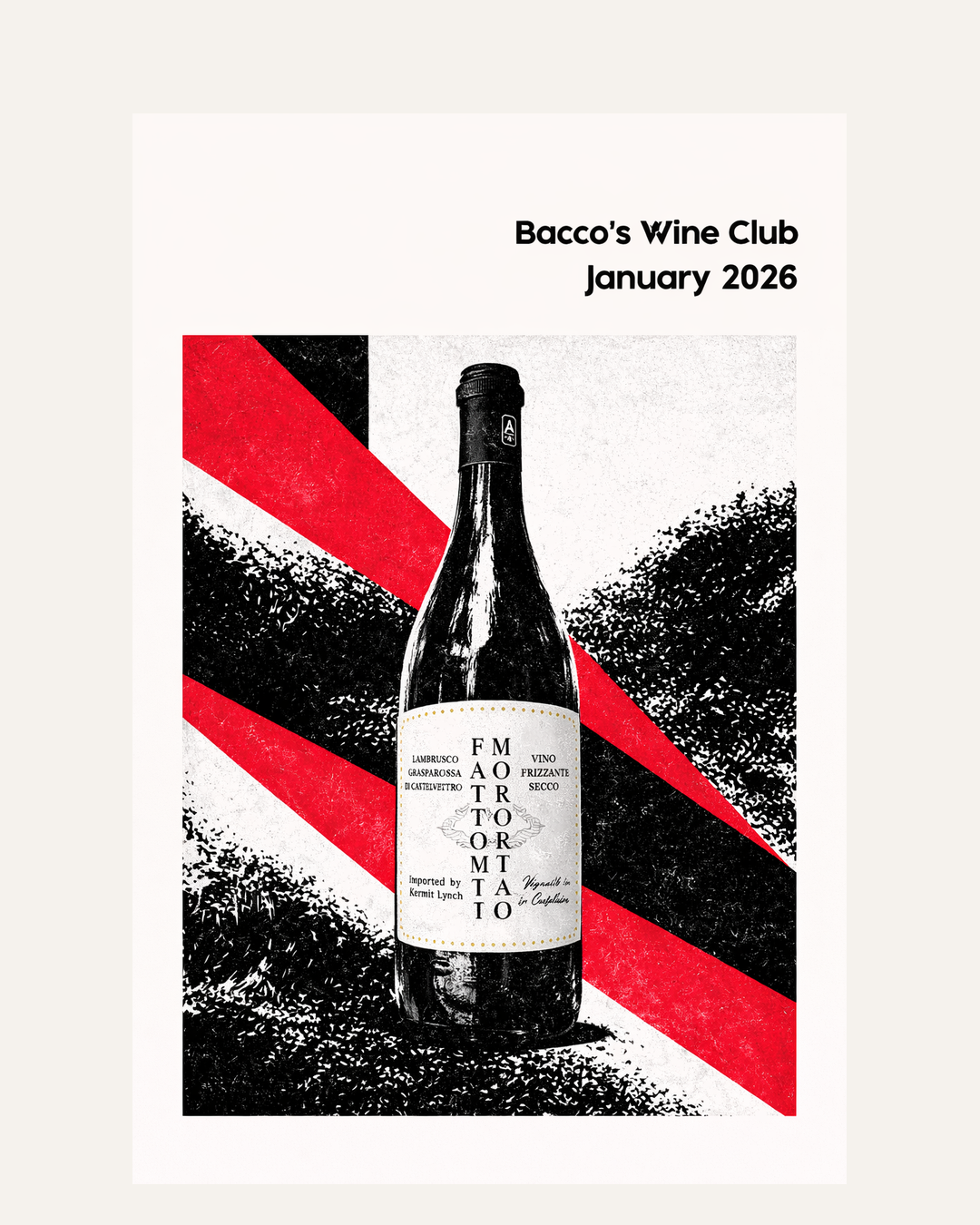
Pictured: Fattoria Moretto Lambrusco Grasparossa di Castelvetro Secco
Louis Claude Desvignes - Chateau Gaillard Morgon 2023
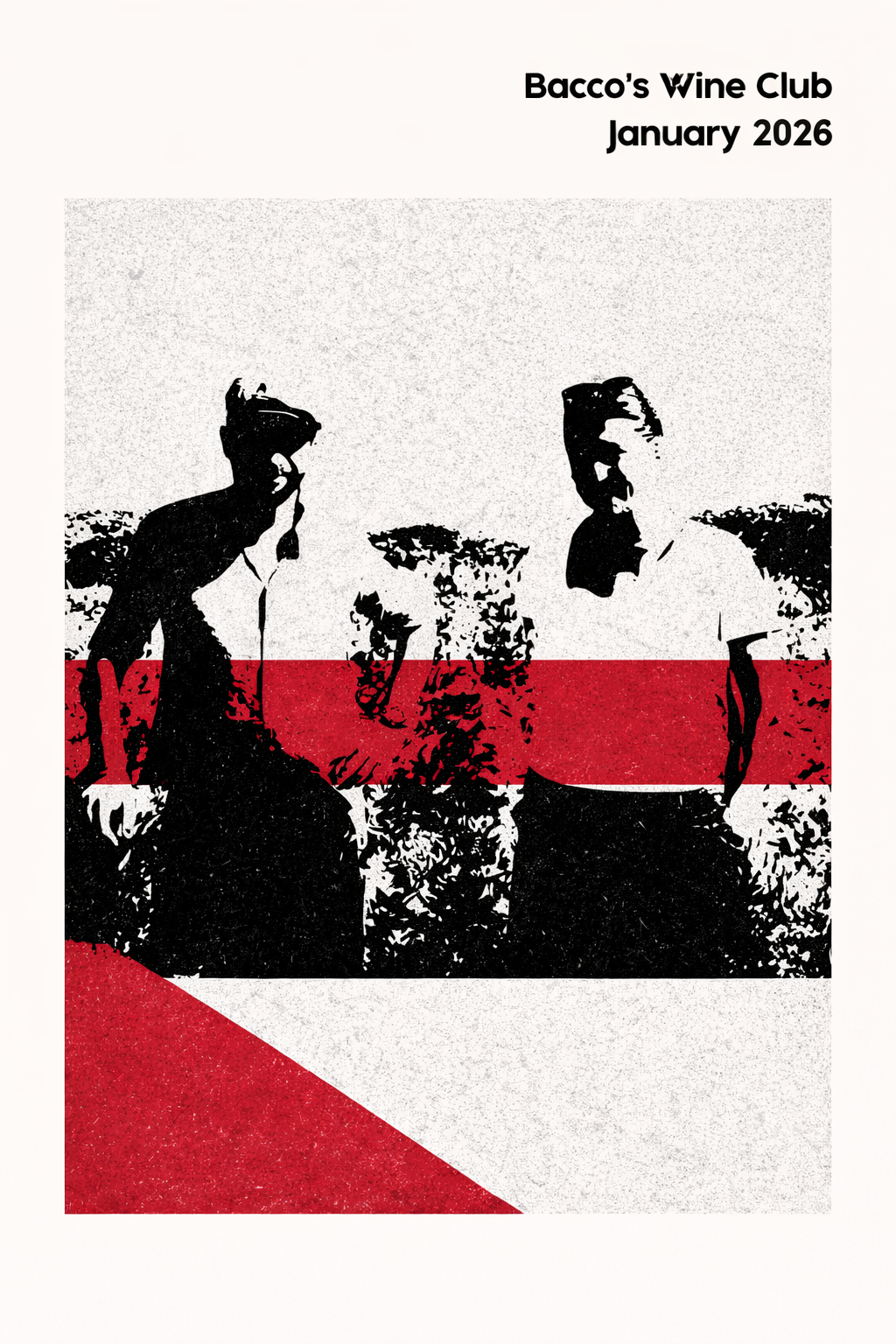
Pictured: Claude-Emmanuel and Louis-Benoît Desvignes of Louis Claude Desvignes
Louis-Claude Desvignes was a very particular kind of Beaujolais vigneron—restless, quick-witted, and seemingly incapable of standing still. Tastings in his cellar were as likely to include laughter and asides as they were bottles pulled from every corner of the domaine: experiments, comparisons, older vintages offered purely for context. The energy was light, almost playful. The seriousness of the wines never was.
Desvignes passed away in 2021, having already handed the estate over to his children, Claude-Emmanuelle and Louis-Benoît, the eighth generation of the family to work these vineyards in Morgon. Emmanuelle joined in 2001, and Benoît in 2004. While the core identity of the domaine has remained intact, their stewardship has quietly sharpened it. Today, all production is estate-bottled, the vineyards are certified organic, and the family has begun exploring small, focused bottlings that highlight individual lieux-dits within Morgon.
The Desvignes holdings have long centered on Morgon’s most serious ground. Much of the fruit for the estate’s wines comes from the Côte du Py, widely regarded as the beating heart of the appellation. If Morgon were formally classified, this hill would sit at the top. Its decomposed schist soils—and, in certain parcels, added clay—give the wines their depth, structure, and capacity to age, setting them apart from the lighter, more immediate expressions found elsewhere in Beaujolais.
That pedigree comes into particularly clear focus with Château Gaillard. Once blended into the estate’s broader Morgon cuvée, this 1.03-hectare plot of south-facing, old-vine Gamay proved distinctive enough to stand on its own beginning in 2020. Planted on sandy granite soils near the Fleurie border, the vines—now around 80 years old—deliver fruit with concentration, firmness, and a sense of gravity that feels unmistakably Morgon.
In the cellar, the approach is traditional and restrained: largely whole-cluster fermentation, gentle extraction, and élevage in concrete. The aim is not to soften Morgon’s edges, but to frame them. When young, Château Gaillard shows dark cherry, raspberry, and blackcurrant, carried by a structure that feels composed rather than heavy. With time, the wine begins to “pinotize,” taking on the savory, earthy notes—cocoa, coffee, forest floor—that have long made Morgon one of Beaujolais’ most age-worthy crus.
This is Gamay with intent and patience built in. For Wine Club members, it’s a reminder of why Morgon occupies such a singular place in the region: a wine that drinks beautifully now, but rewards those who give it a little air—or a little time—and one that bridges the space between Beaujolais and Burgundy with confidence rather than comparison.
The Nitty Gritty:
Country: France
Region: Burgundy
Subregion: Morgon
Farming: Organic
Soil: Sandy Granite
Varietal: 100% Gamay
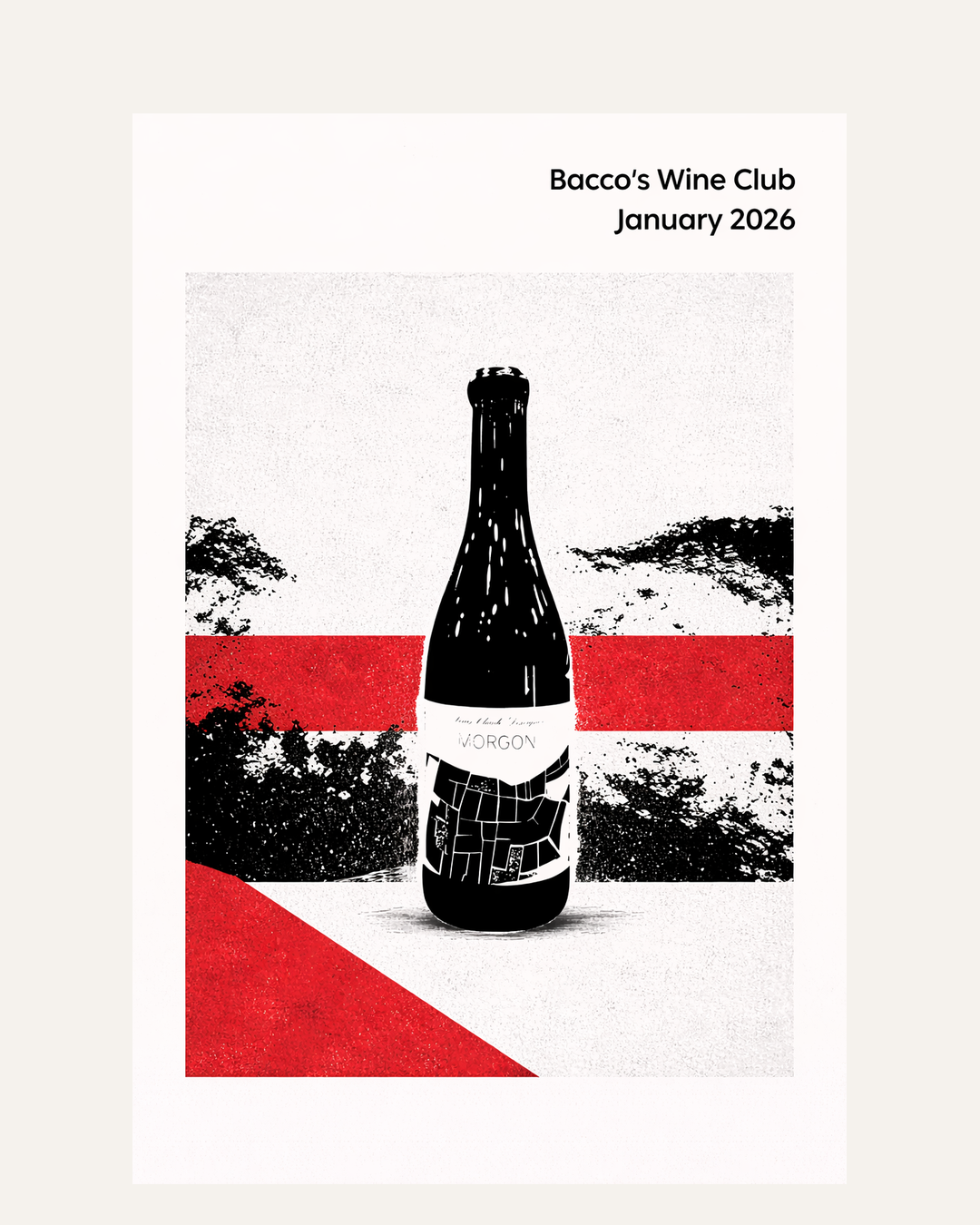
Pictured: Louis Claude Desvignes Chateau Gaillard Morgon 2023